Authorities Investigate Fatal Highway Crash That Claimed 12 Lives
Twelve people began a journey that would never end the way they had imagined. What should have been an ordinary trip home after university classes in Brazil became a devastating tragedy, leaving families waiting for news that many of them would never want to hear.
The reported collision between a university bus and a truck has left a community grieving and raised urgent questions about what happened on the highway that evening. For the families of those who lost their lives, the tragedy is not simply a headline or a number. It is the sudden absence of loved ones who had been part of their everyday lives only hours earlier.
But behind the heartbreaking figure of 12 fatalities lies a much larger story: the injured passengers who survived, the emergency workers who rushed to the wreckage, the investigators trying to reconstruct the collision, and the families now facing a future that has changed forever.
The circumstances surrounding the crash remain central to the investigation. Understanding what happened requires looking beyond the first reports and examining the journey, the possible factors involved in a highway collision, and the questions authorities must answer before the full story can be established.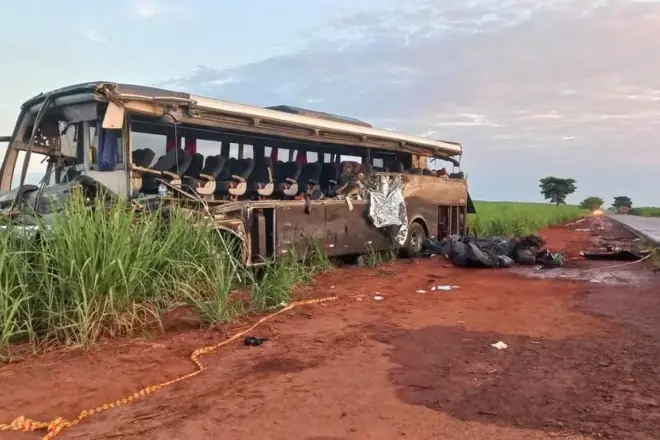
A Journey That Was Supposed to End at Home
The tragedy took place on the night of February 20, 2025, in the countryside of São Paulo state, southeastern Brazil. A bus carrying students from the University of Franca, known as Unifran, was traveling toward São Joaquim da Barra when it collided with a heavy truck on the Waldir Canevari highway.
The crash occurred between the municipalities of Nuporanga and São José da Bela Vista, on a stretch of road used by people traveling between nearby towns.
The students had been returning from university. For many of them, this was not an unusual journey. It was part of the routine that allowed them to attend classes in Franca while living in another municipality.
The bus was carrying 29 students and its driver, according to local reporting. The route covered roughly 70 kilometers between the university and the students’ destination.
A journey of that length might normally involve little more than conversation, music, checking messages, or looking out of the window. Some passengers may have been tired after a day of classes. Others may have been thinking about the next morning.
No one could have expected that the trip would become one of the most devastating moments in the lives of their families.
The collision was reported at approximately 11 p.m. Emergency services were alerted, and firefighters, police officers, and ambulance teams were dispatched to the scene.
The force of the impact caused catastrophic damage to the bus. Images from the aftermath showed that a large section of its left side had been torn apart, leaving the interior exposed.
Twelve university students lost their lives.
The number was devastating not only because of the scale of the collision, but because the victims were young people whose lives were still unfolding. They were studying, building friendships, preparing for careers, and making plans for the future.
Their families had expected them to return home.
Instead, they were confronted with an emergency that would change their lives forever.
The Moment the Highway Became a Scene of Tragedy
When emergency workers arrived, the priority was to reach the passengers who remained alive and provide medical assistance.
The damaged bus presented serious challenges. A collision involving a large passenger vehicle and a heavy truck can leave metal panels twisted, windows shattered, seats displaced, and access points blocked.
In such circumstances, rescuers must work carefully. They need to determine where passengers are located, assess the stability of the vehicles, and decide how to reach people without creating additional danger.
Every minute matters, particularly when someone has suffered serious trauma.
Firefighters and medical teams worked through the night. The rescue operation continued for several hours, with emergency crews treating injured passengers and transporting them to hospitals in the surrounding region.
The victims were taken to medical facilities including hospitals in São Joaquim da Barra and Nuporanga. Some patients required more specialized treatment.
The rescue operation was reported to have concluded in the early hours of February 21.
For the families waiting for information, those hours were filled with uncertainty. A phone call from a hospital or an official could determine whether a loved one had survived, whether they were injured, or whether the family would receive the news they feared most.
The aftermath of a major road collision is often chaotic. Authorities must identify victims, coordinate medical care, secure the scene, and begin collecting evidence.
At the same time, relatives and friends are trying to understand what has happened.
The highway itself became a place of investigation. Police needed to examine the vehicles, the road surface, the positions of the wreckage, and any marks that could help explain how the collision occurred.
The damaged bus was not simply a vehicle that needed to be removed. It was also a critical piece of evidence.
The same was true of the truck.
Investigators had to reconstruct the movement of both vehicles in the moments before impact. That process would eventually become central to understanding why the crash happened.
Twelve Students Lost Their Lives
The twelve people who died were students of the University of Franca.
Their deaths left a painful void in the university community and in the towns where they lived.
The victims included students from different academic programs. They were pursuing studies in fields such as psychology, chemistry, nursing, architecture, administration, biomedicine, computer science, engineering, and information technology.
Some were still teenagers. Others were in their early twenties.
They were at a stage of life when many people begin to imagine what adulthood will look like. Graduation, employment, professional ambitions, relationships, and independence may all have been part of their plans.
For their families, each student was much more than a name on a list.
They were sons and daughters, siblings, friends, classmates, and people whose presence shaped everyday life.