At first glance, the scene looks like something from a miniature horror movie.
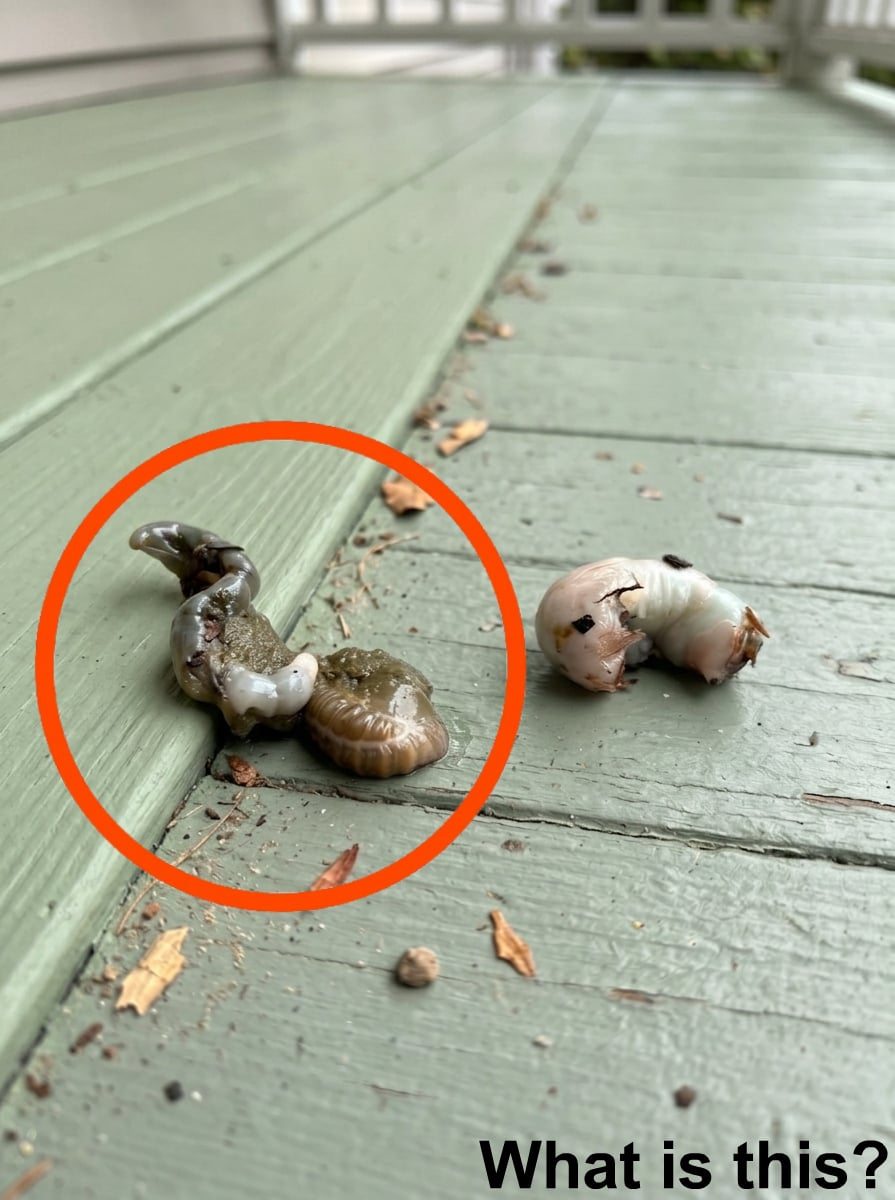
A forest floor is scattered with ordinary-looking acorns. But in the second part of the image, one of those acorns appears to have opened, revealing a strange pale, worm-like creature emerging from inside. Another acorn looks as though something has already crawled out.
For anyone discovering something similar in their yard, garden, or around an old oak tree, the obvious question is:
What is that thing?
The good news is that this unusual sight is usually not a mysterious parasite or dangerous creature. The image is consistent with the activity of an acorn weevil and its larva, one of the many small insects that quietly depend on oak trees as part of their life cycle.
And once you understand what's happening inside those acorns, the discovery becomes much less frightening and much more fascinating.
The Strange Creature May Have Been Living Inside the Acorn
Acorns may look like simple seeds, but they can become tiny nurseries for insects.
Certain species of acorn weevils, particularly members of the genus Curculio, lay their eggs in developing acorns. After the egg hatches, the larva feeds inside the acorn, consuming some of the nutritious material stored within.
That means an acorn lying on the forest floor isn't necessarily empty.
It may contain a tiny developing insect that has been hidden from view for weeks or even months.
The larva can remain concealed while it feeds, which is why someone may pick up an acorn and have no idea that anything is living inside.
Why Does the Larva Come Out?
Eventually, the larva reaches a stage where it needs to leave the acorn.
This is one of the most interesting parts of the life cycle.
After feeding and developing inside the acorn, the mature larva makes its way out through an opening in the shell. It then drops or crawls into the surrounding soil.
Once underground, it can continue its development, eventually pupating and emerging as an adult weevil.
So when you see a pale larva crawling out of an acorn, you're essentially witnessing one stage of an insect's natural life cycle.
What looks disturbing is actually a fairly ordinary ecological process.
Why Are There So Many Acorns on the Ground?
The top portion of the image shows numerous acorns scattered across the forest floor.
That's completely normal during an oak's seed-producing season.
Oak trees produce large numbers of acorns, and not every acorn will successfully grow into a new tree.
Some are eaten by squirrels, birds, deer, and other wildlife.
Some become homes or food sources for insects.
Others simply decompose.
This enormous amount of fallen plant material is one reason forests can support such a diverse ecosystem.
Even something as ordinary as an acorn can provide food and shelter for multiple organisms.
The Tiny Hole Can Be an Important Clue
If you've ever picked up an acorn and noticed a small, perfectly round hole, there's a good chance an insect has already emerged.
Acorn weevil larvae eventually chew their way through the shell.
Once the larva has left, the empty acorn may remain behind with a characteristic opening.
This is one of the easiest ways to recognize that an acorn has been occupied.
If you collect acorns for crafts or decoration, you may occasionally discover that some contain larvae or show exit holes.
That's one reason people who collect large quantities of acorns sometimes inspect them carefully before bringing them indoors.
What Does an Acorn Weevil Look Like?
Adult acorn weevils are much different from the pale larvae seen inside infested acorns.
They are small beetles characterized by a distinctive elongated snout, technically called a rostrum.
The female uses this structure to interact with developing acorns and deposit eggs.
Different species vary in appearance, but many are brownish or grayish and blend surprisingly well with bark, leaves, and forest debris.
Their camouflage makes them easy to overlook.
The larvae are even harder to spot because most of their development occurs inside the acorn, completely hidden from view.
Is the White Creature Dangerous?
For humans, an acorn weevil larva is generally not considered dangerous.
It isn't looking for people.
It isn't a venomous creature.
And it doesn't normally pose a threat to pets simply because it happens to be present around oak trees.
Its primary purpose is much simpler:
Find an acorn, eat, develop, leave, and continue the life cycle.
The unsettling appearance comes largely from the fact that we're not accustomed to seeing what happens inside seeds.
Nature can look surprisingly strange when we get a close-up view of processes that normally happen out of sight.
Should You Throw Away Every Acorn You Find?
Not necessarily.
If you're simply walking through a yard or forest, there is no reason to worry about ordinary fallen acorns.
However, if you collect acorns for craft projects, decorations, or indoor displays, it's a good idea to inspect them first.
Look for:
-
Small round holes
-
Cracks in the shell
-
Unusual soft spots
-
Signs of insect activity
-
Larvae emerging from the acorn
You can also choose intact acorns and use appropriate methods for treating them before bringing them indoors.
The goal isn't to panic about insects.
It's simply to avoid accidentally turning your decorative acorn collection into a tiny insect nursery.
Why Do Weevils Target Acorns?
From the weevil's perspective, an acorn is almost the perfect nursery.
A developing acorn contains concentrated nutrients intended to help a future oak seedling begin growing.
Those stored nutrients also make the acorn attractive to many animals and insects.
For an acorn weevil, the seed provides both food and protection.
The larva can feed while hidden inside the hard shell, reducing its exposure to predators.
It's an excellent example of how insects have evolved highly specialized relationships with plants.
They're Part of the Forest Food Web
It can be tempting to think of insects as simply pests.
But creatures such as acorn weevils are part of a much larger ecological system.
Their larvae provide food for other organisms.
Adult insects may become prey for birds and other animals.
Their activity contributes to the movement and breakdown of organic material.
And, importantly, they interact with one of the most important tree groups in many temperate ecosystems: oaks.
Oak trees support an enormous number of insects, birds, mammals, fungi, and microorganisms.
The humble acorn is one of the key links connecting many of these organisms.
Not Every Strange Thing Inside an Acorn Is the Same
It's also worth remembering that several different organisms can interact with acorns.
Various insects may use acorns or oak structures during their life cycles.
Some can create unusual growths or damage, while others simply use the acorn as a food source.
So a photograph alone may not always be enough to identify a particular species with certainty.
The creature in the image appears consistent with an acorn-associated insect larva, and the classic acorn-weevil life cycle is a strong possibility.
For an exact species identification, however, entomologists would normally want clearer photographs of the insect's body, head, legs, and other identifying features, as well as information about the location and host oak species.
Why Does It Look So Much Worse in a Photograph?
There's something psychologically interesting about images like this.
An ordinary acorn is familiar.
A small insect larva is also harmless in most circumstances.
But put the two together and suddenly the scene feels completely different.
The brain tends to react strongly to unexpected things emerging from places where they aren't supposed to be.
That's why discoveries such as worms inside fruit, insects inside seeds, or larvae beneath tree bark can produce such a strong reaction.
We're seeing a hidden part of nature that we normally never encounter.
The mystery makes it seem much more threatening than it actually is.
What If You Find One in Your Backyard?
If you have oak trees near your property, finding insect-infested acorns is completely possible.
You don't need to treat your yard with pesticides simply because you find a few larvae.
Instead, you can simply leave them alone or remove heavily infested acorns if you prefer.
If you're collecting acorns for indoor use, inspect them and discard any that show obvious insect activity.
For most homeowners, this is more than enough.
The presence of a few acorn-associated insects doesn't automatically indicate an infestation of your home.
An Acorn Is More Than Just a Seed
Perhaps the most fascinating lesson from this photograph is how much activity can be hidden inside something so ordinary.
We walk across forests covered in acorns without giving them a second thought.
But each one represents a potential oak tree—and potentially a temporary home for another organism.
An acorn can be:
Food for wildlife.
A seed for a future tree.
A shelter for an insect larva.
A source of nutrients for decomposers.
And eventually, part of the forest floor itself.
That tiny ecosystem is easy to overlook until something crawls out and suddenly gets our attention.
Don't Panic If You See One
If you encounter a pale, grub-like creature emerging from an acorn, there's usually no reason to panic.
Take a closer look from a safe distance.
If the acorn has a small exit hole, that's another clue that an insect larva has completed its time inside the seed.
You can move the acorn outdoors if it's somewhere inconvenient, or simply leave it where it is.
In nature, these insects are simply doing what they evolved to do.
The Surprising Truth Behind the Photo
What initially looks like a bizarre creature invading an acorn is likely a much more ordinary story.
An insect has been using the acorn as a temporary source of food and shelter.
For an acorn weevil larva, the seed is essentially a carefully packaged meal. It spends much of its early development hidden inside, feeding on the nutritious contents before eventually chewing its way out and entering the next stage of its life.
So the next time you see an acorn with a tiny hole—or one that seems to be moving—you might want to look twice.
You could be witnessing a miniature chapter of the forest's life cycle.
And that's perhaps the strangest part of all: the forest is full of activity that remains completely invisible until something finally emerges into the light.