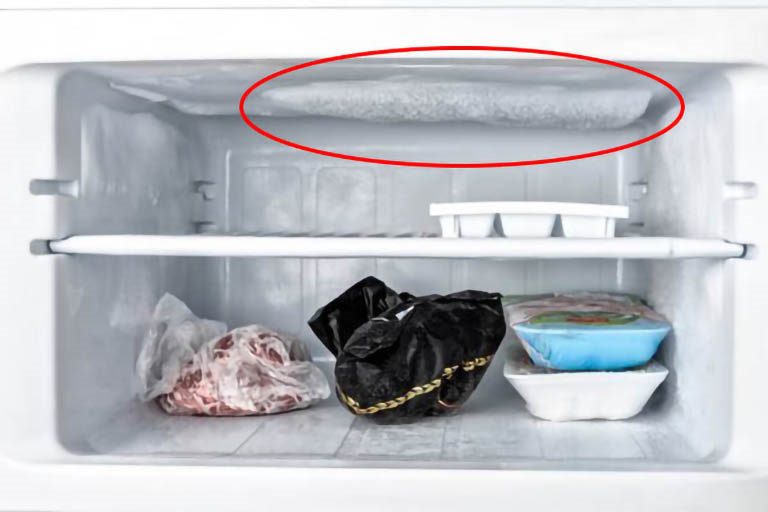
What If the Frost Is Mainly in the Freezer?
This is an important distinction.
If you're seeing frost primarily inside the freezer, the possible causes can include:
-
Door gasket problems
-
Frequent door opening
-
Blocked vents
-
Excessive humidity
-
A malfunctioning defrost system
-
A problem with the evaporator fan or related components
If the freezer is developing a thick sheet of ice over the rear interior panel, particularly if it returns quickly after being removed, the problem may be more than a simple door-seal issue.
In that situation, professional diagnosis may be necessary.
Should You Simply Scrape the Ice Away?
Removing visible frost can make the refrigerator look better, but it doesn't necessarily solve the cause.
If you decide to defrost the appliance, do not use a knife, screwdriver, or other sharp metal object to chip away the ice.
It's surprisingly easy to puncture tubing or damage components hidden behind an ice layer.
Instead, follow the manufacturer's defrosting instructions.
For appliances that allow manual defrosting, the safest approach is generally to turn the appliance off or unplug it as directed, remove food, allow the ice to melt naturally, and protect the surrounding area from water.
Never use an open flame or an inappropriate high-heat device to speed up defrosting.
When Frost Keeps Coming Back
Here's where timing becomes useful.
Suppose you completely defrost the refrigerator, clean the door gasket, reorganize the shelves, and check the temperature.
If the frost stays away, the original problem may have been related to moisture, airflow, temperature, or the door seal.
But if heavy frost quickly returns, that is a clue that something deeper may be wrong.
A frost-free refrigerator normally relies on a defrost system that periodically melts accumulated ice from the evaporator area.
Problems involving the defrost heater, thermostat or sensor, control system, fan, or other components can prevent proper defrosting.
Those issues generally aren't ideal DIY repairs unless you have the appropriate technical knowledge.
A Quick Checklist Before Calling a Technician
Before paying for a service visit, go through this checklist:
1. Inspect the door gasket
Look for cracks, gaps, deformation, dirt, or loose sections.
2. Clean the gasket
Use a soft cloth and warm water.
3. Check the door
Make sure nothing inside is preventing it from closing completely.
4. Keep vents clear
Rearrange food if containers are blocking airflow.
5. Check the temperature
Use the manufacturer's recommended setting.
6. Reduce unnecessary door opening
Especially in hot or humid conditions.
7. Avoid introducing excessive moisture
Cover foods appropriately and don't place steaming uncovered food directly inside.
8. Defrost safely if appropriate
Follow the appliance manual rather than aggressively scraping ice.
9. Watch what happens afterward
If heavy frost quickly returns, further diagnosis may be necessary.
Don't Ignore Frost That Affects Food Storage
Frost isn't merely a cosmetic inconvenience.
Heavy ice accumulation can take up valuable storage space and interfere with normal airflow.
In some circumstances, the refrigerator or freezer may also struggle to maintain a stable temperature.
That can become a food-safety concern.
A refrigerator should generally be kept at 40°F (4°C) or below, while a freezer should be around 0°F (-18°C), according to widely used food-safety guidance.
If you suspect the appliance isn't maintaining a safe temperature, use an appliance thermometer rather than relying solely on how cold the compartment feels.
When It's Time to Call a Professional
A simple inspection is worthwhile, but there's a point where professional help makes sense.
Consider contacting a qualified appliance technician if:
-
Frost returns rapidly after proper defrosting
-
The refrigerator isn't maintaining the correct temperature
-
The freezer becomes heavily iced over repeatedly
-
You hear unusual mechanical noises
-
The appliance runs almost constantly
-
Food is freezing unexpectedly in the refrigerator compartment
-
The door gasket is damaged and replacement isn't straightforward
-
You suspect a fan, sensor, heater, thermostat, or control-board problem
-
You notice signs of electrical damage or burning
Some refrigerator components require specialized testing and replacement.
Trying to repair electrical or refrigeration components without the proper knowledge can create additional damage or safety risks.
The Biggest Mistake Is Assuming More Frost Means More Cooling
It may seem logical that a refrigerator covered in ice must be extremely cold.
But that's not necessarily true.
More frost does not mean better cooling.
In fact, significant ice accumulation can interfere with the way air moves through parts of the appliance.
The result can be a refrigerator that looks frozen but doesn't cool food as efficiently as it should.
That's why the goal isn't to eliminate every tiny trace of frost by constantly scraping it away.
The goal is to identify why excessive frost is forming in the first place.
A Few Minutes of Checking Could Save You a Service Call
When you discover a refrigerator covered in frost, it's understandable to assume that something expensive has gone wrong.
But before calling a technician, start with the simplest possibilities.
Check the door seal.
Clean the gasket.
Make sure the door closes completely.
Clear the vents.
Review the temperature setting.
Look at how food is arranged inside the appliance.
And pay attention to whether the frost returns after the refrigerator has been properly defrosted.
These basic checks won't fix every refrigerator problem, but they can help identify simple causes and may save you an unnecessary repair visit.
At the same time, don't keep postponing professional service if the problem continues or the appliance isn't maintaining safe temperatures.
A little frost can be normal. A refrigerator repeatedly becoming covered in thick ice is a signal worth investigating.
Sometimes the solution really is as simple as cleaning a door gasket or correcting airflow.
And when it isn't, recognizing the warning signs early can help prevent a small refrigerator problem from becoming a much more expensive one.