Giant Eagle Captured in Brownsville, Texas? The 10-Foot Wingspan Claim That Has Left Wildlife Lovers Searching for Answers
A bird with a wingspan reportedly reaching nearly 10 feet. Hikers walking near the U.S.–Mexico border. An astonishing encounter in the Texas wilderness. And then, according to a story spreading online, wildlife specialists arrived, captured the enormous eagle and transported it to a rehabilitation facility for examination.
It sounds like the discovery of a lifetime. If the account were true, the bird's extraordinary size would raise fascinating questions about its identity, its health and the wildlife living in the border region. Could it be an unusually large example of a known eagle species? Could the photographs show a rare bird whose proportions have been misunderstood? Or has an ordinary wildlife encounter grown into something much bigger as the story moved across the internet?
The photographs accompanying the claim show a striking bald eagle standing on a grassy lakeside property, first with its wings folded and then spreading them wide. Its white head, dark body and enormous-looking wings make an impressive sight. But the pictures alone cannot establish a 10-foot wingspan, prove that the bird was captured in Brownsville, or confirm that scientists examined it.
That distinction is at the heart of this unusual story. The alleged capture has circulated through multiple websites, yet the supplied account does not identify the wildlife specialists, name the rehabilitation center, provide verified measurements or present an official scientific assessment. The extraordinary claim has attracted attention—but the evidence needed to confirm it remains missing.
And that leaves a much more interesting question than simply how large the eagle looked: what can the photographs and available reports actually tell us, and what would scientists need to prove before calling this a genuine wildlife discovery?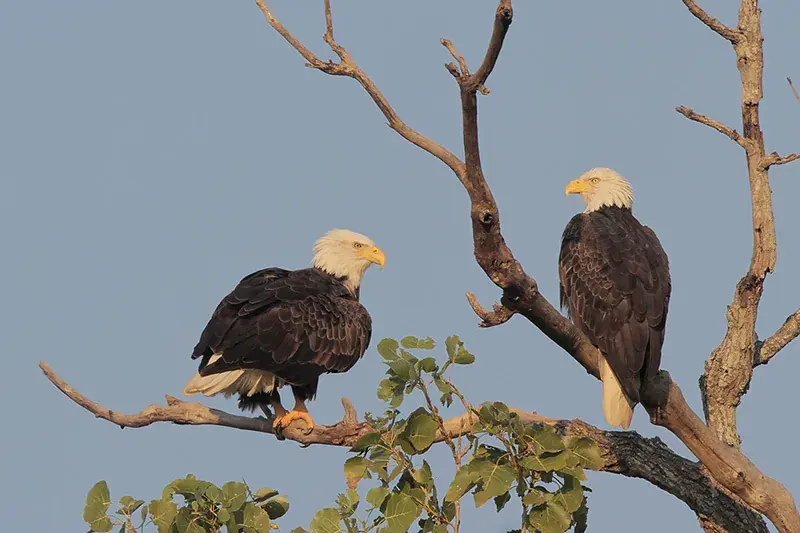
The Story Behind the Alleged Capture Near Brownsville
The account circulating online describes an encounter near Brownsville, a city in southern Texas close to the Mexican border. According to the story, a group of hikers was exploring a wooded area when they noticed a bird that appeared far larger than the eagles they were accustomed to seeing.
At first, the encounter was supposedly nothing more than an extraordinary wildlife sighting. The bird was described as having an imposing body, powerful legs and exceptionally broad wings. Some versions of the story claim that its wingspan approached 10 feet, a measurement that quickly became the most repeated detail.
The story then takes a dramatic turn. Rather than simply flying away, the eagle was allegedly tracked by wildlife specialists. After several days, the bird was reportedly captured using techniques intended to avoid injuring it. It was then said to have been transported to a conservation or rehabilitation facility in the Brownsville area.
That is where the account becomes especially difficult to verify.
The supplied article does not identify the hikers, provide a precise location for the encounter, name the specialists involved or state which organization supposedly received the bird. It also does not include an official capture report, a veterinary examination, a measurement record or a scientific paper.
These omissions do not prove that nobody ever encountered an unusually large eagle in the region. They do mean that the central claim—that a previously extraordinary bird was captured and transferred for scientific examination—cannot be treated as an established event.
Several websites have repeated versions of the same story, sometimes adding dramatic details about DNA testing, conservation facilities and possible new subspecies. Repetition, however, is not independent confirmation. When multiple articles repeat the same unsourced claim, they may simply be circulating one original story rather than providing separate evidence.
For readers, the distinction is important. A wildlife sighting can be genuine even when the interpretation of the sighting is mistaken. A photograph can show a real eagle without proving that the bird is an unknown species or that it has a wingspan of 10 feet.
The most responsible way to understand the Brownsville story is therefore to separate three things: what the photographs visibly show, what the online account alleges, and what has actually been confirmed by wildlife authorities or scientific evidence.
What the Photographs Appear to Show
The image accompanying the story is a collage of several photographs showing a bald eagle on a grassy property beside a lake.
In the upper images, the bird is seen standing on the grass with its wings folded, then facing forward with both wings extended. The lower images show it from different angles, including a side view and a moment when it appears to be preparing to move or take flight.
The bird has a white head, a dark brown body and broad dark wings. These are characteristic features of an adult bald eagle, also known as Haliaeetus leucocephalus.
Its appearance is striking. The eagle looks powerful even when standing still. When its wings are extended, the broad feather structure creates an impressive silhouette that can make the bird appear much larger than it does with its wings folded.
But a photograph is not a measuring instrument.
The size of an animal in a photograph depends on several factors, including the distance between the camera and the subject, the camera lens, the angle of view and the presence or absence of objects of known size. A bird positioned close to the camera can appear enormous beside a boat, dock or cabin that is farther away.
This is a common challenge in wildlife photography. Photographers often use long lenses to capture animals from a distance. Those lenses can compress the apparent distance between objects, making subjects at different depths appear closer together. Wide-angle lenses can create a different effect, particularly when the subject is close to the camera.
Perspective can therefore influence how large a bird appears.
The collage also does not provide a clear measurement reference. There is no measuring tape, standardized scale, known-size object positioned in the same plane as the eagle or documented measurement procedure. Even if the photographs show a very large individual, they cannot independently establish the claimed 10-foot wingspan.
There is another important limitation: the collage does not, by itself, establish where or when the photographs were taken. The lakeside setting may look consistent with a natural habitat for a bald eagle, but the visible background cannot confirm that the location is Brownsville, Texas.