Giant Hail Recorded Tuesday Evening in the Town: Residents Stunned as Ice Stones Batter Homes and Vehicles
The storm arrived with little warning. One moment, the town was facing an ordinary Tuesday evening; the next, thunder shook the sky and enormous pieces of ice began striking roofs, windows, roads, and parked vehicles. Within minutes, familiar streets were covered in white, gardens were flattened, and residents were rushing indoors as the hail grew louder and more violent.
The most alarming detail was not simply the amount of ice falling from the sky. It was the reported size of the hailstones. Some residents compared them to golf balls, while others said the largest pieces looked closer to baseballs. The photographs accompanying the report show a landscape scattered with hail and a single large ice stone resting in a person's palm—a striking reminder of how powerful a severe thunderstorm can become.
But what causes hailstones to grow so large? Why can one neighborhood be battered while another nearby receives only rain? And after a storm like this passes, what should residents check first to protect their families, homes, and vehicles?
The available report does not identify the town, provide an exact date, or name a local weather agency. Those details cannot be confirmed from the supplied material, so the article below stays with the reported account and explains the weather science and safety issues without inventing a location or official damage figures.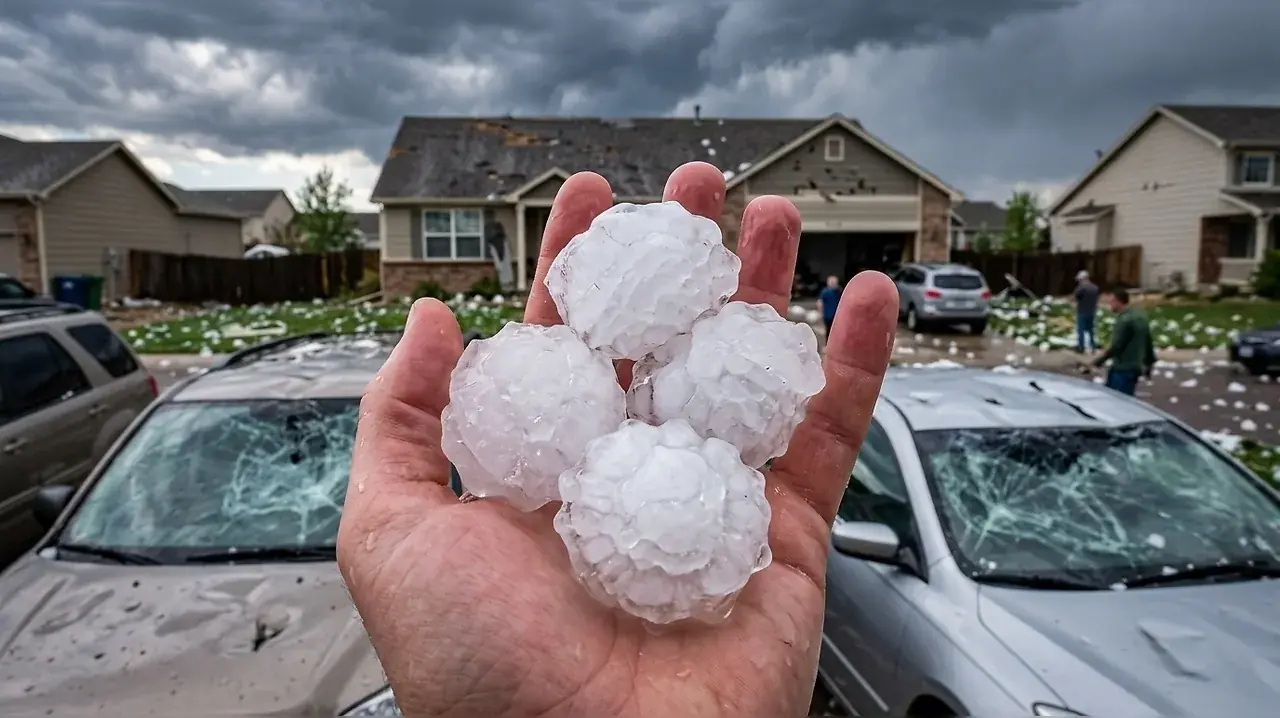
Chapter 1: A Tuesday Evening That Turned Into a Hailstorm
The report describes a storm that transformed an ordinary evening into a frightening experience for residents. Thunder rolled across the town, strong winds swept through the area, and hail began falling with enough force to make people rush indoors.
Unlike ordinary rain, hail does not simply collect on the ground as a thin layer of water. Each stone is a solid piece of ice, and even relatively small hail can become dangerous when it falls in large quantities or is driven sideways by strong winds.
The photographs accompanying the report show a broad area covered in white hailstones. In one image, the ground appears almost carpeted with ice. Another shows a person's open hand holding a large, rounded hailstone, giving readers a sense of its scale.
The account says some residents compared the largest stones with golf balls and baseballs. These comparisons help communicate the seriousness of the event, although they are not a substitute for official measurements. Hailstones can have irregular shapes, and estimating their diameter by eye is difficult. A ruler or caliper provides a more reliable measurement.
Why the storm felt so violent
A severe thunderstorm can produce several hazards at the same time. Hail may strike roofs and vehicles while strong winds bend trees, scatter branches, and push rain into exposed openings. Lightning can create additional danger, and intense rainfall may overwhelm drains or cause sudden flooding.
When these hazards arrive together, residents may have little time to react. The sound of hail hitting a roof can be startling, particularly when the stones are large. Windows may rattle, metal surfaces can ring, and people outdoors may struggle to hear warnings or instructions.
The report describes residents rushing indoors as the storm intensified. That is the most important immediate response: when large hail is falling or a severe thunderstorm warning is issued, people should seek a substantial enclosed building and stay away from windows.
Why the ground can look completely white
A hail-covered street can resemble a snowy landscape, even when the temperature is far too warm for ordinary snowfall.
This happens when hailstones accumulate faster than they melt or drain away. If a storm produces a large volume of ice in a short period, the stones can cover lawns, roads, driveways, and rooftops. Water from melting hail may then mix with rain and debris, creating slippery surfaces and obstructing drainage.
The amount of visible ice does not always tell the full story. A road can become hazardous even when the hail layer is relatively shallow. Small stones can roll beneath tires, while larger accumulations may conceal potholes, curbs, and other obstacles.
The photographs therefore show more than an unusual weather scene. They illustrate how quickly a storm can change the condition of an entire neighborhood.
Chapter 2: How Can Hailstones Become as Large as Golf Balls or Baseballs?
Hail begins inside thunderstorms, where powerful rising currents of air—known as updrafts—carry water droplets upward into very cold parts of the cloud.
At those heights, liquid water can remain unfrozen even when the surrounding air is below the normal freezing point. Meteorologists call this supercooled water. When droplets collide with a small ice particle, they can freeze onto its surface and gradually enlarge it.
This process can happen repeatedly while the developing hailstone remains inside the storm.
The role of powerful updrafts
The strength of the updraft is one of the key factors determining how large hailstones can become.
A weak or short-lived updraft may allow small ice particles to form, but it may not keep them suspended long enough to grow substantially. A stronger, sustained updraft can support a hailstone for longer, allowing it to encounter more supercooled water and accumulate additional layers of ice.
Some hailstones are carried through different parts of a thunderstorm before finally falling. Their paths are not necessarily simple vertical journeys. Winds inside the storm can move them horizontally as well as vertically.
Eventually, a hailstone becomes too heavy for the updraft to support, or it moves out of the strongest rising air. Gravity then brings it toward the ground.
Why some hailstones have layers
If you cut open a sufficiently large hailstone, you may see alternating areas of clear and cloudy ice.
These layers develop under different conditions inside the thunderstorm. When water freezes slowly, air bubbles may escape, leaving clearer ice. When droplets freeze quickly, bubbles can become trapped, producing a cloudy appearance.
This layered structure is one reason a hailstone can resemble a small frozen onion.
However, not every hailstone has obvious rings, and the presence of layers does not provide a simple record of how many times it moved up and down. Its structure depends on the temperature, water content, and other conditions it encountered while growing.
How large is golf-ball-sized hail?
A golf ball is approximately 1.7 inches, or around 4.3 centimetres, in diameter. Baseball-sized hail is larger, commonly around 2.75 to 3 inches, depending on the comparison being used.
These are substantial pieces of ice. The National Weather Service classifies a thunderstorm as severe when it produces hail at least one inch in diameter, among other criteria. That means hail does not have to reach golf-ball size to present a serious threat.
The report's descriptions of golf-ball- and baseball-sized stones should therefore be treated as residents' estimates unless an official weather service has measured or verified them.