He Sat Down to Use the Bathroom — Then His Life Changed in Seconds: The Hidden Danger of a Shattered Toilet
A routine bathroom visit turned into a nightmare when a familiar household fixture became a source of danger. But what makes a ceramic toilet suddenly shatter, and why can the consequences be far more serious than people imagine?
Imagine waking up, walking into your bathroom and preparing for an ordinary morning. Nothing seems unusual. The toilet looks perfectly normal, the floor is dry, and everything is exactly where it should be.
You sit down, expecting nothing more than a few quiet minutes.
Then, without warning, there is a sudden cracking sound.
In an instant, the ceramic structure beneath you breaks apart. Sharp porcelain fragments scatter across the floor, and what should have been an ordinary bathroom visit becomes a frightening emergency.
For anyone who has never considered the possibility, the idea sounds almost unbelievable. Toilets are designed to support considerable weight. They are installed permanently, used repeatedly and generally regarded as some of the most dependable fixtures in a home.
Yet ceramic is not indestructible.
A toilet can develop hidden cracks, suffer damage during installation or become weakened by years of use. Under certain circumstances, the pressure placed on a damaged fixture may cause it to fracture suddenly.
The most frightening part is that some of the warning signs may be difficult to notice.
A tiny crack can remain unnoticed for months. A toilet may appear stable even when its structural integrity has been compromised. And because bathrooms are used so routinely, people rarely inspect the fixtures they depend on every day.
The incident described in the circulating story raises an important question: Could the toilet in your own home be more dangerous than you think?
To understand the risk, it is necessary to look beyond the dramatic images and examine what actually happens when porcelain breaks, why injuries can be severe, and which warning signs should never be ignored.
The answers may change the way you look at one of the most familiar objects in your house.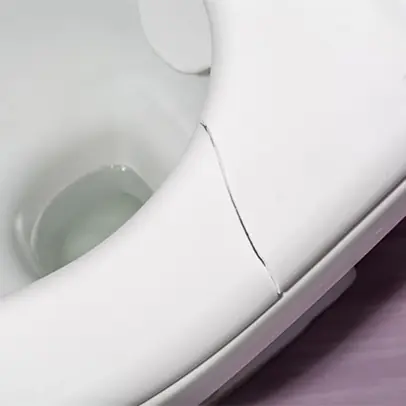
When an Everyday Bathroom Routine Becomes an Emergency
A bathroom is usually considered one of the safest rooms in a home.
Unlike a kitchen, it contains relatively few sharp tools. Unlike a garage, it is not normally associated with heavy machinery or dangerous equipment.
However, bathrooms contain several objects that can cause serious injuries when they fail.
Ceramic toilets, sinks, shower enclosures and tiled surfaces are all vulnerable to damage under certain conditions.
The toilet is particularly important because people place their body weight directly on it.
Most toilets are manufactured from vitreous china or similar ceramic materials. These materials are hard, durable and resistant to everyday moisture.
But hardness does not mean flexibility.
Ceramic can withstand ordinary use for many years, yet it is relatively brittle compared with materials such as reinforced plastic or metal.
When a ceramic fixture develops a crack, the damage can spread under pressure.
A person sitting on a compromised toilet may unknowingly place additional stress on an already weakened section.
If the structure fails, the resulting fragments can have extremely sharp edges.
This is where an ordinary household accident can become a serious medical emergency.
Why a Broken Toilet Can Cause Severe Injuries
Unlike a smooth plastic surface, fractured porcelain can produce irregular, razor-like edges.
When a person falls against these fragments, injuries may include:
-
Deep cuts to the thighs and buttocks.
-
Lacerations around the lower abdomen.
-
Injuries to the hands and arms when attempting to break a fall.
-
Damage to muscles and soft tissues.
-
Injuries to blood vessels and nerves.
-
Significant bleeding.
-
In severe situations, penetrating injuries requiring emergency surgery.
The severity depends on the location of the fracture, the direction of the fall and the position of the broken pieces.
A particularly dangerous situation occurs when a person attempts to stand immediately after the fixture collapses.
Sharp fragments may remain beneath the body or become trapped against the skin.
Moving without assessing the situation can create additional injuries.
For this reason, a shattered toilet should never be treated as an ordinary household inconvenience.
It should be approached as a potential injury emergency.
Why Can a Ceramic Toilet Suddenly Break?
To understand the danger, it helps to understand how a toilet is made.
Most traditional toilets are manufactured from vitreous china, a type of ceramic material that is fired at high temperatures and coated with a smooth, glass-like glaze.
This manufacturing process produces a hard, water-resistant surface that is suitable for daily use.
However, the same material has an important limitation: it is brittle.
Unlike rubber or certain plastics, ceramic does not bend significantly when pressure is applied. If the force becomes greater than the material can tolerate, it may crack or fracture.
The damage can happen gradually or suddenly.
A toilet that has been weakened by an earlier impact may remain apparently functional until another load causes the damaged section to fail.
There are several possible explanations for ceramic breakage.
1. A Hidden Crack That Has Been Growing Over Time
One of the most concerning possibilities is a crack that develops long before the toilet actually breaks.
A small fracture may begin after an accidental impact, an installation problem or repeated stress.
At first, the damage might be almost invisible.
The toilet may continue functioning normally, and the person using it may have no idea that the ceramic has been weakened.
Over time, repeated pressure can make the fracture spread.
Eventually, the damaged section may no longer withstand ordinary use.
This is why a visible crack should never be dismissed as a cosmetic problem.
A crack in a ceramic toilet bowl can indicate that the fixture has lost some of its structural strength.
Even if the toilet does not leak, it may no longer be safe to use.
2. Improper Installation
Installation quality is another important factor.
A toilet must sit securely on a stable surface.
Its mounting hardware must be appropriate, and the fixture should be supported without creating unnecessary pressure at particular points.
If the floor is uneven or the toilet is not installed correctly, stress may become concentrated around certain areas.
The fixture may begin to move slightly whenever someone sits down or stands up.
At first, this movement may seem harmless.
A person might simply assume that the toilet needs tightening.