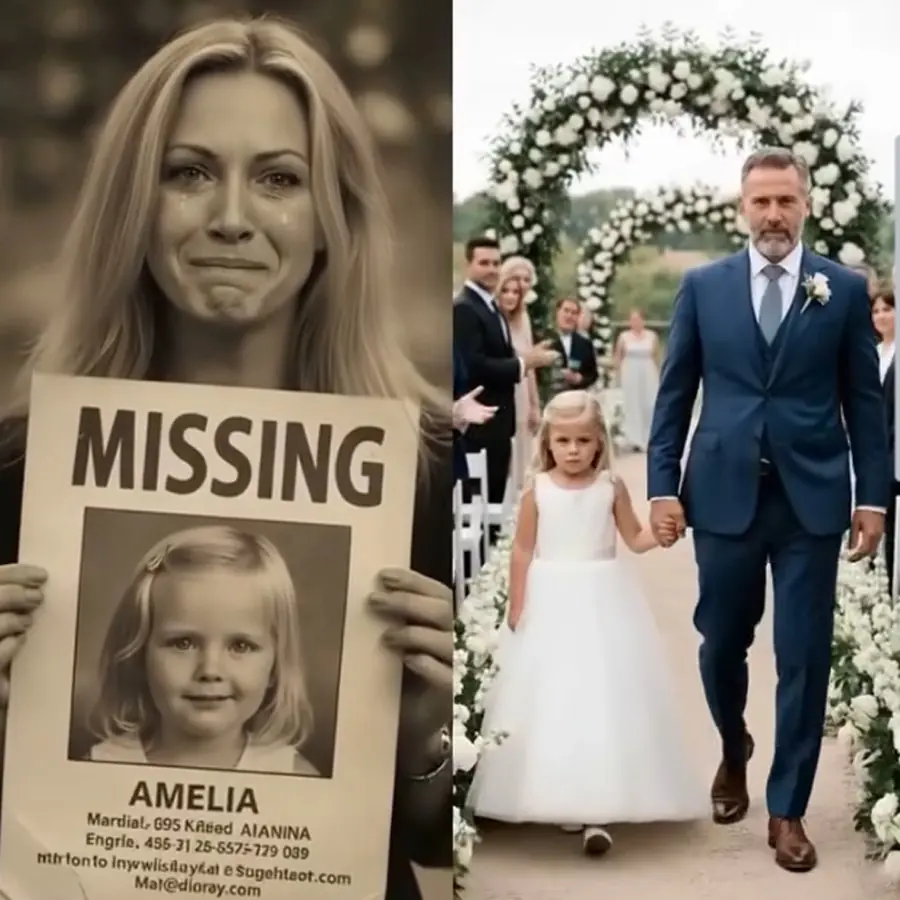
The day her daughter vanished began like any other.
The first chill of October had settled over Willow Creek, that in-between season when the mornings smelled faintly of rain and cinnamon, and the sun hung low even at noon. At the town’s sprawling shopping mall, the air was filled with the hum of weekend life: strollers rolling, laughter echoing from the food court, and the distant whir of the carousel spinning under artificial lights.
Laura Bennett—32 years old, tired but devoted—had brought her six-year-old daughter Emily there for what was meant to be a small, ordinary joy.
Sneakers, soft pretzels, and maybe, if they had time, a ride on the carousel before heading home.
She didn’t know it would be the last normal moment of her life.
The Disappearance That Haunted a Town
Laura still remembers the way Emily’s hand felt—small, warm, sticky from lemonade—as they walked past the department store.
“Mommy, I need to go to the bathroom,” Emily had whispered.
They stepped into the women’s restroom. The smell of soap and perfume mingled in the air. Stalls clattered open and shut. Someone laughed near the sinks.
“I can go by myself, please?” Emily pleaded.
Laura hesitated. Just a few feet away. Just a moment.
“Okay,” she said softly. “But don’t talk to anyone, alright?”
Emily nodded, her pink backpack bobbing as she disappeared into a stall.
That was the last time Laura saw her daughter.
Two minutes passed. Then five.
“Emily?” she called.
No answer.
One stall after another—empty. The pink backpack was gone.
Her scream echoed off the tiled walls.
A Vanishing Without a Trace
By the time mall security arrived, Laura’s face was streaked with tears. She described her daughter over and over—her height, her denim jacket, the missing front tooth she’d been so proud to show off.
Police swept the mall within minutes.
Witnesses were questioned. Store entrances sealed.
Security footage showed Emily entering the restroom at 11:42 a.m.
But she never came out.
No back door. No window. No sign of struggle.
It was as if the little girl had dissolved into the air.
For weeks, the case dominated headlines across the state. News anchors replayed the same footage, the same smiling school photo: Emily Bennett, Age 6. Missing.
Volunteers combed nearby woods and rivers. Helicopters hovered overhead. Flyers fluttered on every lamppost.
Yet every lead led to nowhere.
The janitor who’d clocked out early. A man seen near the restroom. Even Laura herself—grieving, broken—was questioned more than once.
Rumors spread. Theories multiplied.
But the evidence was mercilessly silent.

Four Years of Silence
Time became elastic after that—long, unyielding, cruel.
Days turned to months. Seasons blurred.
Laura left her job as a paralegal. Sleep became foreign, replaced by long nights of scrolling missing persons forums, writing letters to detectives who stopped answering, chasing every tip no matter how absurd.
Emily’s bedroom remained untouched: the pastel walls, the stuffed animals lined on the bed like witnesses frozen in time.
Friends told her to move on. To start over.
But how does a mother move on when there’s no grave to visit, no answers to hold?
She kept a single ritual. Every year on October 8—the day Emily disappeared—Laura drove to the Willow Creek Mall and sat in her car in the same parking spot, watching families come and go, trying to understand how life kept moving when hers had stopped.
Four years passed like that. Four years of nothing.
Until one gray morning, the world gave her a sign.
The Day at the Beach
It was early spring when Laura finally gave in to a friend’s invitation to visit the coast.
“Just for a few days,” her friend had insisted. “You need air, Laura. You need to breathe again.”
The beach town was quiet that morning—mist curling off the waves, gulls circling lazily overhead.
Laura walked alone along the shoreline, her shoes in one hand, the other brushing against her coat pocket where she still kept a photo of Emily.
Then, as she passed a row of small shops, something caught her eye.
A flash of pink.
For a second, her brain didn’t register it—just a child’s backpack hanging in the window of a seaside thrift store. But not just any backpack.
The same faded pink. The same cartoon patches—one of a smiling cat, another of a shooting star.
Her heart stopped.
The Backpack
Laura froze in front of the store window, her pulse pounding.
It couldn’t be.
But when she stepped inside, the smell of salt and old fabric hit her like déjà vu. The backpack was hanging from a hook by the counter, a small white tag fluttering from the zipper.
“Where did this come from?” she asked the woman behind the register, her voice shaking.
“Oh, that one?” The woman glanced up. “A man brought it in last week with a box of kids’ clothes. I think he said his niece had outgrown them.”
Laura’s knees almost buckled.
She turned the bag over. Inside, beneath the worn lining, was a small stitched label with a name written in faded ink: E. Bennett.
Her hands trembled. The letters blurred.
“Can you tell me who brought it?” she asked.
The woman frowned. “He’s local, I think. Paid cash. Didn’t leave a number.”
A Trail Reopened
By nightfall, the police were at the shop. Forensic teams bagged the backpack as evidence. The fabric still smelled faintly of lavender—Emily’s favorite scent.
It was the first tangible clue in four years.
Detectives combed through store receipts, security footage, anything that could identify the man who had brought it in.
The footage showed a figure—tall, wearing a baseball cap, carrying a cardboard box. His face partially obscured, his movements calm, practiced.
A local lead.
For the first time in years, Laura dared to hope.
“I don’t know if I’ll ever find her,” she told reporters quietly. “But I know she was here. Somewhere.”
A Town Holds Its Breath
The revelation reignited the case. News vans once again parked outside her small suburban home. Neighbors whispered.
People wanted closure. Answers. A villain. A miracle.
Theories resurfaced: child trafficking, mistaken identity, a staged disappearance.
But Laura wasn’t chasing theories anymore—only truth.
Police traced the thrift store donation to a nearby storage unit rented under a false name. Inside were boxes of children’s clothes, toys, and old furniture.

Among them—photographs.
Faded snapshots of beaches, parks, empty motel rooms.
And in one of them, a little girl with light brown hair sitting on a swing, wearing a denim jacket.
The same missing front tooth.
The Woman in the Photograph
When Laura saw the photo, her body went cold.
The child was older—maybe eight—but the resemblance was undeniable. The tilt of her head. The small scar above her eyebrow.
Emily.
Police analyzed the photo, confirming the match through digital reconstruction.
The location in the background—a beach café—was traced to a coastal town just two hours away.
Within days, investigators descended on the area, interviewing locals, showing the picture to anyone who would look.
One waitress remembered seeing the girl months ago with a man who “kept her close.”
Another recalled her name: “He called her Emma.”
A Mother’s Instinct
Laura traveled there herself, despite police warnings.
“I had to,” she said later. “No one was going to recognize her faster than me.”
For days, she walked the boardwalk, scanning faces. Every sound, every laugh made her heart leap.
Then, one evening near dusk, she saw her.
A small girl with braids, running along the sand, chasing a stray kite.
Laura’s breath caught. The girl turned—and for one brief, shattering moment, their eyes met.
Recognition flickered. Confusion.
Then the man beside the girl called out, and she ran toward him.
Laura screamed her daughter’s name.
The man turned. And everything changed.
The Arrest
Police moved swiftly that night. The man—a drifter using a fake identity—was taken into custody. Inside his rented home, investigators found multiple items linked to missing children’s cases across several states.
Among them were Emily’s drawings, neatly folded inside a shoebox.
DNA tests confirmed the impossible.
Emily Bennett was alive.
Reunion and Reckoning
When mother and daughter finally reunited in the hospital, there were no cameras, no interviews, no headlines—just two people trying to learn how to breathe again.
Emily, now ten, spoke softly, her memories fragmented but real.
“He said you didn’t want me anymore,” she whispered to her mother.
Laura held her tightly. “I never stopped looking, baby. Not for one second.”
The Story That Refused to Die
Today, years after that morning on the beach, Laura still walks the shoreline sometimes—where it all began again.
People ask her how she knew to stop that day, what made her notice the backpack.
She doesn’t have an answer.
“Maybe a mother always knows where to look,” she says quietly. “Even when the world tells her to stop.”
Four years of silence. One pink backpack. A miracle that began with a walk by the sea.
Some stories fade. This one refused to.
Because sometimes, when love refuses to die, it finds its way back—against all odds, against all reason—home