The Truth About Eyelash Mites: What Demodex Really Means for Your Face, Sheets, and Skincare
The tiny mites living near your eyelashes may sound frightening, but their presence is far more common—and often far less dangerous—than viral posts suggest. They are called Demodex, microscopic organisms that can live in human hair follicles and oil glands, including those around the eyes. Most people never know they are there. Problems arise when their numbers increase or when the eyelids become inflamed, irritated or affected by another condition.
The idea can be unsettling: microscopic organisms living around the roots of your eyelashes, feeding on material associated with your skin and spending much of their lives hidden from ordinary view. Online photographs often make them look enormous and alarming. Some posts go further, suggesting that they are crawling across pillows, contaminating bedsheets or proving that someone's skincare routine is inadequate.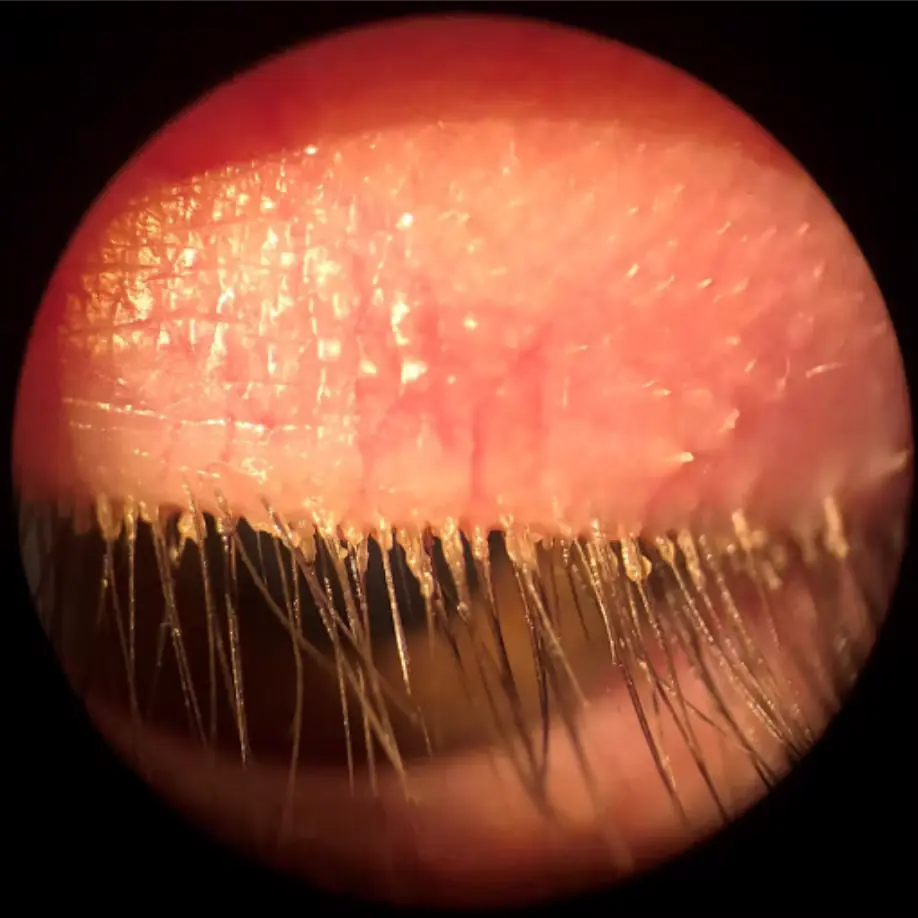
But what does the science actually say?
The truth is more nuanced. Demodex mites are naturally associated with human skin, particularly in adults. Their presence does not automatically mean that a person is dirty, infected or in need of aggressive treatment. Nor does finding out about them mean that every pillow, towel or cosmetic product in the home has become dangerous.
Understanding the difference between ordinary colonization and a problem involving eyelid inflammation is essential. It can help people recognize symptoms, avoid unnecessary fear and make sensible decisions about hygiene and skincare.
And there is one detail that deserves particular attention: the condition of the eyelid margin may matter much more than the mere presence of a microscopic mite. To understand why, we first need to look at what Demodex actually is, where it lives and how it interacts with the skin around the eyes.
CHAPTER 1: WHAT EXACTLY ARE DEMODEX MITES?
Demodex mites are microscopic, eight-legged organisms belonging to the arachnid group, the same broad animal group that includes spiders and ticks. They are not insects, and they are not unusual discoveries restricted to people with skin problems. They are naturally associated with human skin and are particularly common around areas containing hair follicles and oil-producing glands.
Two species are most frequently discussed in connection with humans: Demodex folliculorum and Demodex brevis.
Although both are extremely small, they do not occupy exactly the same locations.
Demodex folliculorum is generally associated with hair follicles. It can be found around facial hair, eyebrows and eyelashes. These mites may live in groups within or near follicles, where they feed on material associated with the skin.
Demodex brevis tends to inhabit deeper structures, including sebaceous and meibomian glands. Meibomian glands are particularly important around the eyes because they produce the oily component of the tear film. This oil helps slow the evaporation of tears and contributes to the stability of the eye's surface.
The difference between the two species helps explain why Demodex is discussed in both dermatology and eye care. One organism may be associated with facial skin and hair follicles, while another may be found in structures involved in eyelid oil production.
These mites are usually too small to be seen without magnification. The adult organisms are commonly described as measuring only a few tenths of a millimeter. Their elongated bodies and small legs are easier to recognize in microscope photographs than in ordinary pictures of the face.
The dramatic images circulating online are often enlarged many times. A photograph showing a large, worm-like creature beside an eyelash can therefore create a misleading impression of its real size. It is a magnified view of an organism that would otherwise be invisible to the naked eye.
Demodex feeds on materials associated with the skin, including sebum and dead cells. Sebum is the oily substance produced by sebaceous glands. It helps protect and lubricate the skin, although excess oil can contribute to clogged pores and other skin concerns.
The mites spend much of their lives close to the follicles and glands that provide their habitat. Their presence is part of the microscopic environment associated with human skin.
This does not mean that every person has the same number of mites. Their abundance can vary with age, skin characteristics, health conditions and other factors. Some people may carry them without noticeable symptoms, while others may develop inflammation associated with a higher mite population.
A review published in 2025 estimated that the global pooled prevalence of human Demodex mites was approximately 35 percent across the studies included. The researchers also reported considerable variation between populations and study groups, meaning the estimate should not be interpreted as a precise figure for every country or individual.
The most important point is that finding Demodex does not automatically establish disease.
The American Academy of Ophthalmology explains that almost everyone may carry some Demodex and that the organisms are part of the normal microscopic environment of human skin. Even people without eye complaints can have mites around their eyelashes.
This is why the word "infestation" can sometimes be misleading when used casually. In everyday conversation, it sounds as though a person has an unusual or dangerous problem. In clinical practice, however, the important question is whether the mites are associated with symptoms and visible inflammation.
A person who has no irritation, redness or eyelid problems does not necessarily need treatment simply because Demodex exists on their skin.
The organisms are also not evidence that someone has failed to wash properly. A person may shower regularly, clean their face every day and follow a careful skincare routine while still naturally carrying these mites.
That is the first major misconception to leave behind: Demodex is not proof of poor personal hygiene.
Why the eyelash image looks so frightening
The supplied photograph shows an enlarged, pale, segmented organism beside human eyelashes. It is designed to make the microscopic structure visible, not to represent what someone would see when looking in a mirror.
At ordinary scale, a Demodex mite is too small to be identified with the naked eye. The photograph's dramatic appearance comes from magnification and close-up lighting.
The same principle applies to many microscopic organisms. Images of bacteria, dust mites and cells can look unfamiliar or alarming when enlarged. Their appearance in a laboratory image does not tell us by itself whether they are dangerous.
A useful distinction is the difference between an organism's existence and its effect on the body. Demodex can be present without causing noticeable symptoms. Problems become more relevant when there is an increased population, inflammation around the follicles or a condition such as Demodex-associated blepharitis.