The approval is important because it provides a treatment specifically developed and evaluated for this condition. However, availability and prescribing rules differ between countries. Patients should consult an ophthalmologist or other qualified eye-care professional about appropriate options in their location.
4. Why ordinary skin creams are not a substitute for eye treatment
Some medicines used for skin conditions involving Demodex may also be discussed in ophthalmology, sometimes as off-label treatments.
But a cream intended for facial skin is not automatically safe for use on the eyelids.
The skin around the eyes is thin, and the eye itself is vulnerable to chemical irritation. Products containing antiparasitic ingredients should not be applied close to the eye unless a qualified clinician specifically recommends them.
The same warning applies to products designed for animals. Veterinary treatments may contain different concentrations or formulations and should never be used as substitutes for human eye medication.
5. Why treatment should match the actual diagnosis
Not every case of blepharitis is caused by Demodex.
Some cases are associated with bacteria, oily skin, dandruff, rosacea or blocked eyelid glands. Allergies and dry eye can also cause symptoms that resemble Demodex-related irritation.
If someone treats the wrong condition, symptoms may continue even after weeks of effort.
This is why professional assessment matters. A clinician can examine the eyelid margins, assess the tear film and look for signs that point toward a particular cause.
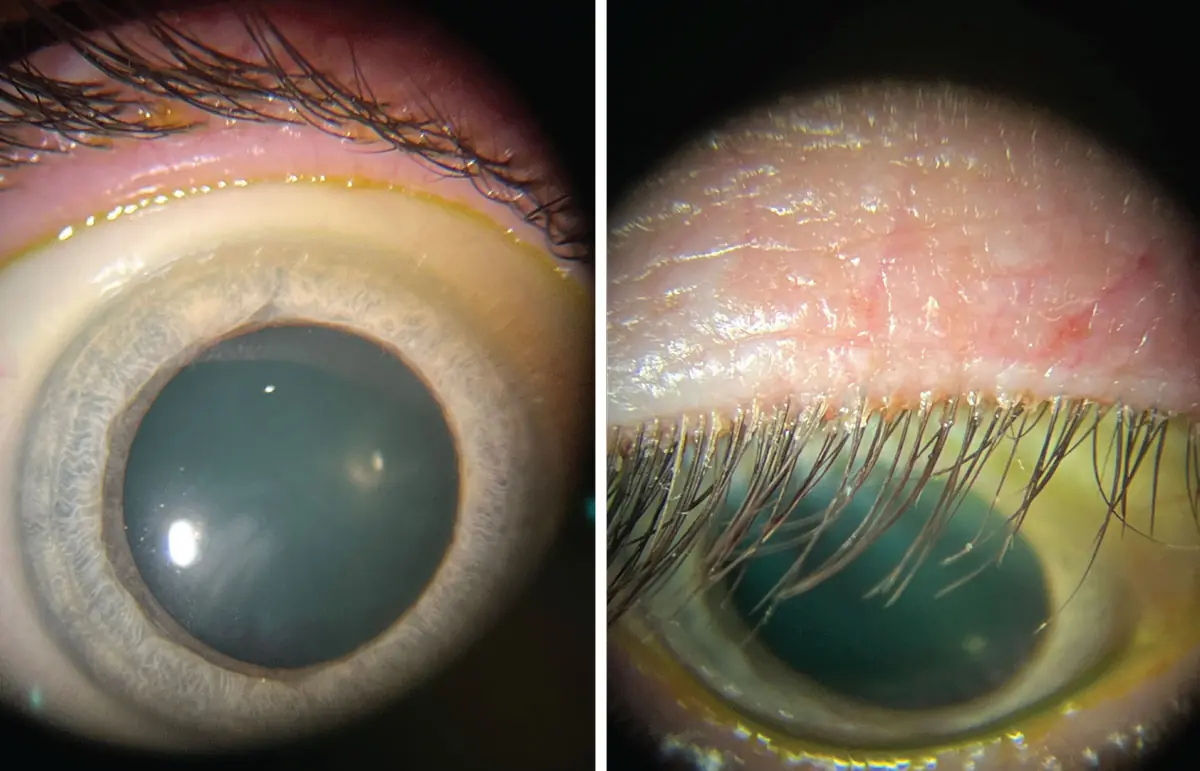
The American Academy of Ophthalmology explains that persistent eyelid inflammation, itching, recurrent styes and characteristic cylindrical debris around the lashes may raise suspicion of Demodex. Microscopic examination of eyelashes can also be used when needed.
6. How an eye doctor checks for Demodex
An examination may begin with a close look at the eyelids using a slit lamp, a specialized microscope used in eye care.
The clinician can examine the base of the eyelashes, the eyelid margin and the openings of the oil glands.
If characteristic collarettes are present, they may provide a strong clue.
In selected cases, eyelashes can be collected and examined under a microscope to look for mites. This allows the clinician to assess whether Demodex is present and, in some circumstances, estimate its density.
American Academy of Ophthalmology+2
A patient should not attempt to reproduce this procedure at home. Pulling eyelashes with tweezers or scraping the eyelid can cause injury and does not provide a reliable diagnosis.
7. What should people avoid?
Fear can lead people to try treatments that are more harmful than the condition they are trying to address.
Avoid:
-
Applying undiluted tea tree oil to the eyelids.
-
Using insecticides, household disinfectants or cleaning chemicals on the face.
-
Putting veterinary antiparasitic products near the eyes.
-
Scrubbing the eyelid margin until it becomes sore.
-
Pulling out eyelashes to look for mites.
-
Applying facial treatments inside the eye or along the waterline without professional advice.
-
Stopping prescribed eye medication without discussing it with the prescriber.
-
Assuming that every episode of redness or itching is caused by Demodex.
If a product accidentally enters the eye and causes significant irritation, rinse the eye with clean running water or sterile saline as appropriate and seek medical advice if symptoms persist or are severe.
8. When eye symptoms need prompt attention
Some symptoms should not be attributed casually to eyelash mites.
Seek prompt medical attention for significant eye pain, sudden changes in vision, marked sensitivity to light, severe swelling, a very red eye or symptoms that are rapidly worsening.
These signs can be associated with conditions that require assessment beyond routine eyelid hygiene.
People with contact lenses should be particularly careful about a painful or red eye, as some contact lens-related infections can become serious.
Demodex may be part of the explanation for certain chronic eyelid problems, but it should never become a reason to ignore warning signs.
21. The Real Answer: Should You Be Worried About Demodex?
After looking at the science, the answer is more reassuring than many viral photographs suggest.
Demodex mites are microscopic organisms commonly associated with human skin. They are found around hair follicles and oil-producing glands, including structures near the eyelashes. Many people carry them without experiencing noticeable symptoms.
Their presence does not mean that someone has poor hygiene. It does not automatically mean that their face is dirty, that their pillow is contaminated or that every skincare product must be thrown away.
The important distinction is whether the mites are contributing to inflammation.
When they are associated with Demodex blepharitis, people may experience itching, redness, irritation and characteristic cylindrical debris around the bases of their eyelashes. An eye-care professional can examine these signs and determine whether treatment is appropriate.
The condition can be managed. Gentle eyelid hygiene may be recommended, and prescription treatment is available in some countries for confirmed cases. The U.S. FDA's approval of lotilaner ophthalmic solution in 2023 represents an important development in this area.
But treatment should be guided by an accurate diagnosis rather than fear generated by enlarged images or dramatic online claims.
The same principle applies to bedding and skincare. Regular washing of pillowcases and towels, careful handling of eye cosmetics and gentle facial care are sensible habits. Extreme cleaning measures are not necessary simply because Demodex is naturally associated with the skin.
Perhaps the most useful lesson is that microscopic does not automatically mean dangerous.
The human face is a complex living environment. It contains bacteria, fungi and other microscopic organisms, many of which exist without causing disease. Health is not achieved by trying to eliminate every organism from the skin. It depends on maintaining the body's natural barriers and recognizing when a genuine problem needs attention.
So if you have ever looked at an enlarged photograph of an eyelash mite and wondered whether your face or bedding is crawling with dangerous organisms, remember the difference between the image and reality.
The photograph shows a tiny organism under magnification. It does not show what your skin looks like to the naked eye, and it does not prove that you have an eye condition.
If your eyelids are comfortable and healthy, there may be no reason for concern. If you experience persistent irritation, redness or crusting, an eye examination can help identify the cause.
You do not need to panic, throw away your pillows or attack your skincare routine. You need accurate information, sensible hygiene and appropriate medical advice when symptoms appear.