Chapter 1: The Hospital Image That Sparked a Mysterious Debate
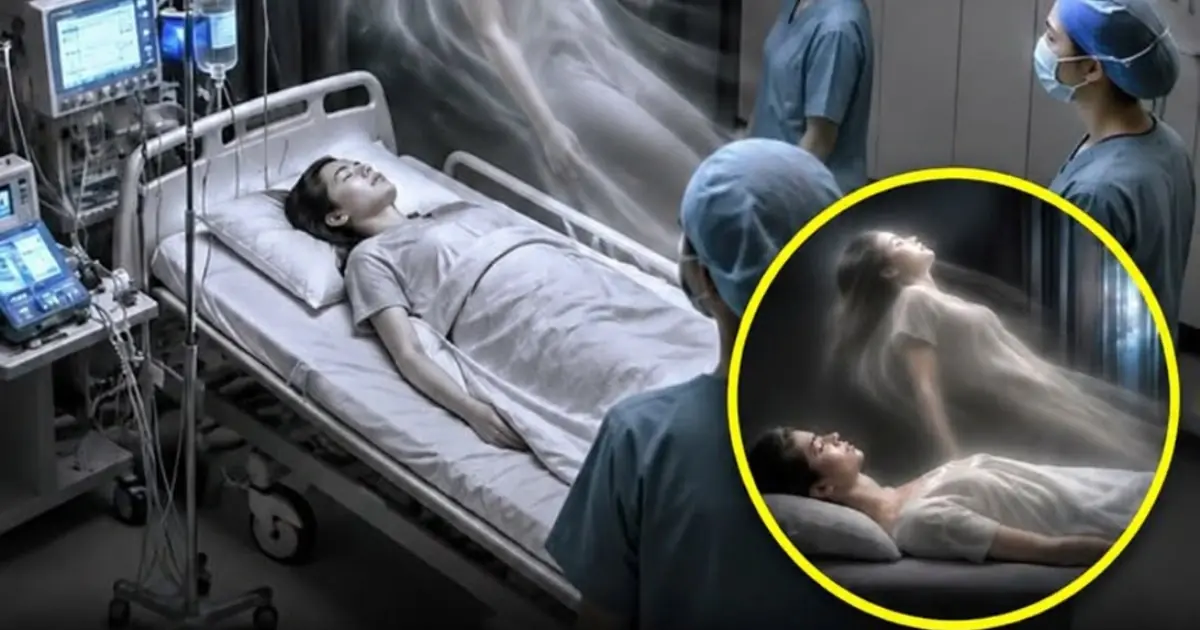
The image is striking. A patient lies motionless in a hospital bed, surrounded by medical equipment and healthcare professionals. Above the body appears a pale, glowing figure that resembles the same person, seemingly rising into the air.
For many viewers, the scene immediately brings to mind one of humanity's oldest questions: What happens when life comes to an end?
The image has been presented with a dramatic claim suggesting that hospital surveillance cameras captured a soul leaving the body in just a few seconds. Such a description is powerful because it combines two things people often regard as convincing: medical technology and a mysterious experience that cannot easily be explained.
Yet there is an important distinction between a compelling image and verified evidence.
A photograph or edited illustration cannot establish that a supernatural event occurred. The scene may have been created digitally, staged for dramatic effect, or designed to represent an idea rather than document an actual hospital incident. Without the original recording, reliable information about the patient, and independent examination of the footage, the claim remains unverified.
Still, the image touches on a subject that deserves serious attention.
People have reported unusual experiences during moments of extreme physical danger for centuries. Some describe feeling detached from their bodies. Others say they watched medical staff working on them from a position above the bed. A number recall moving through a dark passage toward a bright light, while some describe a profound sense of peace.
These accounts are commonly known as near-death experiences, or NDEs.
They are not limited to one country, religion, or age group. People with different cultural backgrounds have described experiences that share certain features, although the details and interpretations vary considerably.
For some individuals, these memories become among the most meaningful events of their lives. They may report feeling less afraid of death, becoming more appreciative of their relationships, or changing their priorities after recovery.
But the question remains: Are these experiences evidence that consciousness can exist independently of the body, or do they reflect unusual processes occurring within the brain?
Scientists have not reached a complete answer to every aspect of this question. Research into consciousness during severe medical crises is difficult because the events are unpredictable and often happen when patients cannot communicate.
Modern medicine can monitor heart rhythm, breathing, oxygen levels, and certain patterns of brain activity. However, these measurements do not provide a complete description of subjective experience.
A person may have a memory of an event without being able to explain exactly when it occurred. A vivid experience may feel completely real even if it was shaped by altered perception, memory, or the brain's response to extreme stress.
This is why researchers distinguish between what a person sincerely remembers and what can be independently verified.
The viral hospital image invites viewers to imagine a dramatic moment when the physical body and consciousness separate. It may be emotionally powerful, but it should not be treated as proof of that separation.
The real mystery is not simply whether a glowing figure appeared above a hospital bed. It is how the human mind can produce such vivid experiences during moments when the body is under extraordinary strain.
That question continues to attract researchers, doctors, psychologists, and people who have survived life-threatening emergencies.
And the answers may be more fascinating than the image itself.
Chapter 2: What Survivors Say They Experienced
Near-death experiences are often described as unusually vivid memories formed during a medical emergency or shortly afterward.
Although each account is personal, researchers have identified several recurring features.
One of the most frequently discussed is the sensation of leaving the body.
A person may report feeling as though they are floating above the bed, looking down at themselves, or observing the room from a position that seems separate from their physical body. Some describe seeing medical staff moving around them or hearing conversations.
These experiences can be deeply convincing to the person who remembers them.
In some accounts, the individual describes a sensation of moving through a tunnel or toward a bright light. Others report meeting deceased relatives, encountering unfamiliar figures, or experiencing a panoramic review of important memories.
A feeling of peace is also commonly mentioned, although not every near-death experience is pleasant. Some people describe confusion, fear, darkness, or a sense of being unable to move.
The variety of these reports is important. Near-death experiences should not be reduced to one universal story.
A person who remembers floating above a hospital bed may interpret the event as evidence that the soul temporarily left the body. Another may believe it was a dream produced during a medical crisis. Someone else may remain uncertain, accepting that the experience felt real without claiming to know its ultimate meaning.
These interpretations can be influenced by personal beliefs, cultural background, previous experiences, and the way a person understands death.
Researchers studying these reports often use interviews and questionnaires to identify common patterns. They examine when the experience was remembered, what the person felt, and how the memory affected their life afterward.
However, the timing can be difficult to establish.
A patient who experiences cardiac arrest may pass through several stages: the initial emergency, reduced blood flow to the brain, medical resuscitation, and recovery. Consciousness may fluctuate during these stages.
The memory of an experience does not necessarily reveal the exact moment when it occurred.
This creates a challenge for anyone trying to connect a particular sensation with a specific medical measurement.
For example, a person may remember hearing a sound during an emergency. That memory alone cannot establish whether the sound was perceived before consciousness was lost, during a period of partial awareness, or while the brain was recovering.
The same issue applies to out-of-body experiences.