Before unpacking, inspect the entrance door.
Make sure the lock, deadbolt, and security latch work properly.
Check the windows and balcony doors.
If anything cannot be secured, contact reception before settling in.
Minute 2: Inspect the Television and Electronics
Look at the television, remote control, chargers, lamps, and other electronic equipment.
Check for damaged housings, unexplained attachments, or exposed wiring.
Make sure unfamiliar devices have an understandable purpose.
Minute 3: Examine the Mirrors and Surrounding Fixtures
Look at the mirror's frame and mounting.
Check whether there are unexplained openings, unusual attachments, or visible damage.
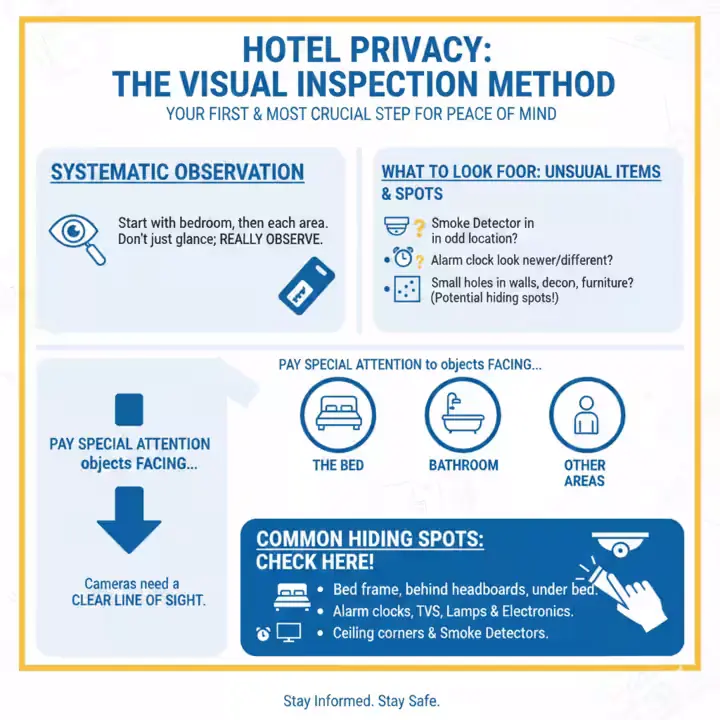
Pay attention to the objects surrounding the mirror, particularly anything that appears to have an unexplained view of private areas.
Minute 4: Inspect the Bed and Mattress
Look at the sheets, pillowcases, and exposed mattress edges.
Check for dark spots, visible insects, unpleasant smells, dampness, or other signs of inadequate cleaning.
If you find evidence of pests or contaminated bedding, request an inspection and replacement accommodation where appropriate.
Minute 5: Check the Bathroom and General Condition
Inspect the bathroom for cleanliness, water leaks, damaged electrical equipment, and unusual fixtures.
Make sure the shower, toilet, and sink are functioning.
Check that towels and essential supplies are clean.
Once these checks are complete, you can decide whether the room meets your expectations.
The goal is not to find something wrong with every hotel.
It is to avoid overlooking a problem simply because the room initially looks attractive.
Mistakes Travelers Should Avoid When Checking Into a Hotel
Even experienced travelers sometimes overlook basic precautions.
A few common habits can make it easier to miss problems or create unnecessary difficulties.
Mistake 1: Unpacking Immediately
Many people enter their room and immediately spread their belongings across the bed, furniture, and bathroom.
It is more practical to perform a quick inspection first.
Keep your suitcase closed until you have checked the main areas.
This is particularly useful when you are concerned about cleanliness or pests.
Mistake 2: Assuming an Expensive Hotel Cannot Have Problems
A high room price does not guarantee that every part of the accommodation is perfect.
Even well-known hotels can experience maintenance problems, housekeeping mistakes, or occasional pest issues.
The quality of a room should be assessed based on its actual condition.
A modest accommodation that maintains good hygiene and security may provide a better experience than a more expensive room with unresolved problems.
Mistake 3: Ignoring Small Signs Because the Room Looks Beautiful
A room may have attractive furniture, decorative lighting, and expensive-looking bedding.
However, appearance does not replace proper maintenance.
A damaged lock, exposed wire, suspicious device, or visibly dirty mattress should not be ignored simply because the room looks luxurious.
Mistake 4: Accepting an Unclear Explanation
If you report a genuine concern, you should receive a reasonable response.
A staff member may explain that an unfamiliar device is part of the hotel's lighting system or that a mark on the wall resulted from recent maintenance.
That may be perfectly reasonable.
But if nobody can identify an unexplained device or address an obvious safety problem, asking for another room is appropriate.
Mistake 5: Trying to Investigate Everything Yourself
Guests are not professional electricians, security technicians, or pest-control specialists.
Do not remove electrical fixtures, open wall panels, dismantle smoke detectors, or attempt to repair hotel equipment.
Your responsibility is to recognize visible concerns and report them.
Qualified professionals should handle technical inspections.
How Hotels Can Make Guests Feel Safer
Room safety is not only the responsibility of travelers.
Hotels and motels also have an important responsibility to maintain their facilities and protect guest privacy.
A clean room is only one part of a satisfactory accommodation experience.
Guests also expect secure locks, functioning electrical equipment, reliable fire-safety systems, and appropriate privacy.
Consistent Housekeeping Inspections
Housekeeping teams should follow consistent procedures when preparing rooms for new guests.
These procedures may include checking bedding, inspecting bathroom surfaces, removing waste, replenishing supplies, and reporting maintenance problems.
Supervisors should also examine mattresses and surrounding furniture when pest activity is suspected.
A proper cleaning process should not focus only on what guests can see from the doorway.
The condition of frequently overlooked areas matters too.
Regular Maintenance of Electronic Equipment
Televisions, lighting systems, air-conditioning controls, and other electronic devices should be maintained properly.
Damaged equipment should be repaired or replaced.
Unexplained modifications should be investigated.
Hotels should also ensure that any legitimate monitoring systems are disclosed and used in accordance with applicable privacy requirements.
Respecting Guest Privacy
A hotel room should provide a private environment.
Security cameras may be appropriate in certain shared public areas, subject to applicable rules.
However, recording guests in bedrooms and bathrooms without lawful authorization and appropriate consent is a serious privacy concern.
Hotels should establish clear policies governing surveillance equipment, employee access, data storage, and guest complaints.
Staff should also receive training on how to respond when someone reports a possible privacy violation.
Taking Complaints Seriously
A guest who reports an unusual device or a damaged lock should not automatically be treated as difficult.
Sometimes the concern will have a simple explanation.
Other times, an investigation may reveal a genuine problem.
Either way, a respectful response helps maintain trust.
Offering another room when appropriate can prevent a minor issue from becoming a much larger dispute.
The Best Way to Protect Yourself Is to Stay Observant, Not Afraid
The photograph highlights three ordinary objects: a television, a mirror, and a bed.
These objects are found in countless hotel rooms around the world.
There is nothing inherently dangerous about any of them.
A television provides entertainment.
A mirror helps guests prepare for their day.
A bed offers a place to rest after traveling.
However, each deserves a reasonable inspection because unusual damage, unexplained modifications, or visible hygiene problems can sometimes reveal that a room has not been properly maintained.
The television should be checked for unfamiliar equipment and unexplained modifications.
The mirror should be examined for unusual installation details and suspicious attachments, without relying on unreliable internet tricks.
The bed should be inspected for stains, insects, unpleasant odors, and signs of inadequate housekeeping.
These three checks address different concerns: privacy, physical condition, and hygiene.
Travelers should also examine door locks, windows, electrical outlets, bathroom fixtures, and essential safety equipment.
Most importantly, a suspicious appearance is not proof of wrongdoing.
A small mark on a sheet does not automatically indicate bed bugs.
A mirror facing a bed does not prove surveillance.
An unfamiliar electronic device may have a legitimate function.
The correct response is to investigate calmly, ask questions, and seek assistance when necessary.
If a serious concern remains unresolved, requesting another room or leaving the property is a reasonable decision.
A hotel stay should provide comfort and peace of mind.
You should be able to close the door, put your belongings away, take a shower, and sleep without worrying about unexplained hazards.
A few minutes of observation before unpacking can help you make a better decision.
And that is the real lesson behind the three warning signs in the photograph: Never let an attractive hotel room distract you from checking whether it is actually clean, secure, and suitable for your stay.