There is another human consideration that can easily disappear when a story becomes popular.
The woman shown in the supplied images is a person whose identity and employment have not been independently established.
Millions of online viewers may form opinions about her based on a few seconds of footage.
Some may praise her. Others may criticize her appearance, personality, or professional judgment.
But without a verified account, those reactions risk becoming judgments about a person whose full circumstances remain unknown.
It is possible that the footage shows a staged performance, a promotional recording, an edited social media clip, or an actual interaction during a commercial flight.
Those possibilities should not be treated as interchangeable.
If the footage was staged, describing it as a genuine workplace scandal would be misleading.
If it was recorded during an actual flight, the complete sequence would still be necessary to understand what happened.
The same standard should apply to claims about passenger reactions and airline investigations.
Responsible reporting means allowing evidence to determine the conclusion rather than allowing the headline to determine the evidence.
A Bigger Conversation About Entertainment and Professional Boundaries
The controversy also reflects a broader change in public expectations.
People increasingly want their everyday experiences to be entertaining.
Restaurants create memorable presentations. Hotels encourage employees to provide personalized experiences. Airlines experiment with humorous announcements and creative promotional campaigns.
These approaches can help companies stand out in a competitive industry.
However, there is a difference between an organized entertainment activity and spontaneous behavior during a normal work assignment.
A promotional event has a defined purpose, participants may know that they are being filmed, and the company can approve the content before publication.
An ordinary passenger flight is different.
People aboard the aircraft may be traveling for business, family responsibilities, medical appointments, or personal reasons. Not everyone wants to become part of a performance.
For this reason, the most appropriate form of entertainment is usually one that allows passengers to enjoy the experience without feeling pressured to participate.
A humorous announcement can make people smile without singling anyone out.
A friendly greeting can improve the cabin atmosphere without creating an uncomfortable personal interaction.
A memorable safety presentation can capture attention while still delivering essential information.
These examples demonstrate that professionalism does not have to eliminate creativity.
It simply requires that creativity be used with consideration for others.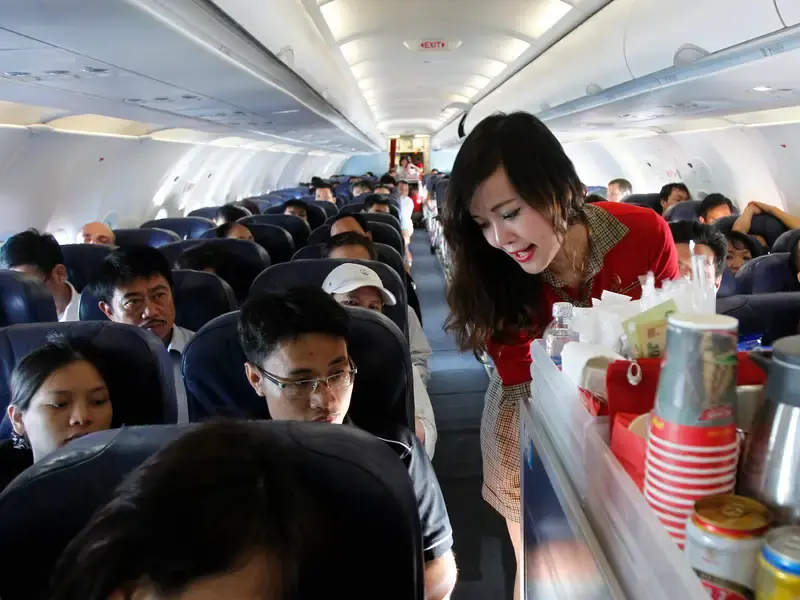
The Difference Between a Viral Headline and a Verified Incident
Perhaps the most important lesson from this story is the difference between an online narrative and a confirmed event.
The headline suggests that an airline experienced chaos after an unusual flight attendant interaction.
The accompanying images show a woman in a uniform and several apparent aircraft-cabin scenes.
The circulating article adds a more detailed account involving a Mexico City–Cancun route, a passenger, flirtatious gestures, millions of views, and an alleged internal review.
However, the available material does not independently confirm all those details.
No authenticated airline statement has been established in the material reviewed, and the claimed suspension remains unverified.
There is also insufficient evidence to conclude that the event caused an actual operational disruption.
This does not mean the discussion is meaningless.
The story still raises legitimate questions about workplace behavior, passenger comfort, social media recording, and the importance of maintaining professional boundaries.
It also demonstrates how quickly a short clip can become a much larger public discussion.
Readers should be able to enjoy an unusual story while recognizing which details remain uncertain.
That approach protects both the people involved and the credibility of the reporting.
What Airlines Can Learn From Moments Like This
Regardless of the exact circumstances behind the footage, the story offers several lessons for airlines.
The first is the importance of clear professional standards.
Employees should understand what kinds of personal interactions are appropriate while working, especially when they are wearing company uniforms and representing the airline.
The second is the importance of consistent training.
Cabin crew members need to know how to balance friendly customer service with the responsibility to maintain a safe and orderly cabin.
The third is the need for fair internal investigations.
If an incident becomes controversial, airlines should examine the original footage, speak with relevant witnesses, and establish the facts before making decisions.
A company should not discipline an employee simply because a video attracts negative comments. Equally, popularity on social media should not protect someone from legitimate concerns about their conduct.
Fairness requires evidence and consistent standards.
Finally, airlines should recognize that social media is now part of the working environment.
Employees may be recorded at any moment, while passengers increasingly expect transparency when something unusual happens.
Clear communication can help prevent misunderstandings and protect both travelers and crew members.
Will This Incident Change How People View Flight Attendants?
Probably not because of one video alone, but it may contribute to an ongoing discussion about the profession.
Flight attendants occupy a unique position. They are expected to represent an airline's image while also carrying responsibilities that can become critical during an emergency.
Passengers often notice their appearance, uniforms, and customer-service skills. What they may not see is the preparation and training behind those responsibilities.
A viral clip can temporarily change the way viewers perceive an individual employee or even an entire airline.
However, a single recording should not define a whole profession.
There are countless flight attendants who quietly perform demanding duties every day without attracting public attention.
They help frightened passengers, assist families, respond to medical emergencies, and maintain order during difficult situations.
Their work deserves recognition beyond the occasional viral moment.
The most valuable lesson is that being friendly and being professional should never be considered opposing qualities.
An excellent flight attendant can make passengers smile while remaining attentive to every responsibility.
That is the standard airlines should encourage.
So, What Really Happened on the Flight?
The circulating story describes a female flight attendant whose unusual and apparently flirtatious behavior toward a passenger attracted widespread attention.
The supplied photographs show a woman in a dark uniform and several apparent aircraft-cabin scenes. The accompanying online account claims that the incident occurred on a Mexico City–Cancun flight and generated millions of views.
However, the airline's identity, the exact circumstances, the passenger's full reaction, and the alleged disciplinary measures have not been independently confirmed.
Therefore, the most responsible conclusion is that the images and accompanying claims have generated a debate about professionalism rather than established proof of an airline scandal.
The situation nevertheless highlights an important issue in modern aviation: cabin crew members can be friendly, humorous, and entertaining, but passenger comfort and safety must always come first.
Perhaps the most interesting question is not whether the flight attendant was funny or provocative.
It is whether the interaction remained appropriate for everyone aboard the aircraft.
And until the full footage and reliable information become available, viewers should leave room for the possibility that the viral headline tells only part of the story.