A conventional oven may therefore be more efficient when the quantity of food is large.
The practical recommendation is simple: use an air fryer when preparing smaller portions and an oven when cooking a substantial amount of food.
4. Which One Uses Less Electricity?
Energy consumption is another important consideration, particularly for households that use cooking appliances frequently.
Air fryers are often more energy-efficient for small meals because they have smaller cooking chambers and usually require less preheating.
A conventional oven generally needs to heat a much larger space. If you turn on a full-size oven just to cook one or two portions of food, some of that energy may be spent heating an area that is not being fully used.
However, the actual difference depends on several factors:
-
The wattage and efficiency of each appliance
-
The amount of food being prepared
-
Cooking temperature and duration
-
Whether the oven has a convection setting
-
How frequently the door is opened
-
Whether multiple dishes are cooked together
For example, an air fryer may use less total electricity when preparing a small serving of vegetables. But an oven may be more efficient when cooking several trays of food simultaneously.
The best way to compare appliances is to look at their actual energy consumption over the time needed to prepare the same quantity of food.
An appliance's wattage alone does not tell the whole story. A higher-powered device may finish cooking more quickly, while a lower-powered device may need considerably more time.
For households concerned about electricity costs, an air fryer can be a sensible choice for everyday small meals. A conventional oven remains useful for larger cooking tasks.
5. Is Air-Fried Food Healthier Than Oven-Cooked Food?
This is perhaps the most important question for people considering an air fryer.
Air fryers are frequently advertised as a healthier alternative to deep frying because they can produce a crispy texture without requiring food to be submerged in oil.
That advantage is real, but it needs to be understood correctly.
Traditional deep frying often involves exposing food to a substantial amount of hot oil. Depending on the food and cooking process, this can significantly increase its fat and calorie content.
Air frying can reduce the need for added oil. For example, potatoes can become browned and crisp with a small amount of oil rather than being immersed in a deep fryer.
However, an air fryer is not automatically healthier than a conventional oven.
Both appliances can prepare nutritious meals using similar ingredients. Roasted vegetables, baked fish, chicken breast, and homemade potatoes can all be healthy choices when prepared with appropriate amounts of oil, salt, and seasoning.
The nutritional value of a meal depends on several factors:
-
The ingredients being used
-
The amount and type of added fat
-
The portion size
-
The cooking temperature
-
The cooking duration
-
Whether the food is processed or minimally processed
For example, air-fried vegetables may be a nutritious option, while heavily breaded, highly salted frozen snacks can still contain considerable amounts of sodium and calories.
The appliance does not determine the nutritional quality of the food by itself.
The key distinction is between air frying and deep frying—not necessarily between air frying and oven baking.
If you already prepare food in a conventional oven using modest amounts of oil, switching to an air fryer may not produce a major nutritional improvement.
6. Does an Air Fryer Require Less Cooking Oil?
In many cases, yes.
One of the most practical advantages of air frying is that it can produce a crisp exterior with substantially less added oil than deep frying.
For example, homemade potato wedges can be lightly coated with oil before being placed in an air fryer. The circulating hot air helps brown their surfaces without requiring a large quantity of cooking fat.
The same approach can work well with:
-
Sweet potato wedges
-
Chicken pieces
-
Broccoli
-
Carrots
-
Zucchini
-
Fish fillets
-
Homemade vegetable chips
Nevertheless, a small amount of oil may still improve flavor, browning, and texture.
It is also important to remember that some foods already contain considerable amounts of fat. Sausages, fatty cuts of meat, and certain prepared products may release oil during cooking.
Adding more oil is not always necessary.
A conventional oven can also prepare food with relatively little oil. A tray of roasted vegetables, for instance, does not need to be deep-fried or covered in fat to become flavorful.
Therefore, if your goal is to reduce added oil, both appliances can support that goal. An air fryer simply makes it particularly convenient for small portions of crispy food.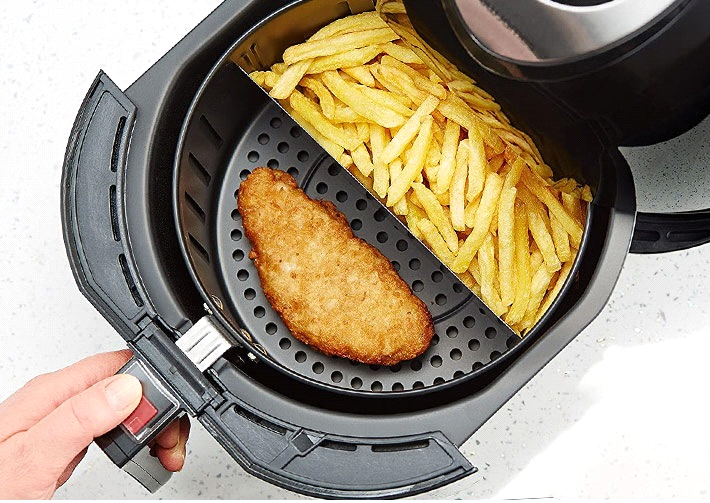
7. Which Appliance Produces Better Texture?
Texture is one area where air fryers often stand out.
The rapid movement of hot air can help create a crisp exterior, especially when cooking smaller pieces of food with sufficient space around them.
Potato wedges, chicken wings, breaded vegetables, and frozen snacks are common examples.
The result can be particularly appealing to people who enjoy the texture of fried food but want to use less oil.
However, air fryers do not always produce the same texture as deep frying. The surface may be crisp, but the flavor and mouthfeel can differ because the food has not been cooked in hot oil.
A conventional oven can also produce excellent browning and crispness, especially when equipped with a convection fan or a suitable roasting tray.