Another possibility involves structural connections.
Bridges and overpasses depend on carefully designed connections, bearings, joints, supports, and load-transfer systems. These components allow forces to move through the structure in controlled ways.
If a critical component fails, the load may shift unexpectedly.
A section that was previously supported could begin to move. Neighboring elements might suddenly carry more weight than they were designed to handle. The failure could spread, especially if the structure's design or condition leaves limited capacity to redistribute loads.
This is why engineers do not simply examine the largest broken piece of concrete.
They study the entire structural system.
The position of the collapsed section.
The condition of nearby supports.
The direction of the fractures.
The remaining load paths.
The way the debris landed.
Even the shape of the broken surfaces may help establish how the failure developed.
In the photograph, the damaged span appears dramatic enough to invite immediate conclusions. But a structure's failure is rarely explained by appearance alone.
A collision may have triggered a failure in a deteriorated structure.
A structural weakness may have caused a section to collapse without any vehicle impact.
An unexpected combination of damage, loading, and environmental conditions may have created a failure that investigators could not have predicted from a single photograph.
The most important question would not simply be whether the bridge was old.
It would be whether the structure had been properly inspected, maintained, and assessed—and whether warning signs had been visible before the collapse.
Because if the damage had been developing quietly for years, the photograph might represent the final moment of a much longer story.
CHAPTER 4 — THE MINUTES AFTER THE COLLAPSE: WHY RESCUERS CANNOT SIMPLY RUSH IN
When an overpass collapses, the instinct of anyone witnessing the scene is to run toward the danger.
A driver may see someone trapped inside a vehicle. A pedestrian may hear a person calling for help. A rescuer may see a damaged truck surrounded by concrete and immediately want to pull the driver free.
But in a partial structural collapse, moving too quickly can create another disaster.
The concrete that has already fallen is not necessarily the only concrete that is dangerous. Sections of the structure may remain suspended, resting on unstable supports, hanging from damaged reinforcement, or leaning against neighboring components.
A piece that appears secure may actually be balanced in a fragile position.
A small movement could change the forces holding it in place.
A rescue vehicle passing too close could create vibration.
A piece of debris could shift.
A damaged support could suddenly lose its remaining strength.
The result could be a secondary collapse.
That is why emergency responders often approach these scenes with deliberate caution. The first task is to establish a safe perimeter and determine where the danger remains.
Traffic may need to be stopped in both directions. Nearby pedestrians may need to be evacuated. Access routes may be restricted. Responders may need to determine whether electrical lines, gas pipes, water systems, or other utilities have been damaged.
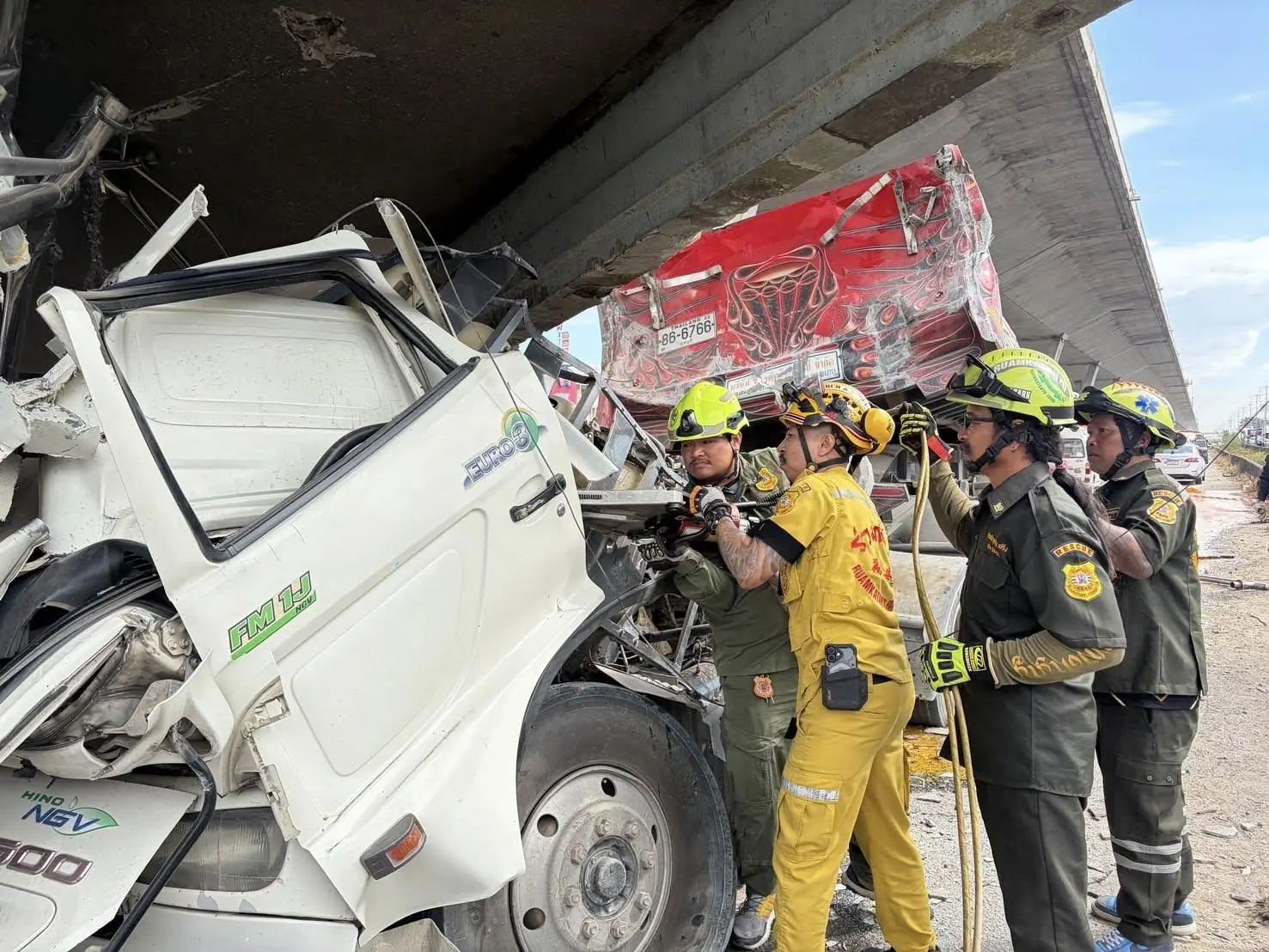
The scene is not simply a pile of rubble.
It is a structure that may still be moving.
Specialized rescue teams may assess the remaining bridge components before entering areas beneath or beside the damaged span. Depending on the situation, engineers and rescue specialists may use stabilization equipment, temporary supports, or controlled lifting methods to prevent additional movement.
If a vehicle is trapped beneath concrete, the rescue operation can become particularly complicated.
Pulling a vehicle free may seem like the fastest solution, but the vehicle itself could be supporting debris or occupying a position that prevents another piece of concrete from moving.
Removing it without understanding the surrounding loads could create additional instability.
Rescue teams may therefore need to stabilize the structure first.
Temporary supports, timber cribbing, hydraulic equipment, and other methods may be used depending on the specific conditions. The process requires careful planning because every movement can change the load distribution.
Meanwhile, medical responders must determine whether anyone is injured and how quickly they can safely reach the affected area.
The photograph shows responders positioned around the damaged structure, but it does not reveal what they were doing at the exact moment the image was captured.
They may have been inspecting the remaining span.
They may have been preparing to approach the truck.
They may have been waiting for structural specialists.
They may have been searching for pedestrians or checking whether additional vehicles were trapped.
Their apparent calm should not be mistaken for a lack of urgency.
In emergency situations, controlled movement is often the result of intense preparation and professional discipline. A rescue team may be moving slowly because the danger is still active, not because the situation is under control.
The first minutes after a collapse can be the most uncertain.
Responders must balance the urgency of saving lives against the possibility that the structure could fail again. Every decision has consequences.
And while rescue crews focus on the immediate danger, another investigation is beginning in parallel.
Someone must establish what happened.
Someone must determine whether the collapse was caused by a vehicle impact, structural deterioration, a construction defect, an unexpected load, or some combination of factors.