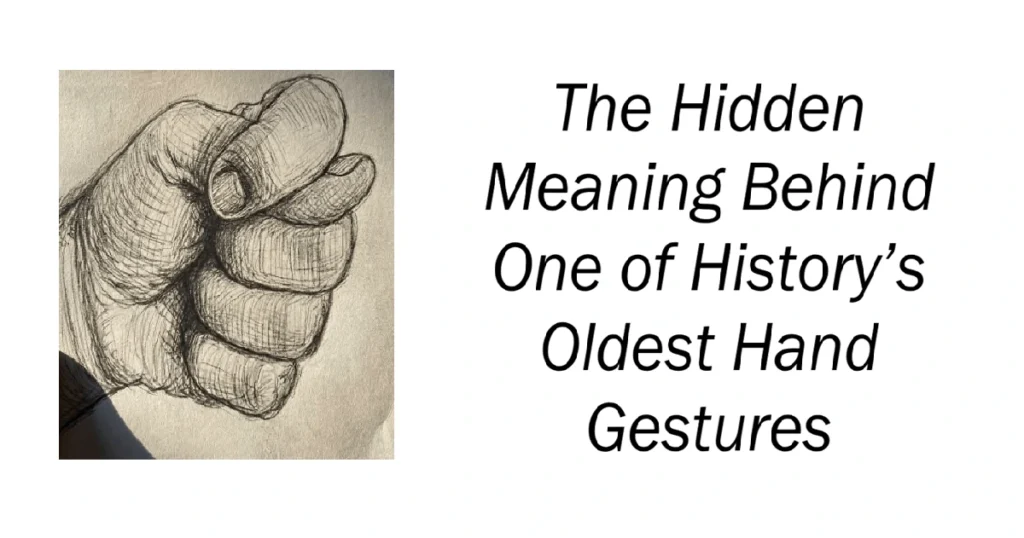
The Hidden Meaning Behind One of History’s Oldest Hand Gestures
At first glance, it looks like nothing more than a clenched fist. But take a closer look, and you’ll notice something unusual—the thumb is tucked between the index and middle fingers.
It’s a small detail, easy to miss. Yet that subtle positioning transforms an ordinary hand into one of the oldest symbolic gestures in human history.
This is known as the “fig” gesture—a sign that has quietly carried meaning across centuries, cultures, and social situations. And in many cases, it spoke louder than words ever could.
When Hands Spoke Louder Than Words
Long before texting, emojis, or even widespread literacy, people relied heavily on nonverbal communication. Gestures were more than just movements—they were a language of their own.
With something as simple as a hand sign, a person could express disagreement, refusal, humor, or even mild defiance—without ever creating open conflict.

The fig gesture was one of those tools.
With a quick, discreet motion, it could:
Politely refuse a request
Signal quiet disagreement
Lighten a tense moment with subtle humor
Maintain dignity without escalating a situation
Its true power came from shared understanding. If you knew, you knew.
A Quiet Symbol of Defiance in 19th-Century Europe
In parts of 19th-century Europe, where etiquette and composure were deeply valued, the fig gesture became a clever social shortcut.
Rather than openly arguing or risking embarrassment, people used it to set boundaries—silently.
It was especially useful in delicate social situations:
Minor power struggles
Unreasonable requests
Playful teasing that went just a bit too far
The beauty of the gesture lay in its subtlety. It allowed people to stand their ground while keeping the atmosphere calm and controlled.
More Than a Gesture: Protection and Symbolism
Beyond everyday communication, the fig gesture also carried deeper symbolic meaning.
In many traditions:
The closed hand represented inner strength
The hidden thumb symbolized protection
Some believed the gesture could ward off bad luck, envy, or unwanted attention. In certain communities, it even functioned as a small protective charm—used quietly in moments of uncertainty or farewell.
From Symbol to Family Tradition
Over time, the fig gesture softened in meaning and found its way into family life.
It became something playful. Familiar. Even affectionate.

Elders passed it down to children through jokes and games. It showed up in light teasing, shared laughter, and small, meaningful moments.
Sometimes, in emotional situations—like goodbyes at a doorstep or a train station—it served as a quiet form of reassurance, saying what words couldn’t.
Why This Gesture Still Matters Today
In today’s world of instant messages and digital reactions, the fig gesture feels like a reminder of something we’ve lost—a slower, more thoughtful way of communicating.
It represents ideas that still matter:
Confidence without aggression
Boundaries without confrontation
Humor without insult
Protection without fear
Even if the gesture itself is no longer widely used, the values behind it continue to resonate.
Because long before technology gave us new ways to speak, our hands already knew how.