This does not mean that every serving of cassava is dangerous. It means that cassava should not be treated as a food that can always be eaten raw or prepared casually.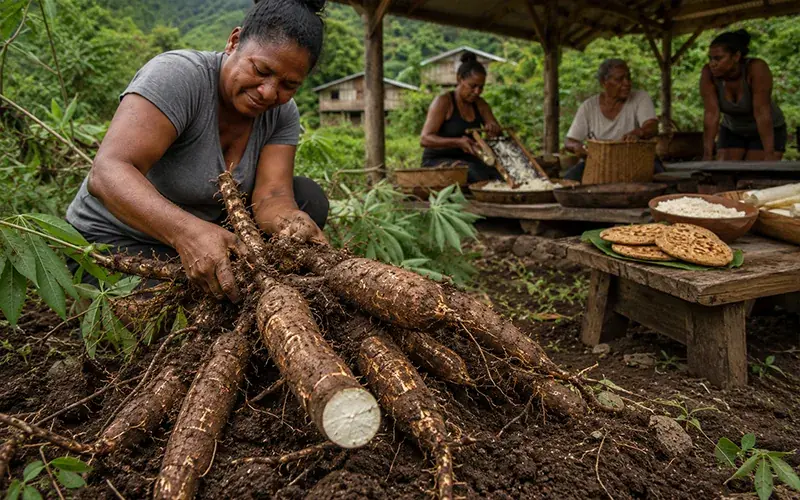
Chapter 4: Sweet Cassava and Bitter Cassava
Cassava is commonly described in terms of sweet and bitter varieties. The distinction is useful, but it should not be misunderstood as a guarantee of safety.
Sweet cassava generally has lower cyanogenic potential than bitter cassava. Bitter varieties can contain substantially higher levels and therefore require particularly careful processing.
However, taste alone is not a reliable safety test. The bitterness of a root does not provide a precise measurement of its cyanogenic content. A root that tastes less bitter should not automatically be assumed to be safe to eat raw or inadequately prepared.
Different varieties have been selected and cultivated for different purposes. Farmers may choose them based on yield, resilience, local conditions, taste, processing requirements, or market demand.
In some communities, bitter cassava is deliberately cultivated because it can offer useful agricultural characteristics. Its high cyanogenic content does not make it useless, but it does make correct processing essential.
The challenge is that the crop's safety depends on more than its name or appearance. Consumers may not know which variety they are buying, especially when roots are sold without clear labeling.
This is one reason traditional knowledge and reliable food-processing systems are so important. Farmers, processors, and households need to understand the preparation methods appropriate for the cassava they use.
A simple rule is worth remembering: do not assume that cassava is safe to eat raw, and do not rely on taste alone to determine whether it has been properly detoxified.
Chapter 5: How Cyanide Poisoning Can Affect the Human Body
Cyanide poisoning can interfere with the body's ability to produce energy. At a cellular level, cyanide blocks an important enzyme involved in the process by which cells use oxygen.
When this happens, organs that need a continuous supply of energy can be affected. The brain and heart are particularly vulnerable in severe exposure.
Symptoms can vary depending on the amount of cyanide involved and the speed of exposure. The World Health Organization lists possible signs of acute cyanide intoxication including rapid breathing, dizziness, headache, stomach pain, vomiting, diarrhea, confusion, and a drop in blood pressure.
Severe poisoning can progress to convulsions, coma, and death. The speed and seriousness of symptoms depend on the dose and individual circumstances.
Not every person who eats cassava will experience poisoning. Properly processed cassava is an important food for millions of people. The risk arises when cyanogenic compounds remain at dangerous levels in the food that is consumed.
This distinction is important because fear-based descriptions can make the crop sound inherently unsafe. That is not an accurate picture. The danger is real, but it can be reduced through appropriate processing and food-safety practices.
If someone develops symptoms after eating cassava that may have been improperly prepared, they should seek urgent medical attention. Suspected cyanide poisoning is a medical emergency. It should not be managed by trying home remedies or waiting to see whether symptoms disappear.
Chapter 6: Why More Than 200 Deaths a Year Is a Claim That Needs Context
The headline says that more than 200 people are killed by cassava every year. It is a striking figure, but the supplied article does not identify the research behind it.
That matters because deaths associated with cassava are not always recorded in a single, consistent global database. Acute cyanide poisoning may be difficult to identify where diagnostic facilities are limited. Cases may be reported locally, grouped with other causes, or missed entirely.
The World Health Organization has noted that available data are inadequate to make reliable global burden estimates for acute poisoning from cyanide in cassava. It does, however, recognize the association between high-cyanogenic cassava, insufficient processing, and serious health effects, including konzo.
Therefore, the figure of more than 200 deaths per year should not be presented as a confirmed worldwide total without a traceable source and a clear explanation of how it was calculated.
This does not reduce the seriousness of the problem. Even without a precise global annual death count, documented outbreaks and cases demonstrate that improperly processed cassava can cause severe poisoning.
The more useful question is how communities can prevent exposure. Accurate statistics are important for public health planning, but practical education, safe processing, access to water, and food security are equally important.
A headline can attract attention by giving a specific number. A responsible article must explain whether that number is verified, what period it covers, and what kind of deaths it includes.
Chapter 7: Why Almost 500 Million People Depend on Cassava
The headline also refers to almost 500 million people eating cassava. Estimates vary according to how consumption is defined and which regions are included. Some research and agricultural publications have described cassava as feeding hundreds of millions of people, with estimates ranging from around 500 million to much higher figures.
Cassava is particularly important in tropical regions where it is grown as a staple crop. It is a major food in many African countries and is also widely consumed in parts of Latin America and Asia.
For households that depend on it, cassava is not an unusual or occasional ingredient. It can be part of the daily meal, eaten alongside vegetables, beans, fish, meat, or sauces depending on local food traditions.
The crop's importance comes partly from its ability to grow in conditions that are difficult for some other staples. It can tolerate periods of drought and may produce a harvest when other crops perform poorly.
That resilience can be especially valuable to small-scale farmers. A crop that can survive difficult growing conditions may provide a measure of food security when rainfall is unpredictable.
Cassava also offers flexibility. It can be processed into products that are easier to store and transport than fresh roots. Flour, dried chips, and fermented foods allow households and communities to preserve part of the harvest.
The headline's estimate of almost 500 million consumers is therefore broadly consistent with the scale of cassava's global importance, although the exact figure should be treated as an estimate rather than a precise count of individual consumers.
Chapter 8: Why Cassava Is So Important in Parts of Africa
Cassava has a particularly important role in many African food systems. In several countries, it is eaten daily and contributes a substantial share of household calories.
The crop is attractive to farmers because it can grow in a range of soil and rainfall conditions. It can also remain in the ground for some time before harvesting, giving farmers flexibility when deciding when to collect it.