The string places pressure on the thumb during the draw and release. Repeated use can cause friction, discomfort, and injury. A protective ring helps shield the thumb and provides a surface against which the string can rest.
This is why historical archery thumb rings often look quite different from ordinary modern jewelry. Some are thick, curved, or shaped with a projecting section that helps guide the bowstring.
They were not simply decorative bands. Their design was connected to the mechanics of shooting a bow.
A tradition found across several regions
Historical thumb rings have been associated with Chinese, Mongolian, Ottoman Turkish, Mughal Indian, Persian, and other archery traditions.
Their shapes and materials varied. Some were simple cylinders, while others had more elaborate forms designed for particular methods of drawing the bowstring.
The National Gallery of Victoria notes that thumb rings were used across a number of cultures and that surviving examples include materials such as hard stone, amber, bone, ivory, shell, and metal.
The Musée de l'Archerie et du Valois also explains how these rings protected the thumb in archery techniques used in China and Mongolia.
This history is a reminder that the thumb ring was not originally invented as a modern symbol of independence. In many historical settings, it was a useful piece of equipment.
From practical equipment to prestigious ornament
Over time, the function of some thumb rings expanded beyond protection.
A plain ring made from a durable material could be suitable for practical use, while a finely decorated example made from jade, silver, or another valuable material could communicate wealth and status.
In certain historical settings, the ring became part of an elite visual culture. It could be admired as an object of craftsmanship, worn as an ornament, or associated with the prestige of archery and military skill.
This transition is not unusual in the history of clothing and accessories. Objects that begin as practical equipment can eventually become symbols of status or fashion.
The same broad pattern can be seen in riding boots, military jackets, workwear, and other items that have moved from functional use into everyday style.
The Chinese tradition of jade thumb rings
Jade is especially associated with Chinese decorative arts and historical objects.
The Royal Collection Trust describes a Chinese archer's thumb ring from the Qianlong reign, which lasted from 1736 to 1795. It was originally connected with the practical use of archery, but thumb rings continued to be worn as fashionable accessories after archery became less central to everyday life.
During the Qing dynasty, some Chinese literati wore thumb rings to suggest culture and wealth.
This is a fascinating example of how an object's meaning can change. A ring that once helped an archer draw a bow could later become a sign of refinement and social standing.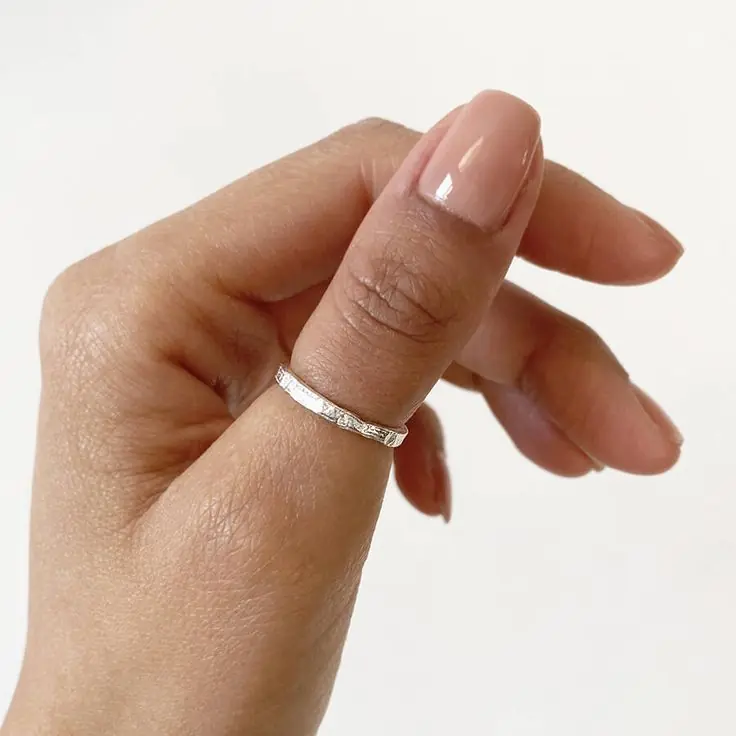
The Ottoman and Indian examples
Thumb rings also appear in collections of Islamic and South Asian art.
The Museum With No Frontiers describes an Ottoman thumb ring made from nephrite and decorated with rubies. It dates to the second half of the sixteenth century and is associated with the practical requirements of archery as well as the status and wealth of its owner.
The Walters Art Museum preserves a seventeenth-century Indian archer's thumb ring made from nephrite, gold, pearls, and gemstones. The museum explains that simpler materials such as wood, bone, and leather were used for practical protection, while elaborate examples could serve as gifts or ornaments rather than equipment intended for shooting.
These objects show that thumb rings could occupy several roles at once: useful tools, works of art, prestigious possessions, and expressions of cultural identity.
What the history tells us today
The historical record does not support the idea that thumb rings have always carried one single symbolic meaning.
Their meaning has changed according to time and place. In one context, the ring protected an archer's thumb. In another, it communicated wealth or refinement. In contemporary fashion, it may express individuality, identity, or simply personal taste.
The most interesting part of the history is not that the ring has one secret meaning. It is that people have repeatedly found new reasons to wear it.
Chapter 5: What Different Thumb Ring Designs Can Suggest
The ring shown in the supplied image has a broad, patterned band. Its geometric decoration gives it a distinctive appearance, somewhere between a simple everyday accessory and a more decorative statement piece.
Design can influence how a thumb ring is perceived, even though it does not create a universal symbolic code.
A plain silver band, for example, may look understated and modern. A large engraved ring can appear more traditional or dramatic. A gemstone design may suggest elegance, while a handmade piece can emphasize individuality.
Plain metal bands
A plain metal band is one of the most versatile choices.
It can be narrow and delicate or wide and substantial. A polished surface creates a clean, modern appearance, while a brushed or hammered finish gives the ring more texture.
Because the design is simple, the wearer can combine it with other jewelry without making the overall look feel crowded.
Some people choose a plain band because they want an everyday accessory that does not compete with their clothing. Others like the fact that a simple ring can become a personal signature through repeated wear.
Engraved and patterned rings
Engraving adds visual character. Geometric patterns, lines, symbols, and repeated motifs can make a ring feel more distinctive.
The ring in the photograph has a patterned surface that draws attention without relying on a large gemstone. This kind of design may appeal to someone who wants an accessory with texture and detail.
An engraved ring can also carry a private meaning. A wearer might choose a pattern connected with a place, family tradition, personal interest, or memory.
However, it is important not to assume that a particular geometric pattern has a specific cultural or spiritual meaning unless its origin is known.
Gemstone thumb rings
Gemstones can transform a thumb ring into a more formal piece of jewelry.
A small stone may create a subtle highlight, while a larger stone can become the main feature of an outfit. Different materials also create different impressions: dark stones can look dramatic, while lighter stones may feel delicate or understated.