Emergency warning signs parents should never ignore
Seek emergency medical help immediately if the child has any of the following:
Difficulty breathing or swallowing. This may indicate a serious allergic reaction or another emergency.
Swelling of the lips, tongue, or throat. Especially when accompanied by breathing problems, this requires urgent treatment.
A rash that does not fade when pressed. Red, purple, or dark spots that remain visible when pressure is applied can be a warning sign of a serious illness.
Unusual drowsiness or confusion. A child who is difficult to wake, unusually limp, or not responding normally needs immediate assessment.
A very high fever with a concerning rash. Fever combined with a rapidly worsening rash or a child who appears severely ill should not be managed at home.
Severe headache, neck stiffness, or repeated vomiting. These symptoms may indicate a condition that requires urgent evaluation.
Rapidly spreading redness with severe pain. Particularly when the skin is hot, swollen, or the child is becoming unwell.
The NHS advises immediate medical attention for children with breathing difficulty, a non-fading rash, or other signs of serious illness.
A parent should not delay emergency care to take photographs, measure the rash, or complete a checklist.
What if the rash is spreading but the child seems fine?
This is one of the most important situations in the original story.
A child may have no fever, no itching, and no obvious discomfort while an expanding rash develops.
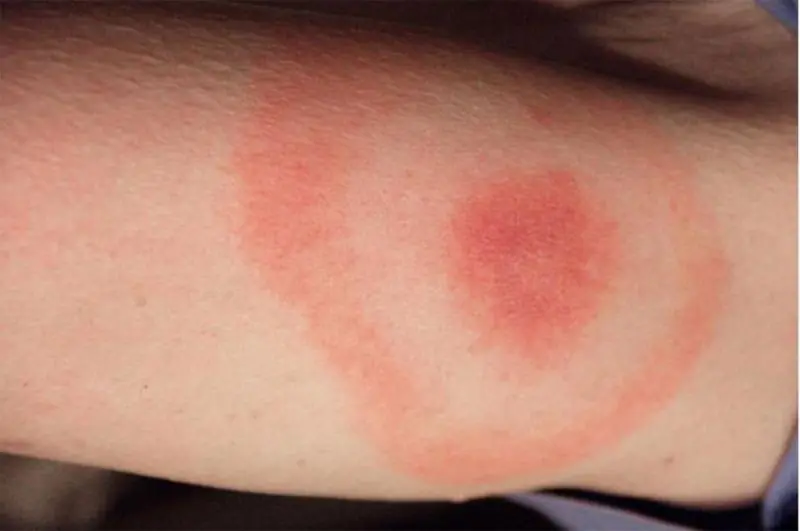
If the rash is gradually enlarging, particularly after outdoor activity in a region where Lyme disease occurs, the child should receive prompt medical evaluation.
The absence of symptoms does not rule out early Lyme disease.
The CDC recommends seeking medical attention when an expanding rash or other possible Lyme symptoms appear after a tick bite, exposure in an affected area, or travel to a region where Lyme disease occurs.
Parents should explain to the clinician:
-
When the rash was first noticed.
-
Whether it has become larger.
-
Whether the child has recently been outdoors.
-
Whether a tick was found or removed.
-
Whether the child has experienced fever, headache, fatigue, or muscle aches.
This information can help the clinician decide whether testing or treatment is appropriate.
Why a parent should not wait for a perfect bull's-eye
Some people believe Lyme disease always produces a perfectly round red ring with a pale center.
That is not true.
The rash may be solid red, reddish-purple, irregular, or only faintly circular.
Some lesions have a central crust. Others have no obvious central clearing.
The CDC's clinical images show several different appearances of erythema migrans, including lesions that do not resemble the familiar target pattern.
Waiting for the rash to develop a textbook appearance could delay diagnosis.
If the rash is expanding and tick exposure is plausible, medical advice should be sought even if the center remains red.
Can a doctor diagnose Lyme disease from the rash?
In some circumstances, yes.
When a patient has a characteristic expanding erythema migrans rash and a compatible exposure history, a clinician may diagnose early Lyme disease based on the clinical findings.
Blood tests may not be positive during the earliest stage of infection. Therefore, a negative early test does not necessarily exclude Lyme disease when the rash is strongly suggestive.
The decision to test or treat depends on the clinical situation and local medical guidance.
Parents should not order tests independently or interpret laboratory results without a healthcare professional.
The important point is that the rash, the child's symptoms, and the exposure history must be considered together.
What should parents do while waiting for an appointment?
If the child is stable and medical assessment is being arranged, parents can take several practical steps.
First, photograph the rash in good lighting.
Second, record the approximate diameter. A ruler placed beside the rash can help show its size without touching or irritating the skin.
Third, note when it appeared and whether the border has changed.
Fourth, check whether the child has developed fever, fatigue, headache, or other symptoms.
Fifth, avoid applying multiple creams or home remedies before the rash has been assessed.
If a tick is still attached, remove it promptly with fine-tipped tweezers by grasping close to the skin and pulling steadily upward. Avoid crushing the tick or using heat, petroleum jelly, or other substances to make it detach.
If possible, note the date and location of the bite.
These steps can help the clinician assess the situation more accurately.
Chapter 4: Understanding the Rash Through Pictures
The following photographs are examples of different ring-shaped skin conditions. They are included to help readers understand why similar-looking rashes may have different causes.
They are not photographs of the child in the headline, and they should not be used to diagnose a child at home.
A fungal rash may have a clearly defined border with dry or flaky skin. The center may look different from the outer edge.
Ringworm is generally treatable, but the correct antifungal medicine should be selected according to the location and severity of the infection.