Then the letters became less frequent.
A week passed without one. Then two. Isobel told herself that the mail was delayed. She knew the conditions could be unpredictable. She refused to interpret silence as a warning.
One afternoon, Benjamin's mother arrived at her home.
Isobel remembered the expression on her face before she remembered anything she said. The older woman looked as though she had spent the entire morning trying to prepare herself for a conversation she never wanted to have.
An Army officer had visited her house.
Benjamin was missing in action.
The words seemed impossible. Isobel asked what they meant, whether he had been wounded, whether someone had seen him, and whether there was any chance he might still be found.
Benjamin's mother had no answers.
For months, Isobel continued writing. She sent letters to the last address she had been given. She wrote to offices, asked questions, and searched every available notice. She kept the ring on her finger and refused to let anyone describe Benjamin in the past tense.
Then another letter arrived.
It stated that Benjamin was presumed dead.
There was no body to bury. No final goodbye. No place where Isobel could stand and say that the waiting was over.
The official words gave her a conclusion, but they did not give her peace.
She placed the letter in a drawer and sat beneath the willow tree until the evening became dark.
For the first time, she wondered whether a promise could survive when the person who made it might never return.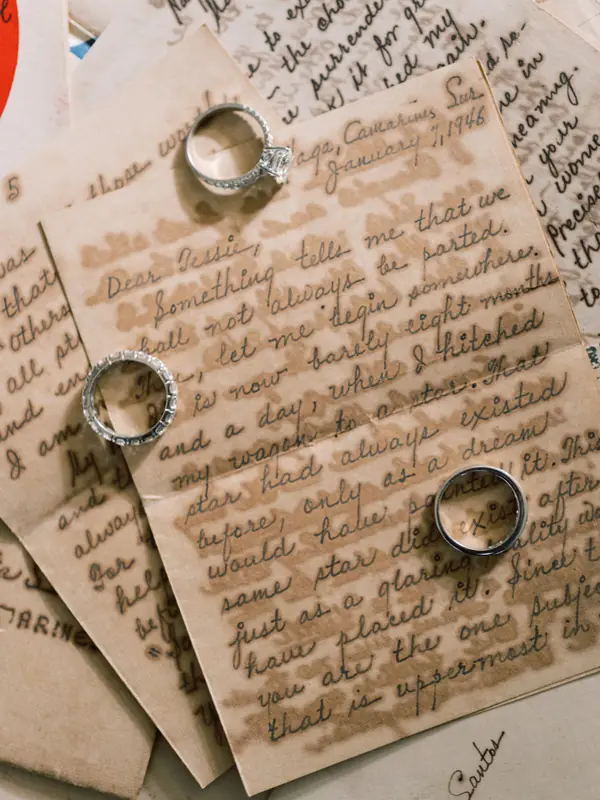
Sixty Years of a Life Built Around Love
People assumed Isobel would eventually move on.
At first, friends encouraged her to meet other men. They reminded her that she was young and that Benjamin would not have wanted her to spend her entire life alone.
She listened politely.
She even accepted a few invitations. She attended dinners, met acquaintances through friends, and once went on a weekend trip with a man who seemed genuinely kind.
But every time someone spoke about marriage, she felt as though she were being asked to erase a part of herself.
She did not believe Benjamin would return. She was not waiting beside a telephone every day, and she did not expect a letter to appear after all those years. Yet the love she had felt for him had become part of the person she was.
She could not manufacture a different feeling simply because other people thought she should.
Eventually, she stopped explaining.
She never married. She never had children of her own. Instead, she built a life around service, friendship, and the families who came into her world.
She helped neighbors care for their children. She volunteered at a children's hospital, where she learned how to comfort frightened parents and restless little ones. Later, she began reading stories to children receiving hospice care.
Every Thursday afternoon, she brought books.
Some children wanted fairy tales. Others preferred stories about animals, trains, or brave explorers. Isobel learned to adjust her voice, pause at the right moments, and make even the smallest room feel like a place where something wonderful could happen.
She discovered that children did not always need adults to explain difficult things. Sometimes they needed someone to sit beside them, hold their hand, and stay until they were ready to speak.
The work gave her a purpose.
There were days when she returned home exhausted, but she rarely regretted going. She had no children of her own, yet she had helped many families through difficult moments. Parents remembered her kindness. Former patients sometimes sent cards. A few children who had grown into adults continued to visit.
Isobel did not consider these relationships substitutes for the life she had imagined with Benjamin. They were simply meaningful in their own right.
She had learned that a life could contain grief and happiness at the same time.
But there was one ritual she never abandoned.
Every year, on Benjamin's birthday, she bought red carnations and walked to the old willow tree.
The school had changed over the years. New buildings had appeared. The path had been repaired, and the surrounding neighborhood had become busier. Yet the tree remained.
She would stand beneath its branches, place the flowers near the trunk, and remember the young man who had once promised to return.
Sometimes she spoke aloud.
Sometimes she simply stood in silence.
The silver ring remained around her neck on a thin chain. She had stopped wearing it on her finger decades earlier, but she could never bring herself to put it away.
It was not a symbol of a life she had failed to live.
It was a reminder of a promise that had mattered.
The Stranger Outside the Café
Last Tuesday would have been Benjamin's eightieth birthday.
Isobel woke early. She prepared tea, chose a warm coat, and placed a small bunch of red carnations in a paper sleeve.
She had planned to go directly to the willow tree, but on the way she passed a small café.
Through the window, she noticed a little girl laughing at something her mother had said. The child had ice cream on her chin and was trying unsuccessfully to keep it from dripping onto her sweater.
Isobel stopped.
The girl's laughter reminded her of the children she had read to over the years. It also reminded her of the family Benjamin and she had once imagined. She stood outside for a moment, smiling at the scene.
Then she noticed a reflection in the glass.
A man was standing behind her.
At first, she thought nothing of it. The pavement was busy, and people often stopped near the café entrance. But when she looked again, she saw his face.
Her heart seemed to stop.
The stranger had bright blue eyes.
His smile turned slightly to one side.
And beneath his chin was a small dimple that Isobel had spent decades remembering.
He looked about fifty, perhaps a little older. His hair was darker than Benjamin's had been when they were young, but his expression carried an unmistakable resemblance.
For a few seconds, Isobel could not move.
She told herself that grief could play tricks on memory. She had seen people who reminded her of Benjamin before. A certain walk, a familiar voice, or a similar profile could make her turn around unexpectedly.
But this was different.
The stranger seemed to recognize her.
He approached slowly, as though he were afraid that a sudden movement might frighten her away.
“Are you Isobel?” he asked.
She nodded, unable to form a complete sentence.
“My name is Edward,” he said. “I've been trying to find you.”
Isobel looked at him carefully.
“Do I know you?”
Edward swallowed.
“Not personally. But I think you knew my father.”