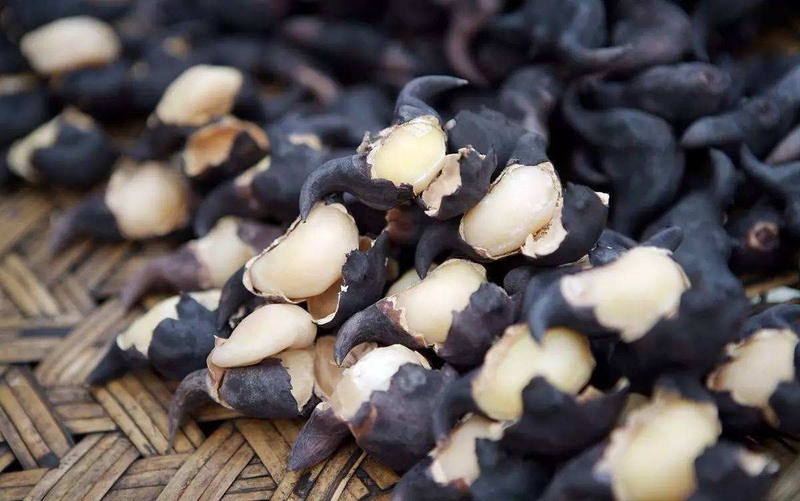
At first glance, the strange black fruits in the photograph almost look like something from another planet.
They have dark, hard shells, pointed horns, and irregular shapes that make them difficult to recognize as something edible. If someone handed you a plastic bag full of them without explanation, it would be completely understandable to wonder:
What exactly are these things and how are you supposed to eat them?
The fruits shown in the image appear to be water caltrops, also commonly called water chestnuts, buffalo nuts, bat nuts, or devil's nuts, depending on the species and region. They belong to the genus Trapa and grow in freshwater environments.
Their unusual appearance is one of the reasons they are so fascinating. Despite looking hard and intimidating on the outside, the inside contains a white, starchy kernel that has been eaten in parts of Asia and other regions for generations.
But there is an important point to understand before trying them:
You shouldn't simply wash one and bite into it raw.
Proper identification, cleaning, and cooking are important, particularly because freshwater plants and fruits can potentially carry microorganisms or parasites when consumed raw.
What Are Those Strange Horned Fruits?
The fruits in the photograph have a distinctive appearance.
They are dark brown to almost black on the outside, with a hard shell and curved projections resembling horns.
This unusual shape is characteristic of water caltrops.
Water caltrops are aquatic plants that grow in ponds, lakes, slow-moving waterways, and other freshwater environments. Their fruits develop underwater and eventually become hard, woody structures.
Depending on the species, the fruit may have two, three, or four prominent projections.
That's why people around the world have given them memorable names.
Some varieties are known as:
-
Water caltrop
-
Horned water chestnut
-
Buffalo nut
-
Bat nut
-
Devil's nut
-
Singhara
The exact common name varies considerably from one country or region to another.
Why Do They Look Like Little Horned Animals?
The strange shape isn't accidental.
Those hard projections are part of the plant's reproductive strategy.
When the fruit matures, its shape and weight help it interact with the surrounding environment and eventually contribute to the plant's reproduction.
The hard exterior also protects the edible seed inside.
From a human perspective, however, the horns create one immediate problem:
They're not exactly easy to peel.
Unlike an apple or peach, you can't simply bite through the skin.
The shell is hard and woody, so the fruit needs to be opened carefully.
What Is Inside?
This is where the surprise comes in.
Inside the dark shell is a relatively pale, firm, starchy edible portion.