That distinction protects people from unrealistic expectations.
Why the Plant Fits Small Homes So Well
Now we can return to the original question.
Why is this one plant worth considering even when your home is tiny?
Because it solves several small-space problems at once.
It grows vertically
That saves floor space.
It tolerates lower light
That makes it suitable for some rooms with limited sunlight.
It does not require frequent watering
That makes it practical for busy people.
It comes in many forms
You can find varieties that suit different interiors.
It adds greenery without creating visual clutter
Its upright structure can actually make a space feel more organized.
One Plant Can Be Enough
You don't need twenty plants.
You don't need hanging baskets everywhere.
You don't need a greenhouse.
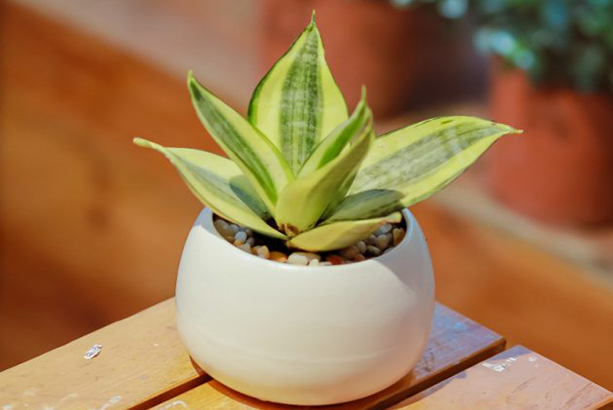
One healthy snake plant in the right location can become a focal point.
Place it near a piece of furniture.
Use a simple pot that matches your interior.
Let the plant grow naturally.
The result can be surprisingly elegant.
In small homes, restraint is often more effective than abundance.
How to Make a Tiny Home Feel More Green Without Making It Crowded
Think vertically.
Use narrow plant stands.
Choose upright plants.
Keep walkways clear.
Use windowsills carefully.
Place greenery in corners rather than directly in the middle of already crowded spaces.
And choose plants that don't demand constant care.
That's where the snake plant becomes such a practical option.
It gives you the feeling of greenery without requiring an enormous amount of space.
A Simple Care Routine
For beginners, the routine can be surprisingly easy.
Step 1: Give It Suitable Light
Bright indirect light is excellent, but the plant can tolerate lower light.
Step 2: Use a Pot With Drainage
This is essential.
Step 3: Use Fast-Draining Soil
Avoid soil that stays saturated for long periods.
Step 4: Let the Soil Dry Between Waterings
Do not water automatically just because a certain number of days has passed.
Step 5: Wipe Dust From the Leaves
Large upright leaves can collect dust.
A gentle wipe can help keep them looking clean.
Step 6: Watch for Pests or Soft Leaves
Early detection makes problems easier to manage.
That's it.
No complicated daily routine.
The Biggest Myth to Avoid
Perhaps the most important thing to remember about snake plants is this:
They are hardy, but they are not magical.
They won't eliminate every indoor pollutant.
They won't fill your bedroom with dramatically more oxygen.
They won't cure allergies.
They won't replace ventilation.
They won't replace medical treatment.
But none of that makes them less useful.
A plant doesn't have to perform miracles to earn a place in your home.
Sometimes being beautiful, adaptable, and easy to care for is enough.
The Bottom Line
If you're living in a small house, apartment, studio, or bedroom and still want a little greenery, a snake plant can be one of the most practical choices.
Its upright growth takes up relatively little floor space.
It can tolerate lower-light conditions better than many houseplants.
Its leaves store water, making it more tolerant of dry periods.
And its care requirements are generally simple, especially compared with more demanding indoor plants.
You may also hear claims that snake plants dramatically purify indoor air or produce large amounts of oxygen at night. There is some scientific background behind why the plant became associated with those ideas, including research into plant-based removal of certain compounds under controlled conditions and the unusual CAM photosynthesis of some snake plants. However, those effects should not be exaggerated into claims that a houseplant can replace good ventilation, filtration, or medical treatment.
The practical benefits are already enough.
A snake plant can turn an empty corner into something alive.
It can add texture and color without crowding the room.
It can fit beside furniture where a larger plant would be inconvenient.
And it can be surprisingly forgiving when life gets busy.
Just remember the most important care rule:
Don't love it to death with too much water.
Give it appropriate light.
Use a pot with drainage.
Let the soil dry between waterings.
Keep it out of reach of pets that may chew it.
And let it grow at its own pace.
No matter how small your home is, you don't need a massive garden to create a little connection with nature.
Sometimes one tall green plant in the right corner is enough to make the whole room feel different.