If it contained the agreement, it might explain why the name appeared.
If it contained something else, the investigators would need to reconsider the purpose of the men’s visit.
Why the original mattered
A photocopy can preserve the words on a page, but it may not preserve every detail.
The original could reveal whether a signature had been added later, whether a page had been attached, or whether a handwritten note had been altered.
It might also show a watermark, stamp, paper type, or other feature that could help establish its origin.
That is why the men may have wanted the original rather than Margaret's copies.
But wanting a document does not prove what someone intended to do with it.
The same original could be sought by a person trying to expose wrongdoing, a person trying to conceal it, or someone who simply wanted to protect a family member.
The folder could point investigators toward a question.
It could not answer every question by itself.
Chapter 9: The Family Begins Asking Questions
Margaret's family had never been told about the motel meeting.
They knew she had been worried. They knew she had received unusual letters. But they did not know that she had traveled with a folder of documents or that three men had come to her room.
The first person to discover the connection was Laura, her niece.
Laura had been asked to collect Margaret's personal belongings. The motel manager handed her a handbag, a small suitcase, and a sealed envelope containing the room key and a receipt.
At first, Laura thought the folder was simply a collection of old paperwork.
Then she noticed the names.
One belonged to a company Margaret had mentioned only once. Another appeared on a letter Laura remembered seeing in her aunt's home. A third was unfamiliar, but it appeared repeatedly beside handwritten dates.
Laura began reading.
The deeper she went, the more she realized that Margaret had been carrying a story she had never shared with her family.
The photograph
Among the papers was an old photograph of several people standing outside an office building.
Margaret had written a date on the back.
There were no names.
Laura recognized one person immediately: a man who had visited the family years earlier and had always been introduced as an old business associate.
She remembered that he had spoken to Margaret privately before leaving.
At the time, Laura had assumed they were discussing work.
Now she wondered whether the photograph had been kept because it connected the people in the picture to the disputed records.
The photograph did not prove anything.
But it gave the family another reason to ask who had known about the documents and when.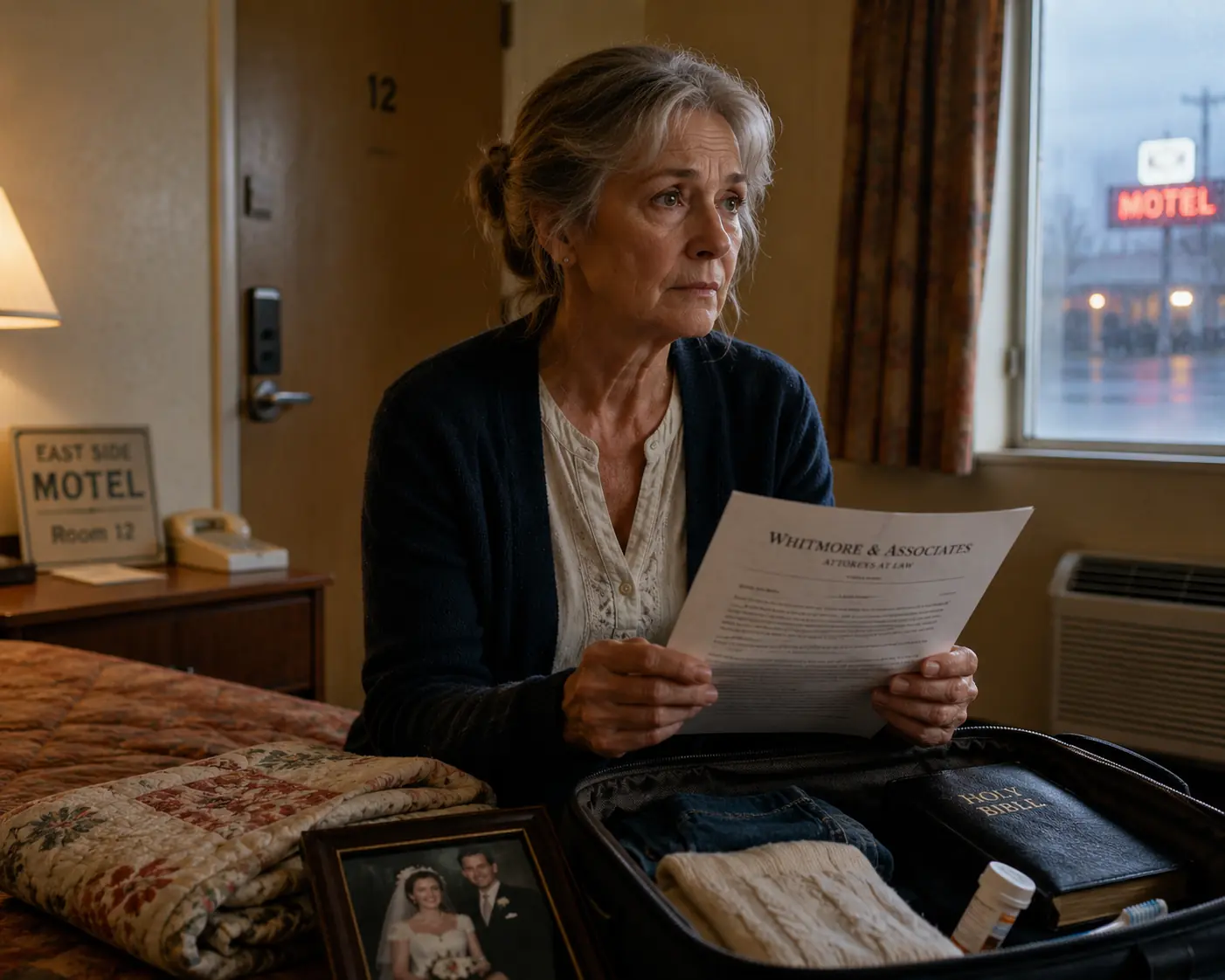
The phone call Margaret never made
Laura also found a note with a telephone number and a short instruction:
Call before sending anything.
There was no name beside the number.
The note appeared to have been written shortly before Margaret checked into the motel.
Laura tried calling it, but the number was no longer active.
She then contacted the person who had originally sent the letters. The response was brief: the sender said they had wanted Margaret to provide a copy of the disputed statement, not the original.
They claimed they had not arranged for anyone to visit the motel.
That answer created a new problem.
If the letter writer had not sent the three men, who had?
A family divided by uncertainty
Some relatives wanted to turn the documents over immediately.
Others believed the papers should remain private until their meaning was clear.
One family member argued that Margaret had spent years protecting the records and that handing them to an unknown person would betray her wishes.
Another said that the documents might contain information that could help explain what happened at the motel.
Laura found herself caught between the two positions.
She wanted the truth, but she did not want to make the same mistake Margaret had made: trusting someone simply because they claimed to have a good reason.
The family eventually agreed to keep the papers together and make an inventory before deciding what to do.
It was the first time they had approached Margaret's secret as a shared responsibility.
Chapter 10: Reconstructing the Final Evening
The motel's records offered a starting point.
Margaret had checked in during the afternoon. She had paid for one night and requested a room away from the main entrance.
The receipt showed no unusual purchases.
The parking lot camera recorded several vehicles entering and leaving, but the footage was not clear enough to establish every driver's identity.
The hallway camera showed three men approaching Room 18.
It also showed that they remained there for a period before leaving.
What the recording did not show was what happened inside.
The timeline
The fictional investigators began by separating the evening into confirmed and uncertain moments.
They could establish that Margaret had arrived, entered the room, and remained there for several hours.
They could establish that three men later came to the room.
They could establish that the men eventually left.
But they could not immediately determine what was said, whether there had been an argument, or whether Margaret had experienced a medical emergency.
The missing envelope added another complication.
No one could say with certainty when it had disappeared.
The room itself
Room 18 contained Margaret's handbag, the brown folder, a notebook, and several personal belongings.
The folder had not been completely emptied.
Some papers remained in the order in which Margaret had arranged them.
The notebook contained dates and reminders, but no complete explanation of the meeting.
The room did not provide an easy answer.
There was no single note that explained why the men had come or what had happened after the door closed.
The motel staff
The night manager remembered seeing three visitors but could not provide a detailed account of their conversation.
He said the men had not created an obvious disturbance in the corridor.
Another guest remembered hearing voices but could not distinguish the words.
The staff had no reason to believe that a serious incident was taking place inside the room.
That detail would later trouble Laura.
She wondered how something so consequential could have happened in a place where other people were only a few doors away.
But a quiet corridor does not reveal what is happening behind a closed door.
Nor does the absence of a disturbance establish that nothing serious occurred.
The unanswered question
The central question remained the same:
Why had Margaret refused to give the men the documents?
She might have believed they were not entitled to them.
She might have suspected that they intended to destroy or alter the records.
She might have wanted to give the papers to an independent lawyer instead.
Or she might have known something about the original envelope that the men did not.
The story does not provide a definitive answer.
What it does show is that Margaret had prepared for the possibility of being pressured. She had arranged her papers, written instructions, and kept the original document separate from the copies.
She had not entered the motel without thinking about the risks.
Chapter 11: The Difference Between a Suspicion and an Answer
As the fictional story spread online, the details became simplified.
Some posts described Margaret as a woman who had refused to cooperate with three men. Others suggested that the men had come to silence her. Still others focused on the old business records and described the incident as the result of a long-running conspiracy.
The problem with those versions was that they turned unanswered questions into conclusions.
The available story does not establish that the three men caused Margaret's death.
It does not establish that the missing envelope contained evidence of a crime.
It does not establish that the old property transactions were illegal.
And it does not establish that Margaret was killed because she refused to hand over the folder.
Those are possible directions for a fictional investigation, but they are not proven facts within the narrative.
Why careful language matters
A mystery becomes more compelling when the reader understands exactly what is known and what remains uncertain.
If a story announces a culprit before presenting the evidence, it removes the central question.
If it describes every unexplained detail as proof of a conspiracy, it becomes difficult to distinguish evidence from speculation.
Margaret's story is unsettling precisely because the pieces do not fit together neatly.
The men came to the motel.
Margaret refused to give them the papers.
She was later found dead.
An envelope was missing.
Those events form a disturbing sequence, but the sequence alone does not establish causation.
The missing details matter.
What an independent review might examine
Within the fictional investigation, an independent review would need to examine several categories of evidence.
First, the original business records would need to be compared with Margaret's copies. This could establish whether the documents were complete and whether any dates or amounts had been changed.
Second, the communications between Margaret and the letter writer would need to be reviewed. That might help establish who knew about the folder and who arranged the motel meeting.
Third, the three men's accounts would need to be compared. Differences in their explanations could reveal whether they had coordinated their visit or whether each believed he was acting for a different purpose.
Finally, the timeline surrounding Margaret's death would need to be established through appropriate records and professional findings.
Without those steps, the most dramatic explanation would remain only a theory.
Chapter 12: The Envelope That Could Change Everything
Several days after Laura began reviewing the folder, she noticed something unusual about the notebook.
The final page had been folded inward.
When she carefully opened it, she found a short entry written in Margaret's familiar handwriting:
The original is not where they think it is.
Below it was another sentence:
If they come for the folder, let them take the copies.
Laura read the words repeatedly.