At first glance, this mathematical puzzle looks almost too simple to be challenging. It contains just a few equations, familiar numbers, and one missing answer. There are no complicated fractions, long calculations, or advanced mathematical formulas. Yet many people find themselves staring at the final line, trying to figure out what the numbers are really telling them.
The challenge is not necessarily about how quickly you can add two numbers together. Instead, it is about recognizing a hidden pattern that connects every equation.
Take a look at the sequence:
-
6 + 6 = 125
-
5 + 5 = 104
-
4 + 4 = 83
-
3 + 3 = 62
-
2 + 2 = ?
Most people immediately notice that the equations do not follow ordinary addition. After all, six plus six is twelve, not 125. Five plus five is ten, not 104. The answers appear unusual, but they are not random.
There is a consistent relationship between the numbers on the left and the two digits on the right. Once you identify that relationship, the final answer becomes much easier to calculate.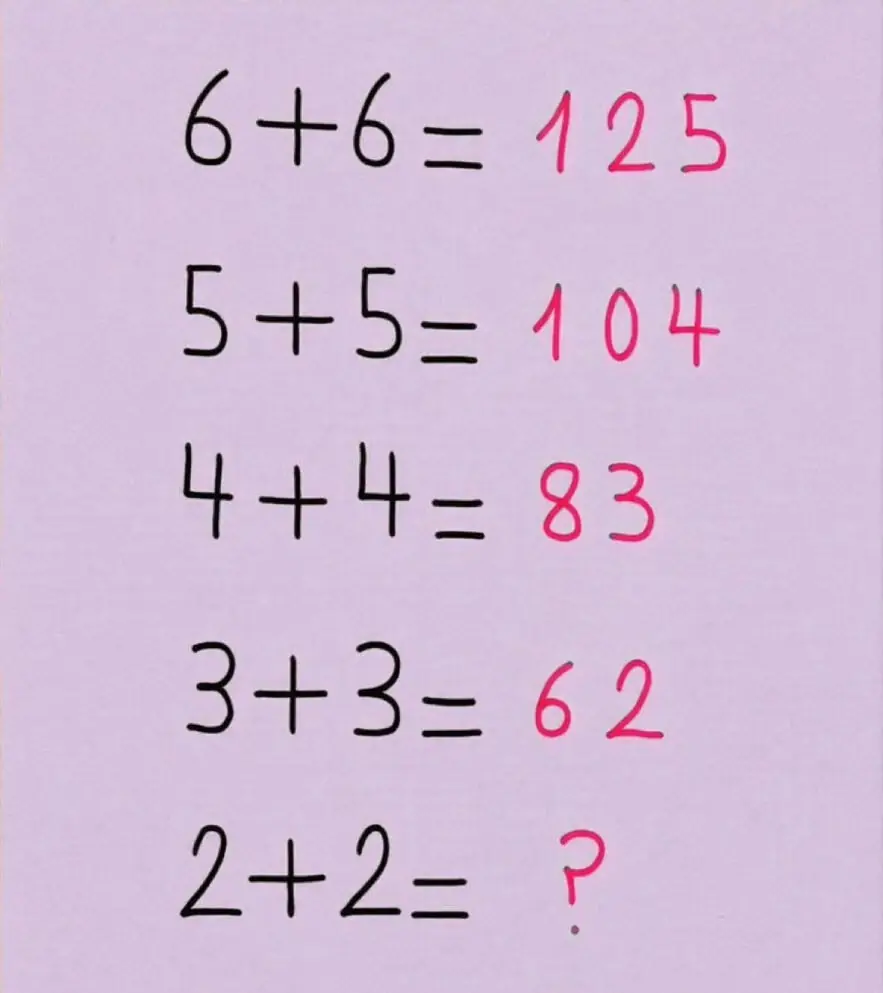
Chapter 1: Why This Puzzle Is More Difficult Than It Looks
One reason this puzzle catches people's attention is that it uses a familiar mathematical operation in an unfamiliar way.
We learn addition at an early age. When we see an expression such as 6 + 6, our brains automatically produce the answer 12. That reaction is perfectly natural, but it can also make us overlook a different kind of mathematical pattern.
In this puzzle, the first equation gives us 125. Rather than treating that result as an ordinary number, we can examine it as two separate parts: 12 and 5.
The next equation gives us 104, which can similarly be separated into 10 and 4.
The third gives us 83, and the fourth gives us 62.
Looking at the results this way reveals something interesting:
-
6 + 6 produces 12 and 5.
-
5 + 5 produces 10 and 4.
-
4 + 4 produces 8 and 3.
-
3 + 3 produces 6 and 2.
The first part of each answer is the ordinary sum of the two numbers. The second part is one less than the number being added.
That observation provides the foundation for solving the puzzle.
Chapter 2: Finding the Hidden Mathematical Rule
Let's examine the first equation carefully.
6 + 6 = 125
The ordinary sum of six and six is 12. That explains the first two digits of the answer.
But where does the final digit, 5, come from?
It is simply one less than 6.
Therefore:
12 followed by 5 becomes 125.
Now consider the second equation:
5 + 5 = 104
Five plus five equals 10. One less than 5 is 4.
Put those two results together, and we get 104.
The same method works with the third equation:
4 + 4 = 83
Four plus four equals 8, while one less than 4 equals 3. Combining them gives 83.
Finally:
3 + 3 = 62
Three plus three equals 6, and one less than 3 equals 2. The resulting number is 62.
At this point, the pattern is consistent across all four examples.
The puzzle is using two simple operations:
-
Add the two identical numbers together.
-
Subtract one from either of the original numbers.
Then place the two results next to each other to form the final answer.
Chapter 3: Solving the Missing Number
Now we can return to the final equation:
2 + 2 = ?
Using the same rule, we start with ordinary addition.
Two plus two equals 4.
Next, subtract one from the original number:
2 − 1 = 1.
Finally, place the results side by side.
The first result is 4. The second result is 1.
Therefore, the missing number is:
2 + 2 = 41
Chapter 4: What Makes Visual Number Puzzles So Interesting?
Puzzles like this are popular because they encourage people to question their first assumptions.
When we encounter a mathematical expression, we generally expect it to follow familiar arithmetic rules. If an answer does not match what we learned in school, we may assume there is a mistake.
However, many number puzzles are designed around alternative patterns. They challenge us to look beyond the obvious operation and examine how the examples relate to one another.
The important skill is not simply calculating an answer. It is identifying a rule that explains every example consistently.
That distinction matters.
For instance, someone might suggest a complicated formula that produces the correct final answer. But if that formula does not explain all the earlier equations, it is probably not the intended solution.
A strong solution should satisfy three conditions:
-
It should explain every equation already provided.
-
It should use the same rule consistently.
-
It should produce a clear answer for the missing number.
The pattern in this puzzle meets those conditions.
There is also an important lesson about visual reasoning. When numbers are presented in a sequence, the way they are written can sometimes be just as important as their numerical values.