Chapter 1: What Happens Inside Your Stomach When You Sleep on Your Right Side?
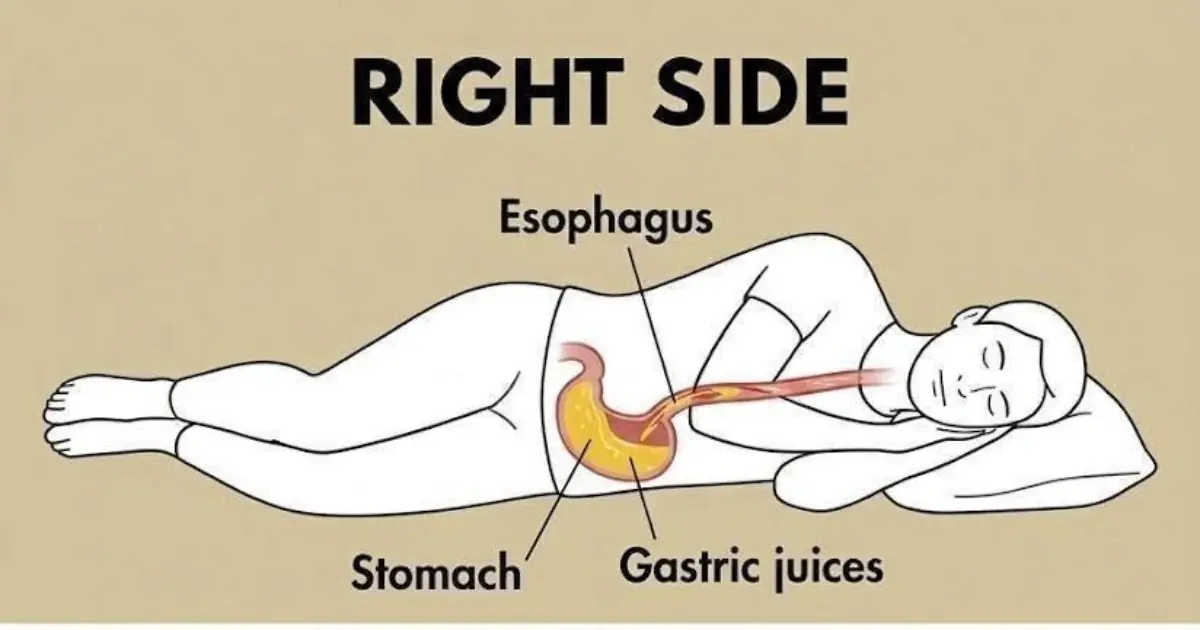
After a long day, most people simply climb into bed, find a comfortable position, and fall asleep. Some prefer lying on their backs, while others instinctively turn toward the left or right side.
Although sleeping positions may seem like a matter of personal preference, they can influence certain processes inside the body.
One particularly interesting example involves the digestive system.
The stomach is responsible for receiving food, mixing it with digestive juices, and gradually releasing partially digested material into the small intestine. It performs this work throughout the day and continues functioning even when someone is asleep.
However, lying down changes the relationship between the stomach, the esophagus, and gravity.
This is especially important for people who experience gastroesophageal reflux disease, commonly known as GERD.
Understanding the connection between the stomach and esophagus
The esophagus is a muscular tube that carries food from the mouth to the stomach.
At the point where these two structures meet, there is a muscular mechanism called the lower esophageal sphincter.
This mechanism acts as a barrier that helps prevent stomach contents from flowing backward.
Under normal circumstances, it relaxes when someone swallows and then closes again.
The stomach also contains highly acidic digestive juices that help break down food and support digestion.
These juices are supposed to remain inside the stomach.
However, the lower esophageal sphincter does not always prevent every episode of backward movement.
When stomach contents travel into the esophagus, the process is called gastroesophageal reflux.
If reflux occurs frequently and produces troublesome symptoms or complications, it may be diagnosed as GERD.
Why can sleeping position make a difference?
When someone lies down, gravity no longer helps keep stomach contents in the same position as when they are standing or sitting.
The orientation of the stomach changes relative to the opening of the esophagus.
This can influence how easily stomach contents reach the lower esophageal sphincter.
Research has found that sleeping on the right side can increase nighttime acid exposure in the esophagus compared with sleeping on the left side among people with reflux.
One explanation is anatomical.
When a person lies on the right side, the position of the gastroesophageal junction relative to the pool of stomach contents may make reflux more likely.
When the person lies on the left side, the relationship between the stomach contents and the esophageal opening is generally more favorable for reducing reflux.
This does not mean that stomach acid suddenly becomes dangerous whenever someone turns to the right.
The stomach is designed to contain acidic digestive fluids.
The concern is what happens when those fluids move into the esophagus, whose lining is not designed to tolerate repeated exposure to stomach acid.
What might someone experience after sleeping on the right side?
People who are prone to nighttime reflux may notice several symptoms:
-
A burning sensation in the chest.
-
A sour or bitter taste in the mouth.
-
Fluid moving upward toward the throat.
-
Repeated burping.
-
A feeling of irritation in the throat.
-
Coughing or disturbed sleep.
These symptoms may become more noticeable after a large evening meal.
Some people wake up during the night because of heartburn, while others experience discomfort when they first get out of bed.
However, not everyone who sleeps on their right side experiences these problems.
People without reflux disease may notice no difference whatsoever.
Why the original illustration matters
The image compares the stomach's position when someone lies on the right and left sides.
It attempts to show how the relationship between the stomach and esophagus changes depending on body position.
Although the illustration simplifies a complicated anatomical process, its central message is supported by medical research: left-side sleeping can reduce nighttime reflux in people who experience GERD.
The American College of Gastroenterology recognizes left-side sleeping as a useful lifestyle measure for managing nighttime reflux symptoms.
The most important takeaway is that sleeping position is not just about comfort.
For some people, it can influence how frequently stomach contents move into the esophagus during the night.
Understanding this connection may help explain why someone experiences heartburn more frequently in one sleeping position than another.
And the difference between the two sides is particularly interesting when we look at what happens to stomach acid during sleep.
Chapter 2: Why Sleeping on Your Left Side May Be Better for People With Acid Reflux
For people who regularly experience heartburn, changing sleeping positions may be a simple adjustment worth considering.
The left-side position has attracted attention from digestive health specialists because research suggests that it can reduce the amount of stomach acid reaching the esophagus during sleep.
But why does this happen?
The answer lies in the natural shape and position of the stomach.
1. The stomach is not positioned symmetrically
The stomach is located mainly in the upper-left portion of the abdomen, although its exact position and shape vary between individuals.
It connects to the esophagus at its upper entrance and continues toward the small intestine through its lower outlet.
When someone lies on the left side, the stomach's orientation changes in a way that generally keeps the gastroesophageal junction above much of the stomach's contents.
This makes it more difficult for stomach contents to flow backward toward the esophagus.
By comparison, lying on the right side can place the gastroesophageal junction in a more dependent position relative to the stomach's contents.
This may make reflux episodes more likely in susceptible individuals.
The difference is not that the stomach stops producing acid when someone lies on the left.
Acid production continues as part of normal digestion.
Instead, the position may influence whether stomach contents reach the esophagus and how quickly the esophagus clears them.
2. Left-side sleeping may shorten acid exposure
One important factor in reflux is how long acid remains in contact with the esophageal lining.
The esophagus has natural mechanisms for clearing refluxed material.
Swallowing produces muscular movements that help move material back toward the stomach. Saliva also helps neutralize some of the acid.