Non-stick cookware has become a kitchen staple because it makes cooking easier, reduces the need for oil, and simplifies cleanup. From frying eggs and pancakes to preparing vegetables and sauces, a non-stick pan can be incredibly convenient.
But what happens when that smooth coating becomes scratched, chipped, or visibly worn?
This is a question many people have, especially when they notice small flakes coming away from an old frying pan or when the surface of a rice cooker pot begins to deteriorate.
The concern is understandable. If the coating is damaged, could tiny particles end up in your food?
The answer depends on what type of coating the cookware has, how badly it is damaged, and how the cookware is being used. Modern non-stick coatings are designed for food contact, but a visibly deteriorating surface is a good reason to reconsider continued use.
Importantly, claims that a scratched pan automatically causes someone to consume a specific number of microplastic particles every day should be treated cautiously. The amount released can vary greatly, and exposure estimates depend on the material, condition of the coating, cooking method, and other factors.
So rather than panicking about one scratch, it is more useful to understand what non-stick coatings are, why they can deteriorate, and when replacement makes sense.

What Is the Coating on a Non-Stick Pan?
The term “non-stick cookware” covers several different materials and technologies.
Traditional non-stick pans commonly use coatings based on polytetrafluoroethylene (PTFE), a fluoropolymer known for its low-friction surface.
PTFE has been used in cookware for decades because food generally does not stick easily to it.
Other cookware uses ceramic-based or other non-stick coatings, which can have different compositions and properties.
This distinction matters because the phrase “non-stick coating” does not refer to one single chemical substance.
Before deciding whether a damaged pan is safe to continue using, it is therefore useful to know what type of cookware you actually have.
What Happens When the Surface Gets Scratched?
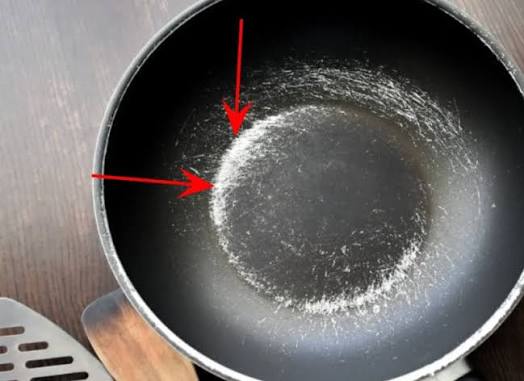
A scratch can occur when someone uses a metal spatula, knife, fork, abrasive cleaning pad, or another hard object on the surface.
Minor scratches may not immediately change how the pan performs.
However, repeated damage can gradually cause the coating to deteriorate.
You might notice:
-
Visible scratches
-
Areas where the surface looks thinner
-
Peeling or flaking
-
Chips around the edges
-
Discoloration
-
Food beginning to stick
-
Uneven areas on the cooking surface
The more severe the deterioration becomes, the less reason there is to continue using the cookware.
A pan that is simply showing minor cosmetic wear is different from one where large sections of coating are visibly peeling away.
Can Tiny Particles Come Off the Coating?
Yes, damaged non-stick coatings can shed particles.
Research has examined the release of microscopic and larger particles from deteriorating polymer-coated cookware.
The important question, however, is what those particles mean for human health.
It is tempting to assume:
“If a particle enters my food, it must be dangerous.”
But toxicology is more complicated.
Risk depends on the material, quantity, particle size, exposure route, chemical properties, and what happens to the material inside the body.
Not every particle that is swallowed produces a harmful biological effect.
What About Microplastics?
The term microplastics generally refers to very small plastic particles, often defined as particles smaller than 5 millimeters.
Some studies have raised concerns that damaged polymer-coated cookware can contribute microscopic particles to food.
However, this should not be interpreted as meaning that every scratched pan produces a known or dangerous daily dose of microplastics.
Exposure estimates can differ dramatically depending on experimental conditions.
A laboratory experiment may use aggressive mechanical abrasion that does not resemble ordinary home cooking.
Similarly, a heavily damaged pan may behave differently from one with a single superficial scratch.
That is why sensational claims involving a precise number of particles should be viewed carefully unless the number is supported by a well-designed study under realistic conditions.
Is Accidentally Swallowing a Small Flake Dangerous?
If a tiny piece of a conventional PTFE coating is accidentally swallowed, the material itself is generally considered to have low chemical reactivity and low toxicity when ingested.
PTFE is highly stable under normal food-use conditions.
That does not mean a badly damaged pan should be used indefinitely.
The issue is less about one accidental flake and more about continued deterioration and unnecessary exposure.
If the coating is visibly peeling, repeatedly shedding material, or becoming damaged across a large area, replacing the cookware is a sensible precaution.
The Bigger Concern: Overheating
For traditional PTFE-coated cookware, excessive heat is a more important safety issue than an ordinary scratch.
PTFE is designed to be used at normal cooking temperatures, but if the pan is severely overheated—particularly when empty—the coating can begin to break down and release fumes.
This is one reason manufacturers generally advise against preheating an empty non-stick pan over very high heat.
A pan left unattended on a burner can become extremely hot.
Under severe overheating conditions, the fumes can irritate the respiratory system and, in people exposed to high concentrations, can cause a temporary flu-like illness sometimes referred to as polymer fume fever.
Birds are particularly sensitive to certain fumes produced by overheated fluoropolymer coatings.
So one of the simplest rules for non-stick cookware is:
Avoid extreme heat, especially with an empty pan.
Don't Heat an Empty Non-Stick Pan for Too Long
This is an easy mistake to make.
Someone may place a pan on the stove, turn the burner to high, and then walk away to prepare ingredients.
By the time they return, the cookware may have become much hotter than intended.
Instead, add food or cooking ingredients promptly and use moderate heat whenever possible.
Non-stick cookware generally performs well without extremely high temperatures.
There is rarely a need to turn the burner to maximum simply because you are using a non-stick pan.
Metal Utensils Can Accelerate Damage
One of the easiest ways to extend the life of non-stick cookware is to use utensils that are less likely to scratch the surface.
Wooden, silicone, or other cookware-compatible utensils are generally preferable.
Metal spatulas, forks, knives, and spoons can cause scratches, particularly when used forcefully.
Even a small scratch may not make the pan immediately unusable, but repeated scratches can gradually compromise the coating.
Think of the coating as a surface that needs to be protected rather than something designed to withstand aggressive scraping.
What About the Dishwasher?
Whether non-stick cookware should go into the dishwasher depends on the manufacturer's instructions.
Some products are labeled dishwasher-safe.
Others are better washed by hand.
Even when a manufacturer permits dishwasher use, repeated exposure to harsh detergents and mechanical contact may contribute to wear over time.
Hand washing with a soft sponge and mild dish soap is often a gentle approach.
Avoid abrasive scouring pads unless the manufacturer specifically says they are appropriate.
Don't Use Abrasive Cleaners on a Non-Stick Surface
If food becomes stuck, it can be tempting to scrub aggressively.
That can make the problem worse.
Instead, allow the cookware to cool, add warm water and a small amount of dish soap, and let residue soften before cleaning.
For stubborn food, gentle soaking is usually preferable to aggressive scraping.
The goal is simple:
Clean the pan without damaging the coating further.
When Should You Replace a Non-Stick Pan?
This is probably the most practical question.
There is no universal number of months or years after which every non-stick pan must be discarded.
The condition of the cookware matters more than its age alone.
Consider replacing it if you notice:
Extensive peeling
If pieces of the coating are visibly coming away from the cooking surface, replacement is reasonable.
Large or deep scratches
A few superficial marks are different from widespread damage.