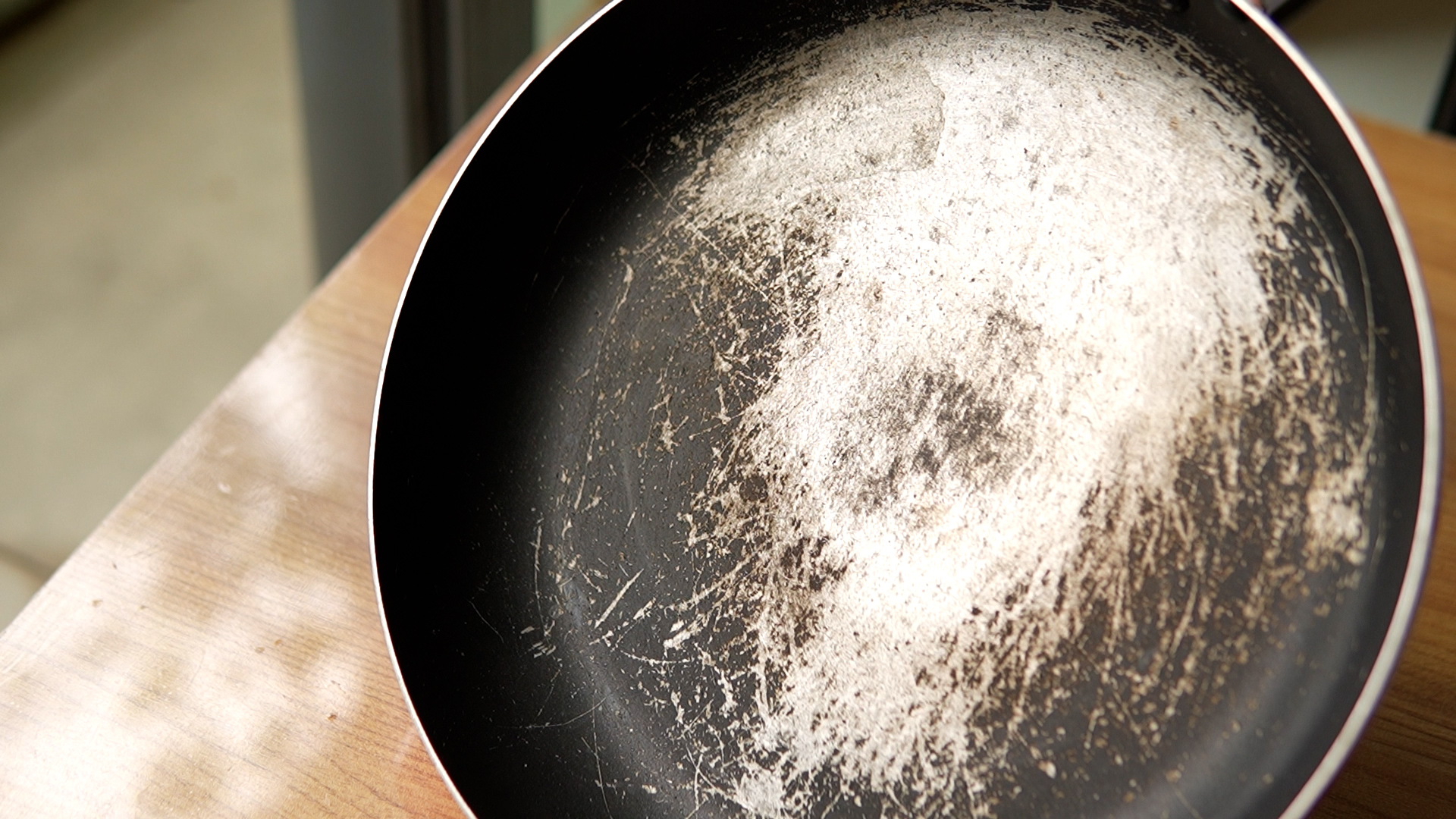
If the underlying metal or other substrate is clearly visible across damaged areas, the coating has deteriorated substantially.
Persistent flaking
If particles repeatedly appear in food or around the pan, stop using it.
Severe loss of non-stick performance
When food suddenly sticks to large portions of the surface, it may indicate that the coating has significantly deteriorated.
Warping or structural damage
A pan that is warped, cracked, or otherwise physically compromised may no longer heat properly or sit safely on the cooking surface.
What About a Scratched Rice Cooker Pot?
The same basic principle applies to the inner pot of a rice cooker.
Many rice cooker bowls use a non-stick coating to prevent rice from sticking and make cleaning easier.
If the surface develops a few light scratches, that does not necessarily mean you have been exposed to a dangerous amount of material.
But if the coating is peeling, flaking, or extensively damaged, replacing the inner pot is a sensible choice.
In many cases, you may not need to replace the entire rice cooker.
Some manufacturers sell replacement inner bowls separately.
Check the model number and manufacturer's recommendations before buying a replacement.
Don't Try to Repair a Peeling Coating Yourself
If a non-stick surface has started peeling, homemade repairs are not a good idea.
Avoid:
-
Painting the surface
-
Applying glue
-
Adding another coating
-
Sanding the pan and continuing to use it
-
Covering damaged areas with improvised materials
Cookware is designed and tested as a complete system.
A homemade repair can introduce materials that were never intended for direct food contact or high-temperature cooking.
If the coating is significantly damaged, replacement is the safer and simpler solution.
Are Ceramic Pans Automatically Safer?
Ceramic-coated cookware is often marketed as an alternative to traditional PTFE non-stick cookware.
Ceramic coatings can have different compositions and properties, and some consumers prefer them because they avoid fluoropolymer-based coatings.
However, “ceramic” does not mean indestructible.
Ceramic non-stick coatings can also lose performance, become scratched, or deteriorate with repeated use.
The same practical principles still apply:
Use appropriate utensils, avoid excessive heat, follow cleaning instructions, and replace cookware when the surface is significantly damaged.
What About Stainless Steel?
If you are concerned about non-stick coatings altogether, stainless steel is one alternative.
Stainless steel cookware does not rely on a polymer non-stick coating.
It can withstand relatively high temperatures and is generally durable.
However, food can stick more easily if the pan is not used properly.
Learning to control heat and use appropriate amounts of cooking fat can make stainless steel much easier to work with.
Other alternatives include cast iron, carbon steel, and certain enameled cookware.
Each material has its own advantages and maintenance requirements.
Don't Throw Away Every Pan Because of One Scratch
Fear-based advice can sometimes go too far.
If you notice one small scratch on your pan, there is no reason to assume that you have suddenly consumed a dangerous quantity of microplastics.
A single scratch does not provide enough information to determine actual exposure.
Instead, inspect the cookware.
Ask:
Is the coating still intact?
Is it peeling?
Are pieces coming off?
Is the damage spreading?
Was the pan exposed to extreme heat?
These questions are much more useful than focusing on a dramatic particle count circulating online.
The Number “10,000 Microplastics a Day” Needs Context
You may encounter claims that a scratched pan causes people to consume thousands or even tens of thousands of microplastic particles every day.
Such statements can be misleading when presented without explaining how the estimate was obtained.
Particle release can vary depending on:
-
The type of coating
-
The age of the cookware
-
The extent of damage
-
The cooking temperature
-
The type of food
-
Mechanical abrasion
-
Washing methods
-
Experimental methodology
A laboratory study measuring particle release under specific conditions cannot automatically be converted into a universal estimate for every household.
So rather than repeating a precise number as if it applies to everyone, it is more accurate to say:
Damaged non-stick cookware can shed particles, but the amount and health significance of that exposure are not the same for every pan or every person.
How to Make Your Non-Stick Cookware Last Longer
A few simple habits can dramatically reduce wear.
Use medium or low heat
Non-stick cookware generally does not require extreme temperatures.
Use silicone or wooden utensils
They are less likely to scratch the coating.
Wash gently
Use a soft sponge rather than abrasive materials.
Avoid stacking pans directly
If you must stack them, consider placing a soft protective layer between cookware pieces.
Don't cut food inside the pan
Using a knife directly against the cooking surface can damage the coating.
Don't use the pan as a storage container
Leaving acidic or salty foods in cookware for extended periods may not be ideal and can affect some surfaces.
Follow the manufacturer's instructions
Different coatings have different care requirements.
What If You Accidentally Used a Damaged Pan?
Don't panic.
If you have cooked with a scratched pan several times, there is no reason to assume that you have been poisoned.
If you accidentally swallowed a small piece of coating, conventional PTFE itself is generally considered to have low toxicity when ingested.
The more useful response is to inspect the cookware and decide whether continued use makes sense.
If the surface is severely damaged, replace it.
If you are concerned about a specific exposure, particularly if there were unusual fumes from severe overheating or you developed symptoms afterward, contact a healthcare professional or poison-control service appropriate to your location.
The Bottom Line
A scratched non-stick pan is not automatically a health emergency.
However, a heavily damaged, peeling, or flaking coating is a good reason to stop using the cookware and replace it.
The biggest practical precautions are straightforward:
Avoid overheating.
Don't intentionally scrape the surface.
Use appropriate utensils.
Clean gently.
Replace cookware when the coating is substantially damaged.
And be cautious with dramatic claims about exact numbers of microplastic particles consumed from a particular pan. Scientific measurements of particle release do not automatically tell us that every person using a scratched pan is consuming the same amount or experiencing a specific health risk.
Ultimately, cookware safety is less about panic and more about proper use, regular inspection, and knowing when an old pan has reached the end of its useful life.
If the coating is still intact and the cookware is used according to the manufacturer's instructions, there is generally no reason to be frightened by the mere existence of non-stick cookware in your kitchen. But once the surface is visibly deteriorating, replacing it is a simple precaution—and one that can give you peace of mind while cooking.