At first glance, a cluster of bright pink eggs attached to a plant stem, tree trunk, wall, or other surface beside a pond may look surprisingly beautiful.
The color can be so vivid that it almost seems artificial.
But those bright pink clusters may be more than an unusual feature of the landscape. In some parts of the world, they can belong to apple snails of the genus Pomacea, several species of which are considered invasive outside their native ranges.
These snails are aquatic or semi-aquatic animals, and their egg-laying behavior makes their presence unusually easy to spot. Rather than placing their eggs underwater like many aquatic animals, female apple snails can crawl above the waterline and attach clusters of eggs to vegetation, rocks, walls, boats, and other surfaces.
The result is a distinctive mass of pink or reddish-pink eggs that can be difficult to miss.
Seeing one cluster does not automatically mean that a damaging infestation is present. In addition, not every pink egg mass around water necessarily belongs to the same species. Identification depends on location, appearance, and other characteristics.
Still, bright pink egg clusters are worth treating with caution—especially in regions where invasive apple snails have been reported.
So why are these eggs so brightly colored? Why are apple snails considered a concern in some areas? And what should you do if you discover a cluster near your home?
Let's take a closer look.
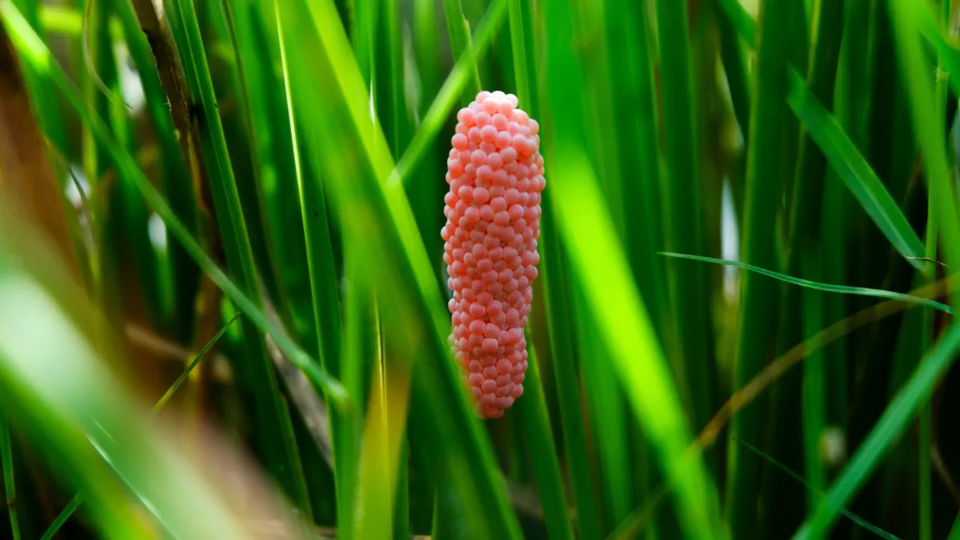
The Strange Bright Pink Clusters
The first thing that catches people's attention is the color.
Apple snail egg masses can appear vivid pink, salmon, reddish-orange, or sometimes paler as they age or dry.
The eggs are usually deposited in clusters rather than individually.
A female snail may climb above the water and attach the mass to a firm surface. Depending on the species and environmental conditions, the cluster may be found on:
- Emergent vegetation
- Reeds
- Grass stems
- Tree trunks
- Rocks
- Concrete surfaces
- Drainage structures
- Fences or posts
- Other objects close to the water
This behavior is unusual enough that people who encounter the eggs for the first time often assume they have found something exotic.
And in a sense, they have.
But the important question is not simply:
“What are these pink eggs?”
It is:
“What animal laid them, and is that species considered invasive where I live?”
Why Do Apple Snails Lay Eggs Above the Water?
One of the most interesting features of apple snail reproduction is that the eggs can be placed above the waterline.
That behavior may look strange because the animals themselves live in or around water.
But it offers an important advantage.
The eggs are not continuously submerged.
Keeping the egg mass above the water can help protect it from some aquatic predators while also providing the developing embryos with access to air.
The exact reproductive behavior varies between species, but the general pattern is highly recognizable in many Pomacea species.
A female can leave the water, crawl onto nearby vegetation or another vertical surface, and deposit a large cluster of eggs.
Then she returns to the water.
Over time, the eggs develop and eventually hatch.
The newly hatched snails enter the aquatic environment and begin their lives there.
This reproductive strategy is one reason a relatively small number of adult snails can potentially produce a much larger population when conditions are favorable.
Why Are Some Apple Snails Considered Invasive?
Not all apple snails are invasive.
That distinction is important.
Apple snails are a group of freshwater snails native to parts of tropical and subtropical regions, particularly in the Americas, with different species naturally occurring in different geographic areas.
Problems arise when certain species are introduced into ecosystems outside their natural ranges.
In a suitable environment, an introduced apple snail population may reproduce successfully and spread.
That can create ecological and agricultural concerns.
Some invasive apple snails are capable of consuming substantial amounts of aquatic and wetland vegetation.
In agricultural areas, particularly where aquatic or semi-aquatic crops are grown, certain species can become significant pests.
In natural habitats, large populations may alter vegetation and compete with native organisms.
That's why environmental authorities in some regions monitor them carefully.
Not Every Apple Snail Is Automatically a Threat
This point is easy to miss when reading viral posts online.
The word “invasive” describes a biological and ecological situation—not simply the appearance of an animal.
A species may be native in one region and invasive in another.
The same-looking snail can therefore have a completely different status depending on where it is found.
This is why local identification matters.
A pink egg cluster in one country may represent a known invasive species.
In another region, the snail may be native or may belong to a different species altogether.
So if you see a bright pink egg mass, it is better to think:
“This could be an apple snail egg cluster that deserves identification.”
rather than:
“Every pink egg mass is definitely dangerous.”
Why the Eggs Are So Easy to Notice
Nature often gives animals camouflage.
Apple snail eggs appear to do almost the opposite.
Their bright color makes them highly visible against green plants, brown mud, and gray concrete.
Researchers have suggested that the striking coloration may serve as a warning signal.
In some apple snail species, the eggs contain defensive compounds that can make them unpleasant or harmful for predators to consume.
The bright color may therefore function as a form of aposematic coloration—a visual warning that the object may not be safe to eat.
However, the exact chemical defenses and their strength can vary by species.
That's another reason not to generalize every bright pink egg mass to every apple snail species.
There Is a Reason You Shouldn't Eat the Eggs
Because these egg masses can contain defensive compounds, people should not treat them as edible objects.
This is particularly important because vivid colors can sometimes attract curious children, pets, or wildlife.
Don't taste the eggs.
Don't crush them with bare hands.
Don't allow children to handle them casually.
And don't assume that because they are attached to a plant or wall outdoors, they are harmless.