If you accidentally touch an egg cluster, wash your hands thoroughly with soap and water.
Do not intentionally crush the eggs and leave them on the ground.
Do not move them to another pond.
And never transport an unknown aquatic organism to a new location.
The goal is to prevent accidental spread.
What About Pets?
Pets can be curious around water.
Dogs, in particular, may investigate unusual objects near ponds and drainage areas.
Because some apple snail egg masses can contain defensive compounds, it's sensible to prevent pets from chewing or eating them.
If you believe a pet has consumed an unusual egg mass or aquatic animal and the animal develops concerning symptoms, contact a veterinarian promptly.
Don't wait for severe symptoms before seeking advice.
Why Children Should Learn to Recognize Them
Bright pink objects naturally attract attention.
Children may think the clusters are candy, decorations, or unusual insect eggs.
That makes simple education useful.
A good rule is:
“Look, don't touch.”
Teach children that brightly colored eggs found near water should not be handled or eaten.
The lesson is broader than apple snails.
Wildlife should generally be observed rather than collected unless there is a clear reason and appropriate supervision.
Are Apple Snails Dangerous to Humans?
The biggest human concern varies depending on the species and circumstances.
People should not assume that every apple snail is poisonous.
However, some apple snail species are associated with parasites or other health risks, and handling wild aquatic animals always deserves basic hygiene precautions.
One particularly important example is the potential association between some freshwater snails and rat lungworm (Angiostrongylus cantonensis) in regions where the parasite occurs.
Humans can become infected by ingesting infected raw or undercooked snails or slugs, or potentially contaminated produce.
This does not mean that simply seeing an apple snail will make someone sick.
Nor does it mean every apple snail carries the parasite.
The risk is geographically dependent and connected to the parasite's presence.
The safest general advice remains simple:
Do not eat wild snails, slugs, or their eggs.
And wash fresh produce carefully before consumption.
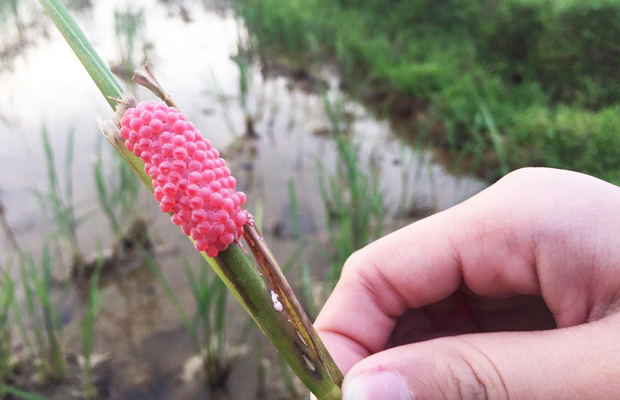
Why “Pink Eggs” Do Not Mean “Poison” Every Time
It is tempting to turn an unusual natural phenomenon into a dramatic warning:
“Bright pink eggs are poisonous!”
That's too broad.
The color of an egg mass is a clue, not a complete identification.
Different species can have different colors.
Egg color may change over time.
Environmental conditions can affect appearance.
And not every snail with colorful eggs belongs to an invasive species.
So the scientifically responsible message is:
Bright pink egg clusters near water can be a distinctive sign of certain apple snails, including invasive species in some regions, and should be identified before being handled or moved.
That is both more accurate and more useful.
The Difference Between Native and Invasive Species
The word “invasive” often gets misunderstood.
An invasive species is not simply an animal that people find unpleasant.
Generally, an invasive species is a non-native organism that becomes established and causes ecological, economic, or other harmful impacts.
That means a species can be:
Non-native but not necessarily invasive
or
Native and ecologically important
or
Non-native and strongly invasive under particular conditions.
The distinction depends on location and impact.
This is why local biological knowledge is so important.
Why You Should Never Release an Aquarium Snail
Some apple snails have historically been kept or traded as aquatic pets.
That creates a potential pathway for introductions.
A person may decide that a pet is too large, produces too many eggs, or is difficult to maintain.
Releasing it into a nearby pond might seem harmless.
But that animal is now outside the controlled environment where it originated.
If it survives, reproduces, and spreads, the consequences can extend far beyond one backyard.
The responsible option is always to contact an appropriate pet-rehoming service, aquarium organization, or local authority rather than releasing unwanted aquatic animals.
Could Climate Affect Their Spread?
Temperature is one of the environmental factors that influences whether aquatic species can survive and reproduce.
Warmer conditions can make some habitats more suitable for species that previously struggled to persist.
But climate alone does not determine whether an apple snail population will become established.
Water availability, food, predators, habitat conditions, human activity, and winter temperatures can all matter.
So it is more accurate to say that environmental conditions can influence the potential range of an invasive species rather than claiming that warmer weather automatically causes an invasion.