Waking up and discovering a sudden change in your skin can be unsettling, especially when the change appears across your cheeks, chin, or around your mouth.
Red bumps. Inflamed spots. Tender pimples. Irritated patches.
At first, it may seem like something must have gone seriously wrong overnight.
But skin can react to surprisingly ordinary things while you sleep. Heat, sweat, friction, pillowcases, hair products, skincare products, and even changes in your usual routine can all influence the skin.
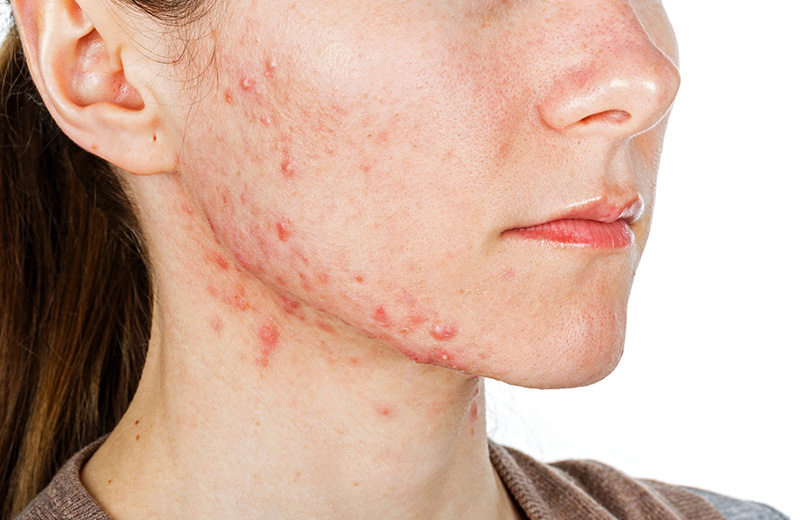
The photograph shows a person with numerous red, inflamed-looking spots concentrated around the cheeks, chin, and lower face. A photograph alone cannot determine the exact cause or diagnose a skin condition. Acne is one possibility, but several other conditions can produce similar-looking redness and bumps.
So what could be happening?
Your Skin Doesn't Simply “Turn Off” While You Sleep
Sleep is supposed to be a period of rest, but your skin continues working throughout the night.
Your body regulates temperature, produces sweat and oil, repairs the skin barrier, and responds to irritation or inflammation.
Meanwhile, your face may remain in contact with a pillow for several hours.
That means your nighttime environment can matter.
If your face becomes hot or sweaty, if you sleep against a dirty pillowcase, or if hair or skincare products repeatedly contact your skin, those factors may contribute to irritation or breakouts in some people.
However, it's important not to assume that one night of sleeping differently automatically causes severe acne.
Acne usually develops through a combination of factors, including clogged pores, excess sebum, inflammation, and hormonal influences.
1. Friction From Your Pillow May Irritate the Skin
One possibility is simple mechanical irritation.
If you sleep on your side or stomach, your face may remain pressed against your pillow for hours.
Repeated pressure and friction can irritate sensitive skin.
This becomes particularly relevant when the skin is already prone to acne or inflammation.
Friction can also trap sweat and oil against the skin.
This type of breakout or irritation is sometimes discussed under the broader concept of acne mechanica, in which repeated pressure, rubbing, heat, or occlusion contributes to acne-like lesions.
The pillow itself isn't necessarily the problem.
The combination of pressure + friction + heat + moisture may be more relevant.
2. Your Pillowcase May Be Part of the Equation
A pillowcase collects whatever comes into contact with it.
Over time, that can include:
-
Skin oils
-
Sweat
-
Dead skin cells
-
Hair products
-
Skincare products
-
Dirt from the environment
-
Residue from detergents or fabric softeners
This doesn't mean an unwashed pillowcase directly “causes acne.”
Acne isn't simply a hygiene problem.
But if you already have acne-prone or sensitive skin, regularly changing and washing bedding can reduce the accumulation of substances that may irritate the skin.
If you notice that breakouts repeatedly appear on the side of your face that contacts your pillow, it's reasonable to consider your sleeping environment as one possible contributor.
3. Sweat and Heat Can Make Things Worse
Some people sleep hot.
Others wake up sweating, particularly during warm weather or when using heavy blankets.
Sweat itself isn't necessarily harmful to your skin.
The problem can arise when sweat mixes with oil, skincare products, makeup residue, and friction.
A warm, damp environment can also make the skin feel more irritated.
This is one reason some people notice more breakouts during hot weather or after activities that cause prolonged sweating.
If you regularly wake up sweaty, consider whether your bedroom temperature, bedding, sleepwear, or nighttime skincare routine could be contributing.
4. Hair Products Can Reach Your Face
Another easily overlooked possibility is your hair.
Shampoos, conditioners, oils, leave-in treatments, styling products, and hair masks can come into contact with the forehead, cheeks, temples, or pillowcase.
Some products contain ingredients that may contribute to clogged pores or irritation in susceptible individuals.
This doesn't mean that a particular ingredient is universally “bad.”
Skin responds differently from person to person.
If you consistently notice bumps around areas that touch your hair—or along the hairline—consider whether a new hair product was introduced around the same time.
Keeping hair away from the face during sleep may also help some people identify whether contact is contributing to their symptoms.
5. Your Nighttime Skincare Routine Could Be Too Heavy
More skincare isn't always better.
A thick moisturizer, facial oil, occlusive balm, sleeping mask, or multiple layered products may feel luxurious at night, but some people may find that certain products contribute to clogged pores or irritation.
This is particularly worth considering if the breakouts appeared after introducing a new product.
Don't immediately stop every skincare product you own.
Instead, look for patterns.
Ask yourself:
Did I recently introduce a new cleanser?
Did I start using a heavier moisturizer?
Did I add a facial oil or sleeping mask?
Did I change my sunscreen or makeup?
Did I begin using several active ingredients at once?
A simple routine can sometimes make it easier to identify what your skin tolerates.

6. Makeup Residue Can Contribute to Problems
If makeup is not completely removed before bed, residue can remain on the skin.
Foundation, concealer, powder, sunscreen, and other cosmetic products may mix with sebum and sweat.
For people prone to acne, leaving makeup on overnight may contribute to clogged pores or irritation.
That doesn't mean every person who sleeps with makeup will develop acne.
But consistently sleeping without properly cleansing the skin can make it more difficult to determine what is triggering recurring breakouts.
A gentle cleanser is generally preferable to aggressive scrubbing.
7. Hormones Can Play a Major Role
Sometimes the explanation has nothing to do with the pillow.
Hormonal changes can strongly influence acne.
And this is one reason acne can appear or worsen even when someone has excellent skincare habits.
Androgens can stimulate sebaceous glands to produce more sebum.
Hormonal fluctuations can therefore contribute to increased oil production and clogged pores.
For some women, acne may become particularly noticeable around certain points in the menstrual cycle.
Hormonal changes associated with pregnancy, stopping or starting hormonal contraception, and other circumstances can also affect the skin.
If breakouts repeatedly follow a hormonal pattern, discussing them with a healthcare professional or dermatologist may be useful.
8. Stress and Poor Sleep Can Affect Your Skin
Stress doesn't necessarily cause acne by itself, but it can influence behaviors and biological processes that affect the skin.
During stressful periods, some people:
-
Sleep poorly
-
Touch their face more often
-
Change their diet
-
Skip skincare
-
Use more cosmetic products
-
Pick or squeeze pimples
Stress-related hormonal changes may also influence inflammatory processes and sebum production.
So if your skin suddenly seems worse during a particularly stressful period, there may be more than one factor involved.
9. Not Every Red Bump Is Acne
This is extremely important.
The bumps shown in the photograph may resemble acne, but a picture isn't enough to determine what condition is present.
Several skin conditions can look similar.