Chapter 1: A Terrifying Bridge Collapse – When an Ordinary Journey Becomes a Disaster
Bridges are among the most important structures in modern transportation.
Every day, millions of people cross bridges to reach workplaces, schools, hospitals, markets, and family gatherings. These structures connect communities separated by rivers, canals, valleys, and other natural obstacles.
For most motorists, crossing a bridge is an ordinary part of daily life.
They rarely think about the enormous engineering systems supporting the vehicles beneath them.
However, when a bridge experiences a sudden structural failure, the consequences can be devastating.
A section of roadway may collapse, vehicles may become trapped, and people can find themselves facing an emergency with almost no time to react.
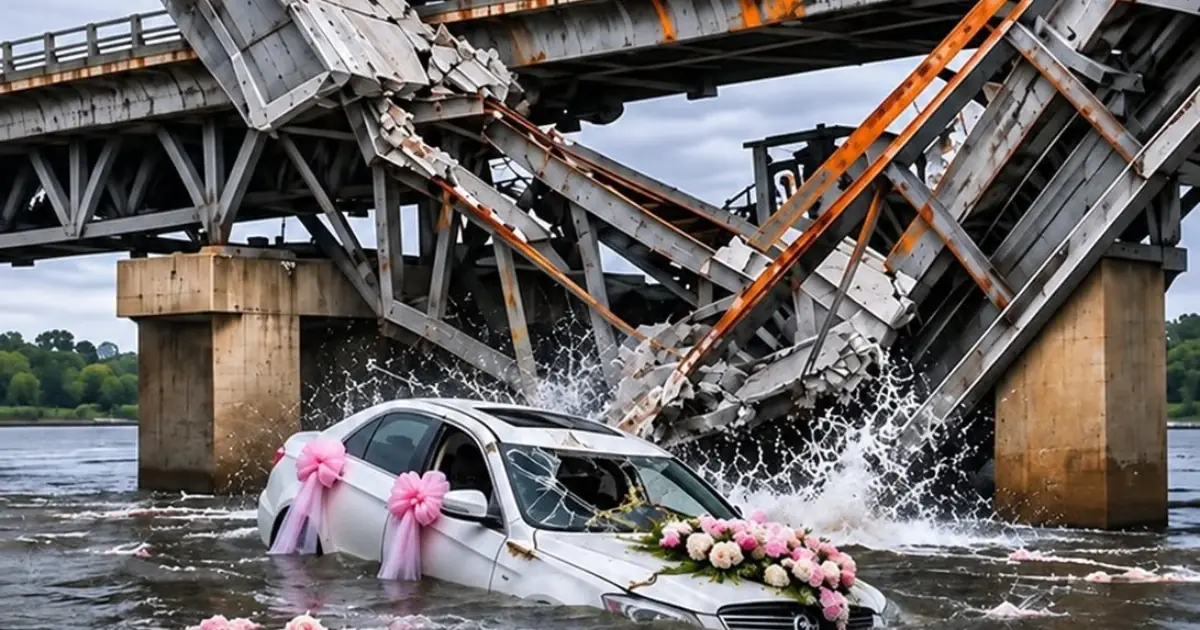
The supplied photograph illustrates an especially frightening scenario: a decorated wedding vehicle appearing to plunge into a canal as a steel bridge collapses overhead.
The pink flowers and ribbons suggest a wedding-related setting, making the imagined situation particularly emotional.
A journey intended to celebrate a happy occasion could, in such a scenario, become a life-threatening emergency.
1. Why Bridge Collapses Attract So Much Attention
Bridge failures are frightening because people generally assume that these structures are safe.
Unlike ordinary roads, bridges depend on carefully engineered systems of beams, supports, foundations, joints, and connecting components.
Every part must work together to carry traffic and withstand environmental forces.
When one critical component becomes damaged or loses its ability to transfer loads safely, other components may experience additional stress.
In some circumstances, this can lead to progressive structural failure.
A collapse may happen gradually, with visible warning signs, or suddenly following a serious impact, extreme environmental event, or unexpected structural failure.
The circumstances vary considerably from one incident to another.
2. What Does the Supplied Photograph Show?
The uploaded image contains several visually important details.
The upper portion shows what appears to be a damaged steel bridge.
Large structural sections are bent or displaced, and some components appear to have separated from their original positions.
Several vehicles can be seen on the remaining elevated section.
Below the damaged structure, a white passenger car decorated with pink ribbons and flowers is partially submerged in water.
The surrounding water appears disturbed, suggesting that the image is intended to represent an ongoing collapse.
However, a photograph cannot independently establish whether this is an actual accident, a staged reconstruction, or an artificially generated illustration.
It also cannot confirm that anyone was inside the vehicle.
For responsible reporting, these details must be checked against independent evidence.
3. Why a Wedding Vehicle Makes the Scenario Particularly Emotional
Weddings are occasions associated with celebration, family reunions, and new beginnings.
A decorated vehicle may carry a bride, groom, relatives, or other members of the wedding party.
People traveling to a ceremony usually expect an enjoyable journey.
They may be wearing special clothing, carrying flowers, or traveling with relatives and friends.
This makes the possibility of a serious accident particularly distressing.
Nevertheless, it is important not to assume that the people pictured were actually wedding guests or that any fatalities occurred.
The decorations are visible, but the identities and circumstances remain unknown.
4. How a Bridge Can Suddenly Lose Its Structural Stability
A bridge must safely transfer its own weight and the weight of traffic into the ground.
This process involves several structural elements.
Deck
The deck is the surface that vehicles travel across.
It must distribute traffic loads to the supporting structure.
Beams and girders
These components carry forces along the bridge and transfer loads toward the supports.
Piers
Piers provide intermediate support for many bridge designs.
Bearings
Bearings allow controlled movement and rotation while transferring loads between structural components.
Foundations
Foundations transfer the forces from the bridge into the underlying soil or rock.
Damage to one component does not automatically cause a collapse.
However, when deterioration or structural damage becomes sufficiently serious, the entire system may become vulnerable.
5. The Importance of Regular Bridge Inspections
Bridge safety depends on more than the original construction.
Structures must be inspected throughout their service lives.
Engineers look for evidence of deterioration, damage, deformation, and other warning signs.
Depending on the bridge design, inspections may examine:
-
Steel corrosion.
-
Cracks in concrete.
-
Damaged welds.
-
Loose or deteriorating connections.
-
Foundation movement.
-
Bearing deterioration.
-
Water damage.
-
Structural deformation.
-
Damage caused by vehicle impacts.
Some defects are difficult to identify through ordinary visual inspections.
Engineers may therefore use specialized equipment, sensors, ultrasonic testing, or other non-destructive examination techniques.
6. Why Older Bridges Require Special Attention
Many bridges remain in service for decades.
Their condition depends on the quality of their original construction, maintenance history, traffic levels, environmental exposure, and previous repairs.
Over time, materials can deteriorate.
Steel may corrode when protective coatings fail.
Concrete may crack or deteriorate due to environmental exposure.
Joints and bearings may lose their original performance.
At the same time, traffic patterns may change.
A bridge designed for an earlier generation of vehicles may experience different loading conditions as transport demand increases.
This does not mean that every older bridge is unsafe.
It means that inspection and maintenance must reflect the actual condition and demands placed on the structure.
7. What Happens When a Bridge Fails Over Water?
A collapse over a river or canal presents additional dangers.
People inside vehicles may be exposed to water, damaged structural components, and rapidly changing conditions.
The vehicle may become partially submerged or move away from its original position.
Rescuers may have difficulty reaching occupants because the bridge structure itself can obstruct access.
Water depth, current speed, visibility, and weather conditions can all affect rescue operations.
In such circumstances, emergency services may need specialized equipment and divers.
8. Why Every Second Matters
When a vehicle enters water, occupants may have only a limited opportunity to escape.
The exact time available depends on the vehicle's position, the speed of water entry, structural damage, and other circumstances.
People can become disoriented as the vehicle moves or water enters the cabin.
Electronic systems may also stop working.
For this reason, knowing how to respond to a vehicle entering water can be extremely important.
The following chapters examine the structural causes of bridge failures and the emergency measures that may help protect lives.
Chapter 2: What Really Happened in Barguna? The Wedding Journey That Ended in Tragedy
The scene depicted in the supplied photograph resembles a real tragedy that occurred in Bangladesh on June 22, 2024.
However, an important distinction must be made: the actual incident involved a microbus carrying wedding guests and an old iron bridge in Barguna. The supplied image of a white flower-decorated sedan beneath a large steel bridge is not the verified original accident photograph.
According to reports from The Daily Star, Dhaka Tribune, and other Bangladeshi news organizations, nine people died after a microbus carrying members of the bride's family plunged into a canal following the collapse of the Haldiya Bridge in Amtali, Barguna.
The Daily Star+2
1. A Journey to Celebrate a Wedding
The tragedy occurred during a journey connected to a wedding celebration.
The bride's relatives were traveling from the Shibchar area of Madaripur to attend a reception at the groom's home in Haldia village, Amtali.
The wedding ceremony had taken place the previous day.
The following afternoon was supposed to be another opportunity for relatives to gather, celebrate, share food, and congratulate the newly married couple.
Some family members traveled in a microbus, while others traveled in an auto-rickshaw.
It was an ordinary journey for a family attending an important celebration.
Nobody could have expected that the bridge they were crossing would suddenly collapse.
2. The Moment the Bridge Gave Way
According to reports published on June 22, 2024, the accident happened at approximately 2 p.m.
The vehicles were crossing the Haldiya Bridge, which connected areas around Naura and Haldia Bazar.
As they reached the middle section, the bridge collapsed.
The microbus and accompanying auto-rickshaw fell into the water below.
Passengers in the auto-rickshaw managed to escape by swimming to safety, according to police statements reported by Dhaka Tribune.
The microbus passengers faced a much more dangerous situation.
The vehicle entered the water and sank, trapping people inside.
The accident happened so suddenly that those involved had little opportunity to understand what was taking place.
Dhaka Tribune+1
3. Nine People Lost Their Lives
Authorities confirmed that nine people died in the tragedy.
Among the victims were six women and three children, according to contemporary reports.
They were relatives of the bride.
The deaths devastated two extended families and shocked the surrounding communities.
The victims were not simply passengers traveling together.
They were mothers, daughters, relatives, and children who had been making their way to a family celebration.
The loss was particularly painful because the journey had been associated with a wedding, an occasion normally connected with happiness and new beginnings.
4. Survivors Recalled the Terrifying Experience
One survivor, Mahbub Khan, described losing consciousness during the incident.
According to The Daily Star, he remembered traveling toward the groom's home before the bridge collapsed.
He later regained consciousness in hospital.
Another account reported by Dhaka Tribune described how passengers attempted to escape after the vehicles fell into the water.
Such recollections demonstrate how quickly a seemingly ordinary journey can turn into an emergency.
Survivors of major accidents may experience physical injuries, confusion, and psychological trauma long after the immediate danger has passed.
The Daily Star+1
5. Local Residents Joined the Rescue Effort
After the collapse, people living near the bridge rushed toward the canal.
Some attempted to help passengers before professional emergency services arrived.
Police officers and firefighters subsequently joined the operation.
Rescue workers faced several difficulties.
The microbus had sunk into the water, and floating vegetation made visibility and access more difficult.
According to reports, heavy rainfall also complicated rescue efforts.
The presence of water hyacinth around the vehicle added another obstacle for people attempting to locate passengers.
The operation required cooperation between residents, firefighters, police officers, and other local authorities.
6. Why the Canal Made Rescue More Difficult
A vehicle entering a canal creates a complicated rescue situation.
The depth of the water, the position of the vehicle, underwater obstacles, and the condition of its occupants all affect the response.
Water hyacinth can make the situation even more difficult.
This floating vegetation may cover large areas of the surface and interfere with visibility.
Rescuers may struggle to identify the precise location of a submerged vehicle.
In addition, a damaged vehicle can have doors or windows that are difficult to open.
The structure of the collapsed bridge may also create additional hazards.
Professional rescuers must assess these conditions carefully before attempting extraction.
7. The Pain Felt by Families
Perhaps the most heartbreaking aspect of the tragedy was the impact on the relatives left behind.
Families had been expecting their loved ones to arrive for a celebration.
Instead, they received news of a devastating accident.
One family member quoted by Dhaka Tribune described losing his wife and two daughters.
His words reflected the enormous emotional consequences of the incident.
The wedding celebration was overshadowed by grief.
Relatives, neighbors, and community members gathered to support the bereaved families.
8. The Baby Who Survived
One particularly moving account emerged in subsequent reporting about the tragedy.
Reports from Bangladeshi media described how a six-month-old baby survived after her mother threw her toward floating water hyacinth as the vehicle entered the water.
The child's father and other people nearby were able to rescue her.
Her mother was among those who died.
This account became one of the most widely discussed human stories connected with the accident.
It also illustrates the extraordinary circumstances that can occur during emergencies.
However, such stories should be reported carefully and with respect for the surviving family members.
unb.com.bd+1
9. The Community Demanded Accountability
The collapse raised serious questions about the condition of the bridge.
Local residents said the structure had been in poor condition and had not received adequate repairs.
Some also alleged that construction quality had been inadequate.
These allegations required investigation rather than assumption.
Officials announced that a six-member investigation committee would examine the circumstances surrounding the collapse.
The committee was expected to inspect the site and investigate possible construction or maintenance irregularities.
Dhaka Tribune+1
10. A Tragedy That Should Not Be Forgotten
The Barguna accident became an important reminder of the consequences of neglected infrastructure.
For the families involved, the loss was permanent.
For the wider community, the collapse raised questions about the safety of other bridges used every day.
The tragedy was not simply about a vehicle falling into water.
It was also about whether an essential piece of public infrastructure had been maintained and monitored appropriately.
Chapter 3: Why Did the Bridge Collapse? Warning Signs, Structural Problems, and Questions About Maintenance
After a major bridge collapse, one of the most important questions is why the structure failed.
A bridge is expected to support vehicles and pedestrians safely under normal operating conditions.
When it suddenly gives way, investigators must determine whether the cause involved structural deterioration, poor construction, excessive loading, inadequate maintenance, environmental conditions, or a combination of factors.
In the Barguna tragedy, local residents raised concerns about the condition of the Haldiya Bridge.
The incident also led to public demands for an investigation into its construction and maintenance.
1. An Old Iron Bridge With a History of Concern
The bridge involved in the Barguna accident was an iron structure used by people living in surrounding communities.
According to contemporary Bangladeshi reporting, residents had raised concerns about its condition before the accident.
The bridge was reportedly around 10 years old according to some local accounts, although other reporting described an earlier construction period.
This difference illustrates why construction records and official engineering documents are important when investigating infrastructure failures.
A bridge's actual age, original design, permitted loading capacity, and maintenance history must be established through reliable records.
The fact that a bridge is relatively old does not automatically explain why it collapsed.
Its condition and the forces acting on it must be examined.
2. Was the Bridge Designed for Heavy Vehicles?
One important issue in bridge safety is the intended vehicle capacity.
Some small bridges are designed primarily for pedestrians, motorcycles, and light vehicles.
Others are engineered to accommodate heavier traffic.
The permitted loading capacity depends on the design, construction materials, structural arrangement, and foundation conditions.