Easy Kitchen Food Safety Guide: What That Strange Bacon Chunk Really Means
A strange lump in a package of bacon can turn an ordinary breakfast into a worrying food-safety question. Before throwing the whole pack away, learn what that unexpected piece might be, what the photograph can—and cannot—tell you, and when bacon should never be eaten.
You open a fresh package of bacon, ready to prepare a quick breakfast. The slices look familiar: pink meat, creamy-white fat, and the usual layers that curl slightly when separated. Then one slice reveals something you were not expecting. Between the meat and fat sits a small, pale, rubbery-looking lump. It is unlike the smooth texture of the bacon around it, and its unusual shape immediately catches your attention.
Is it a piece of plastic? A piece of bone? A gland or lymph node? Could it be a sign that the meat was contaminated, poorly processed, or unsafe to eat?
It is understandable to feel uneasy. Food is something we handle every day, often without thinking twice, and an unexpected object in a familiar product can make even a routine meal feel uncertain. The photograph accompanying this story shows a small, pale, irregular piece embedded in a strip of raw bacon. Its appearance raises a reasonable question, but a photograph alone cannot establish exactly what the material is.
There is, however, an important distinction that can make the situation less confusing: pork is biological tissue, not a perfectly uniform manufactured product. Bacon can contain variations in fat, muscle, connective tissue and, occasionally, other small pieces of tissue that are not immediately recognizable to the person preparing it. Some irregularities are harmless anatomical variations; others may indicate a processing defect or a foreign material that deserves attention.
The safest response is not to assume that every strange lump is dangerous—or that every strange lump is harmless. The key is to understand what can naturally occur in pork, recognize the warning signs of spoilage or contamination, and know what to do when something in the package does not look right.
Let's begin with the most important question: what could that unusual bacon chunk actually be?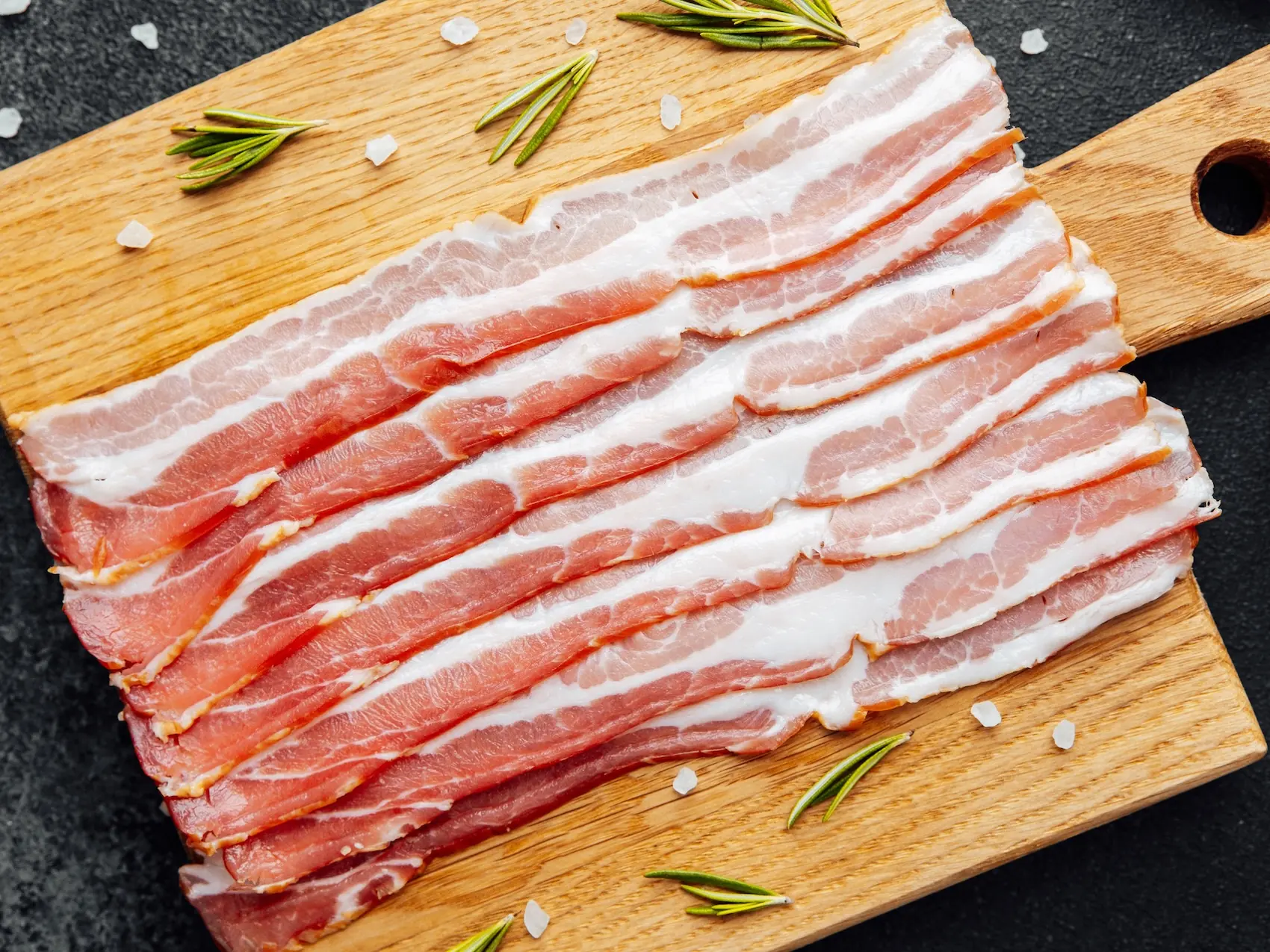
What Could the Strange Chunk in the Bacon Be?
The photograph shows a pale, irregular piece sitting on top of a strip of raw bacon. It appears different from the surrounding pink muscle and white fat: it is thicker, more compact and somewhat rubbery-looking. That contrast is what makes it stand out.
The accompanying article suggests three possible explanations: a lymph node, mammary tissue, or a piece of connective tissue or fat. These are plausible types of animal tissue that may look unfamiliar when they appear in a cut of pork. But there is an important qualification: none of these possibilities can be confirmed from the photograph alone.
The size, color and position of a lump can offer clues, but they cannot reliably establish its identity. A proper examination may require seeing the material in person, feeling its texture, checking how it is attached to the meat and, in some cases, having it assessed by a qualified food-safety or meat-inspection professional.
1. A lymph node
One possibility is a lymph node. Lymph nodes are small structures that form part of an animal's immune system. They are found throughout the body, often in groups near particular tissues and organs.
Their job is to help filter lymph fluid and support immune responses. They contain immune cells and connective tissue, and they can vary in size and appearance depending on their location and condition.
In meat, a lymph node may look like a small oval, bean-shaped or rounded piece embedded in fatty tissue. It may be pale gray, cream, light brown or slightly pinkish. Its texture can be firmer and more compact than the surrounding fat.
That can make it look unusual when it appears in a slice of bacon.
Lymph nodes are not plastic, and their presence does not automatically mean that the animal was diseased. They are normal anatomical structures. New Zealand's Ministry for Primary Industries explains that lymph nodes can occur in fatty areas between or beside muscles and that they are a natural part of the animal. It also notes that lumps in meat can have several causes, so an unfamiliar lump should not automatically be assigned one identity.
There is another important distinction: a normal lymph node is not the same thing as an enlarged, inflamed or otherwise abnormal lymph node. Meat inspection procedures are designed to identify abnormalities in carcasses. If a lump looks unusual, damaged, discolored or associated with other suspicious changes, it should not simply be assumed to be a harmless lymph node.
2. Mammary tissue
A second possibility mentioned in the accompanying article is mammary tissue.
Pigs have mammary glands arranged along the underside of the body. These glands are associated with milk production in female pigs, particularly during pregnancy and nursing. The surrounding area contains skin, fat, connective tissue, ducts and other structures.
Depending on where a piece of pork comes from and how it has been trimmed, tissue from this general region may have a different appearance from the familiar layers of muscle and fat in bacon.
A small piece of glandular tissue can look denser, more compact or slightly rubbery compared with ordinary fat. It may also have an irregular shape.
However, it would be inaccurate to identify the object in the photograph as a mammary gland simply because it is pale and rubbery. A photograph does not reveal the tissue's microscopic structure, exact location in the original carcass or anatomical connections.
Commercial meat processing includes trimming and inspection procedures intended to remove tissues that should not remain in a particular product. Canadian inspection guidance, for example, includes specific procedures concerning the removal of mammary glands and associated lymph nodes during certain pig dressing processes. The exact requirements depend on the animal, product and applicable regulations.
The practical lesson is that unusual gland-like tissue should be treated as a product-quality concern worth raising with the seller or processor, rather than something a consumer must identify independently.
3. Connective tissue, fascia or a dense fat deposit
A third possibility is ordinary connective tissue or a concentrated area of fat.
Pork is made of more than muscle and visible fat. It also contains connective tissue, which helps hold muscles and other structures together. Thin layers of connective tissue can separate muscle groups, surround bundles of muscle fibers and connect different parts of the body.
Some connective tissue is soft and delicate. Other areas can be tougher, thicker or more elastic. When a cut is sliced, a small section may appear as a pale strip, knot or compact lump.
Fat can also vary in texture. Some fat is soft and smooth, while other deposits are firmer or more fibrous. The distribution depends on the animal's anatomy and the exact part of the carcass used.
This is one reason bacon slices do not always look identical. Even when they come from the same package, the amount of lean meat, fat and connective tissue can vary.