A pale piece that looks strange does not necessarily mean the bacon is contaminated. But appearance alone cannot prove that it is harmless either.
4. Could it be a piece of bone or cartilage?
Bone or cartilage is another possibility worth considering when an unexpected hard piece appears in meat.
Bone is a natural part of an animal's body. It is not classified as a foreign object in the same way as glass, metal or plastic. The USDA Food Safety and Inspection Service explains that bones in meat products are not considered foreign material because they are a natural part of the carcass.
That does not mean every bone fragment is acceptable in every product. A package marketed as boneless should meet the relevant product standards, and a sharp or unexpected hard fragment can create a physical hazard.
Cartilage is different from bone. It is a flexible connective tissue found in joints and other parts of the body. Depending on its location, it can appear whitish, smooth or rubbery.
If a lump feels hard, sharp or gritty, do not try to chew it to identify it. Set it aside and contact the retailer or processor if it appears to be an unexpected fragment.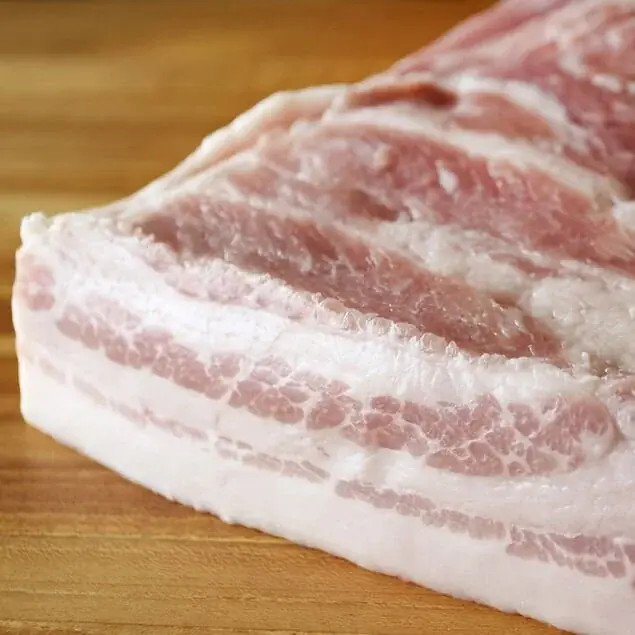
5. Could it be plastic or another foreign object?
The possibility that worries many consumers most is foreign material.
A foreign object is something that does not naturally belong to the meat. Examples include plastic, rubber, metal, glass, wood and other non-animal materials.
The USDA FSIS specifically distinguishes non-animal foreign materials from natural animal components such as bone.
Plastic may have a smooth, molded or uniform appearance. It may have an artificial edge, a consistent thickness or a surface that looks unlike the surrounding tissue. Metal or glass may be hard and sharply defined. Rubber may be flexible but have a manufactured appearance.
However, consumers should not rely on appearance alone. Some natural tissues can look surprisingly artificial, while some foreign materials may be difficult to recognize.
If the object seems manufactured, has a sharp edge, does not resemble meat or fat, or cannot be confidently identified, do not eat the affected portion. Preserve the object and packaging so the seller or manufacturer can investigate.
The safest approach is simple: when an unexpected object cannot be identified, do not take a bite to test it.
Why Natural Tissue Can Appear in a Package of Bacon
To understand why an unusual piece might appear in bacon, it helps to understand how bacon is produced.
Bacon is commonly made from pork belly, a cut that contains layers of muscle and fat. The belly is trimmed, cured, sometimes smoked, chilled and sliced. The precise process varies by manufacturer and product type.
The raw material is biological. It does not begin as a perfectly uniform block with identical layers throughout. Even carefully processed pork can show natural differences from one area to another.
Pork is not manufactured like plastic
A plastic product is made from a controlled material that can be molded into a consistent shape. Meat is different. It comes from an animal whose muscles, fat deposits, connective tissue and other structures have developed naturally.
The shape and thickness of these tissues vary.
Some areas contain more muscle. Others contain more fat. Some have thin membranes or connective tissue running between layers. A slice cut near a boundary between tissues may reveal a pattern that looks unusual to someone who expects every strip of bacon to have the same appearance.
This does not mean that every irregularity is acceptable. It simply explains why visual uniformity is not a realistic expectation for every slice of natural meat.
How the belly becomes bacon
Although manufacturing methods differ, the general process often follows several stages.
Selection and trimming: Pork belly is selected and trimmed to remove unwanted material and prepare it for processing.
Curing: Salt and curing ingredients are applied to preserve the product and develop its characteristic flavor and color. Some products are dry-cured, while others use a curing solution.
Smoking or flavor development: Some bacon is smoked, while other products use smoke flavoring or are sold unsmoked.
Chilling: The meat is cooled so that it can be handled and sliced consistently.
Slicing and packaging: The belly is cut into strips, inspected and packaged for sale.
At different stages, workers and processing systems are intended to identify defects, remove unwanted tissue and prevent contamination. Nevertheless, food manufacturing is not a guarantee that every individual slice will be visually perfect.
Why a lump might be missed
A small piece of tissue can be difficult to distinguish from the surrounding fat, especially when it is pale and located between layers.
A processor may be working with a large volume of meat, and natural tissue can blend into the surrounding material. A lump may also become more noticeable only after the belly is sliced into thin strips.
That possibility does not excuse poor quality control. It simply explains why an unexpected piece may occasionally reach a retail package.
A consumer who finds one should document it and notify the retailer or manufacturer, especially if the object is hard, unusual, or appears to be foreign material.
Is a Strange Lump in Bacon Dangerous?
The most honest answer is that it depends on what the lump is and whether the surrounding product shows other warning signs.
A normal piece of connective tissue or a natural anatomical structure is not automatically evidence of a food-safety hazard. On the other hand, an abnormal lesion, a foreign object, spoiled meat or a product that has been stored improperly may present a genuine concern.
The photograph cannot establish which situation applies.
A normal anatomical structure
A normal lymph node or a piece of connective tissue may be unappealing to look at, but its presence alone does not prove that the bacon is unsafe.
New Zealand's Ministry for Primary Industries notes that some lumps in meat are natural structures, including lymph nodes, and that many lumps and defects are generally safe. It also explains that lumps can have other causes, including injections, foreign objects, localized infections and parasites.
This is why a consumer should avoid jumping to either extreme. A strange lump is not automatically a sign of dangerous contamination, but it should not automatically be dismissed either.
An abnormal or diseased-looking tissue
A lump that is enlarged, discolored, filled with fluid, surrounded by abnormal tissue or associated with an unpleasant odor deserves more caution.
Localized infections and other abnormalities can produce changes in meat. Such findings are different from an ordinary, healthy anatomical structure.
Consumers are not expected to diagnose an animal disease by looking at a slice of bacon. If the tissue looks abnormal, the product should be set aside and the seller contacted.
Do not cut around a suspicious lesion and assume the remaining package is safe. The correct response depends on the nature and extent of the problem, which may require professional assessment.
A foreign object
A piece of plastic, metal, glass or rubber is a different issue from natural tissue.