At first glance, the image looks like a simple grid.
There are several straight red lines forming a large square, with smaller squares and rectangles appearing inside it. The challenge seems easy: look at the picture and count how many squares you can find.
But there is a catch.
The image is designed to make your eyes focus on the most obvious small squares while overlooking larger squares created by combining multiple sections. In other words, the puzzle isn't simply testing how quickly you can count. It is testing whether you naturally look at the whole structure or concentrate on the individual pieces in front of you.
The headline attached to the puzzle makes an even more intriguing claim:
“The Number of Squares You See Will Reveal Your Biggest Flaw.”
That idea has made this type of visual personality test popular online. People count the shapes, compare their answers with friends, and then read a personality description supposedly connected to their number.
But before deciding what your answer says about you, there's an important distinction: a visual puzzle can reveal something about your approach to solving a problem, but it cannot scientifically determine your personality or your “biggest flaw.”
Still, the puzzle itself is fascinating—and there is more to counting the squares than you might expect.
First, Forget the Personality Test and Look Carefully
Take another look at the image.
The large outer shape contains what appears to be a 4-by-4 arrangement, but the horizontal line running through the middle is not continuous from one side to the other.
That small detail is extremely important.
Some lines stop before reaching the edge, while others continue across the entire structure. This means you cannot simply multiply the number of rows by the number of columns.
You have to examine which lines actually connect.
And this is where many people make their first mistake.
They count the obvious small squares and stop.
Others see larger squares but accidentally count shapes that are actually rectangles rather than squares.
A proper solution requires checking every possible square size.
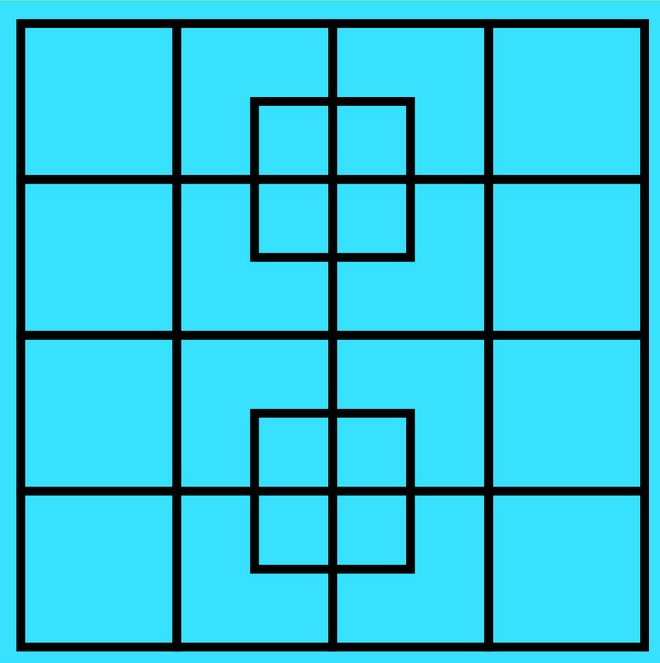
How Many Squares Are Actually in the Image?
If you carefully analyze the geometry, the puzzle contains 22 squares.
That includes the small squares that are immediately visible as well as larger squares formed by combining several smaller sections.
Here's how the count can be broken down.
1. The smallest squares
Start with squares that are one unit by one unit.
Along the top and bottom sections, there are several obvious small squares. In the middle section, however, the shorter horizontal line changes the arrangement.
Counting all of the valid 1×1 squares gives:
12 small squares
These are the easiest ones to spot, which is why many people stop counting here.
But we're not finished.
2. Larger 2×2 squares
Next, look for squares that are twice the width and twice the height of the smallest squares.
These are considerably easier to miss because they are composed of multiple smaller sections.
There are:
5 squares of this size
This is where people who initially counted only the obvious individual boxes begin to realize that the puzzle is more complicated than it appears.
3. Larger 3×3 squares
Now look for squares that span three units.
There are:
4 squares of this size
These aren't necessarily outlined by a single set of internal lines. Instead, their boundaries can be formed by the larger horizontal and vertical lines in the diagram.
This is a classic feature of square-counting puzzles: a square doesn't have to be visually isolated to be a square.
4. The largest square
Finally, there is the entire outer shape.
The complete boundary forms:
1 large square