If you search for larger squares, you'll begin noticing how multiple sections connect.
If you search for patterns, you'll find patterns.
This doesn't mean that reality changes depending on your perspective. It means that human attention is selective.
We can't consciously process every detail around us at the same level of intensity.
Our brains constantly filter information.
That is useful—but it also means that the first thing we notice isn't necessarily the whole story.
Try the Challenge One More Time
Before reading anything else, look at the image again.
Don't count quickly.
Instead, imagine dividing the puzzle into different sizes.
Start with the smallest squares.
Then move outward.
Look at every possible pair of horizontal boundaries and ask:
“Can these two lines form the top and bottom of a square?”
Then check the vertical boundaries.
Repeat the process for each size.
You may find that your first answer changes.
And that's exactly why these puzzles are so engaging.
They reward patience more than speed.
So, What Is Your “Biggest Flaw”?
According to the viral headline, your number of squares is supposed to reveal one.
But there is a more useful interpretation.
Instead of asking:
“What flaw does my answer prove I have?”
Try asking:
“What did my approach to the puzzle reveal about the way I solve problems?”
Did you rush?
Did you inspect every detail?
Did you look at the big picture first?
Did you systematically test every possibility?
Did you become frustrated when the obvious answer wasn't correct?
Those questions can actually be more interesting than a predetermined personality label.
And they don't require pretending that a puzzle can scientifically diagnose your character.
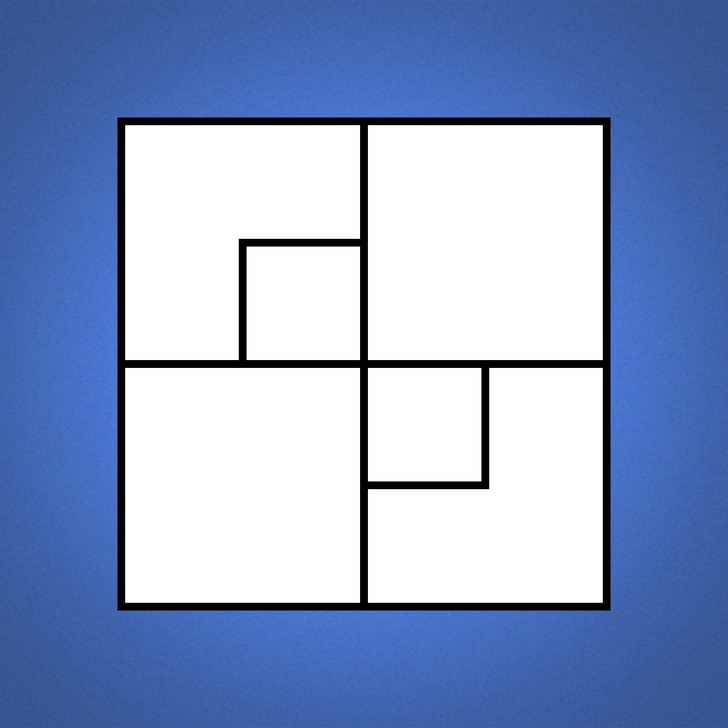
The Final Answer
After accounting for the different sizes and avoiding duplicate counts, the diagram contains:
22 SQUARES
The number includes the smallest individual squares, larger squares created by combining sections, and the large outer square.
But the real fun isn't simply getting the number right.
It's discovering why the answer is higher than your first impression might suggest.
The image demonstrates how easily our attention can become locked onto obvious patterns. Once we slow down and examine the structure systematically, additional possibilities become visible.
So if you looked at the picture and immediately thought you had the answer, take another look.
Count again.
Look for larger squares.
Check the partially connected lines.
And remember: the number of squares you see may make for a fun personality conversation, but it isn't a scientifically established measure of your personality or your biggest flaw.
Sometimes, a puzzle is simply a puzzle.
And sometimes, the most interesting part isn't the answer—it's discovering how your eyes, attention, and assumptions led you there.