Look down at your hands for a moment. Have you ever noticed that your fingers are not exactly the same length as those of other people? Some individuals have a ring finger that appears noticeably longer than their index finger. Others have two fingers that seem almost equal, while some have an index finger that extends slightly farther.
It may seem like a completely ordinary physical difference, but finger proportions have attracted considerable attention from researchers and people interested in personality quizzes.
The illustration presents three different finger-length patterns, labeled A, B, and C. Each one represents a comparison between the index finger and the ring finger. According to popular personality interpretations, these differences are sometimes associated with particular behavioral tendencies, emotional characteristics, and ways of approaching relationships.
At first, the idea may sound surprising. How could something as simple as the length of two fingers possibly tell us anything about the person we are?
The answer requires separating two very different things: scientific research and entertaining personality interpretations.
Researchers have studied a measurement known as the 2D:4D ratio. This refers to the length of the second digit, or index finger, compared with the fourth digit, or ring finger. Scientists have investigated whether this ratio is associated with certain biological factors and behavioral characteristics.
Some studies have explored possible relationships involving prenatal hormone exposure, athletic performance, risk-taking, and other traits. However, findings have been inconsistent, and the ratio cannot reliably determine an individual's personality, intelligence, emotional nature, or future behavior.
In other words, your fingers are not a personality test with scientifically established answers.
Nevertheless, the three patterns in the illustration can serve as an interesting starting point for self-reflection. The popular interpretations often describe three broad personality styles: the ambitious and adventurous individual, the balanced and adaptable individual, and the thoughtful and detail-oriented individual.
As you read, remember that these descriptions are symbolic rather than diagnostic. You may recognize certain qualities in yourself without matching an entire category.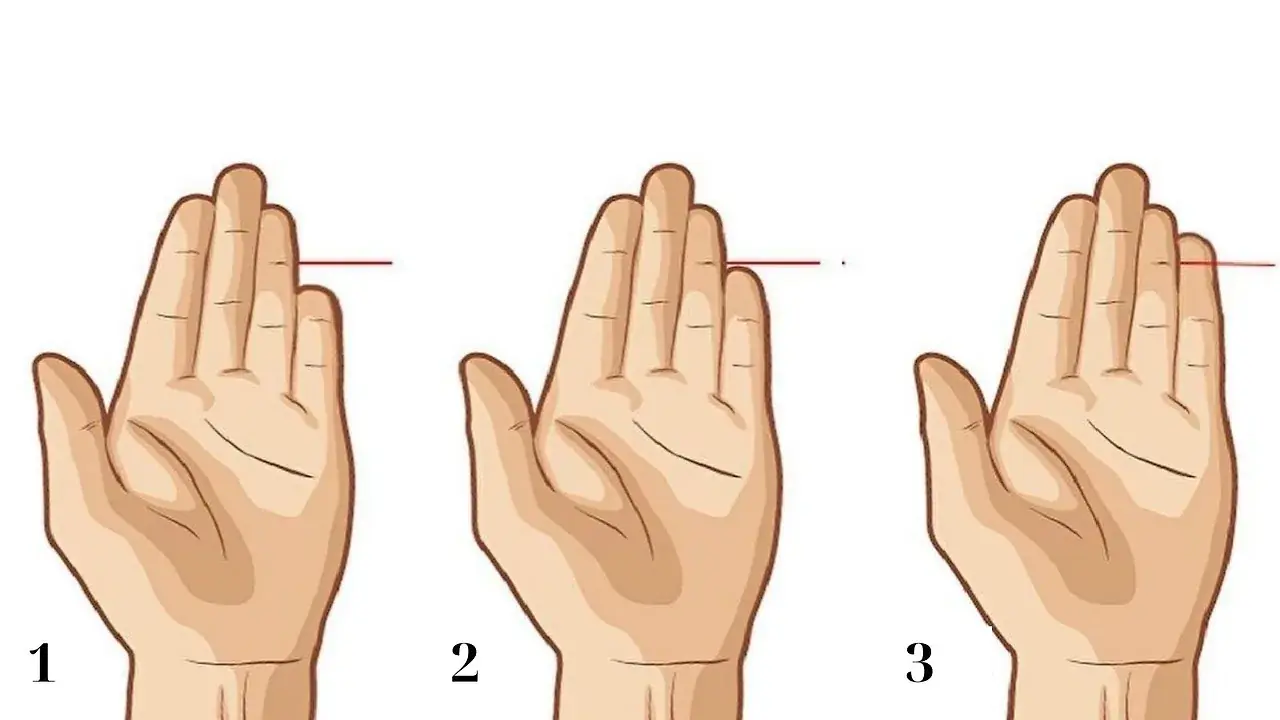
Why are finger lengths different?
Human hands develop through a complex biological process influenced by genetics and other developmental factors. Finger proportions vary naturally between individuals, just as height, facial features, and body proportions do.
Even within the same family, people can have noticeably different hand shapes.
The index finger and ring finger are particularly interesting because their relative lengths are easy to compare. Some people have a ring finger that is longer than the index finger, while others have the opposite pattern. In some individuals, the difference is very small.
These variations are normal.
Before choosing A, B, or C, take a closer look.
The illustration encourages you to compare the two fingers rather than simply judging which hand looks more attractive.
Once you identify the pattern that most closely resembles your own, you can explore the personality description associated with it.
But the most interesting part is not the label itself. It is the opportunity to consider whether the qualities described actually appear in your everyday life.
And one of the three patterns is commonly associated with people who are described as bold, competitive, and willing to take risks.
Could that be you?
Chapter 2: Type A — The Bold, Ambitious, and Adventurous Personality
In popular finger-length personality quizzes, Type A is often associated with people whose ring finger is noticeably longer than their index finger.
This pattern has attracted attention partly because it is easy to recognize. When comparing the two fingers, the ring finger appears to extend farther.
Popular interpretations often connect this pattern with confidence, ambition, competitiveness, and a willingness to explore unfamiliar experiences.
If your hand resembles Type A, you may find some of these descriptions familiar.
A natural attraction to challenges
One characteristic commonly associated with this personality description is a willingness to face challenges.
People who enjoy challenges may feel motivated when they have a clear goal to pursue. They might enjoy competing, learning new skills, improving their performance, or taking on responsibilities that require determination.
Rather than becoming discouraged immediately when something becomes difficult, they may see obstacles as opportunities to discover what they are capable of doing.
For example, imagine two people receiving the same difficult assignment at work.
One person may prefer to wait until every detail is explained before beginning. The other may feel excited by the challenge and start exploring possible solutions immediately.
Neither approach is automatically better. However, the second approach reflects the adventurous spirit often associated with the Type A personality description.
Confidence and independence
Another theme associated with Type A is independence.
People who value independence may enjoy making decisions for themselves. They appreciate advice, but they do not necessarily want others controlling every aspect of their lives.
They may prefer learning through experience rather than relying entirely on instructions.
In professional settings, this tendency can be useful. Independent individuals may be comfortable taking initiative, proposing new ideas, and accepting responsibility for the results of their decisions.
They may also enjoy environments where creativity and personal effort are rewarded.
However, independence can sometimes become stubbornness.
A person who strongly believes in their own judgment may find it difficult to accept criticism, even when that criticism is constructive.