Sometimes a task can be completed well without being perfect.
Sometimes a conversation can be meaningful even if every sentence is not carefully prepared.
Sometimes a decision needs to be made before every uncertainty disappears.
If Type C resembles your fingers, consider whether you are allowing yourself enough freedom to make mistakes.
Being thoughtful is valuable, but personal growth also requires experimentation.
The most important lesson may be learning when to analyze and when to act.
Chapter 5: What Finger Length Really Tells Us About Human Personality
After exploring Types A, B, and C, you may have discovered that one description sounds surprisingly familiar.
Perhaps you identify with the ambition associated with Type A. Maybe you appreciate the balanced and cooperative qualities represented by Type B. Or perhaps the thoughtful, observant nature associated with Type C feels closer to your everyday behavior.
You may even recognize parts of yourself in all three.
That is perfectly normal.
Human personality is far more complex than a comparison between two fingers.
The science behind the 2D:4D ratio
The measurement commonly discussed in finger-length research is called the second-to-fourth digit ratio, or 2D:4D ratio.
It compares the length of the index finger with the length of the ring finger.
Researchers have investigated whether differences in this ratio may be associated with certain aspects of prenatal development, including possible influences involving sex hormones.
Some studies have reported statistical associations between the ratio and selected physical or behavioral characteristics.
However, these findings are not consistent enough to allow researchers to use finger length as a reliable tool for predicting an individual's personality.
There are several reasons for this.
First, human behavior is influenced by many factors, including genetics, upbringing, education, culture, personal experiences, relationships, and environment.
Second, even when a study identifies an association between two variables, that does not prove that one causes the other.
Third, statistical differences between groups do not necessarily provide useful predictions about individual people.
A particular finger-length pattern cannot tell you whether someone is honest, intelligent, loyal, aggressive, romantic, successful, or emotionally mature.
It cannot reliably predict someone's career, relationships, or future.
The popular interpretations of Types A, B, and C should therefore be treated as entertainment rather than scientific conclusions.
How to compare your fingers
If you want to explore the illustration for yourself, you can compare the index finger and ring finger on either hand.
Look at the relative position of their fingertips when your hand is relaxed and your fingers are extended naturally.
For a more consistent measurement, you can measure each finger from the crease at its base to the tip using a ruler.
Then compare the two measurements.
Keep in mind that small differences can be difficult to judge visually. Hand position, finger curvature, and measurement technique can affect the result.
Also, the left and right hands may not have exactly identical proportions.
There is no need to worry if your fingers do not fit neatly into one category.
Why personality quizzes remain popular
People enjoy personality quizzes because they provide an easy way to think about themselves.
A simple question can encourage someone to consider their habits, relationships, strengths, and challenges.
These exercises can also create enjoyable conversations.
Friends may compare their results, discuss which descriptions seem accurate, and discover that they have different approaches to similar situations.
The value comes from reflection and conversation, not from treating the result as a definitive assessment.
A useful personality exercise should encourage curiosity rather than place people into rigid categories.
Your character is shaped by your choices
Whether your fingers resemble A, B, or C, the qualities that matter most are developed through everyday actions.
Confidence grows when you learn to face difficult situations.
Patience develops when you practice listening and responding thoughtfully.
Independence becomes healthier when you combine personal responsibility with the ability to accept support.
Empathy becomes stronger when you make an effort to understand experiences different from your own.
These qualities are not fixed by the shape of your hands.
They can change and develop throughout life.
You can become more confident without becoming arrogant. You can become more patient without allowing others to take advantage of you. You can be independent while maintaining meaningful relationships.
That is what makes personality so interesting: people are constantly learning, adapting, and discovering new sides of themselves.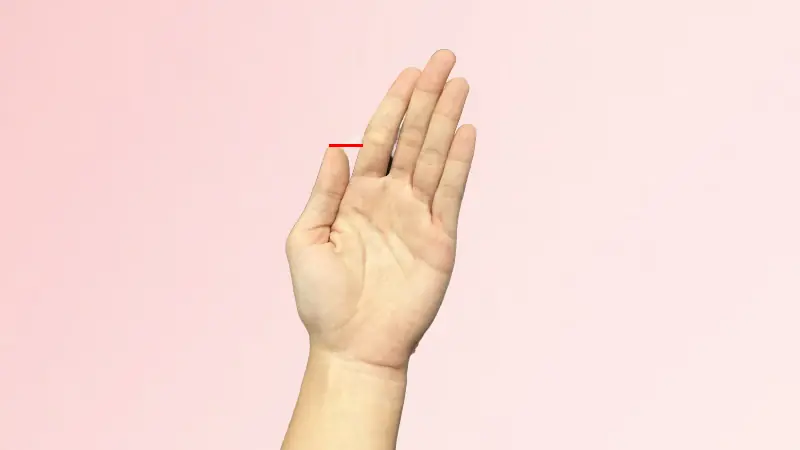
Final question: Which pattern matches your hand?
Take one more look at the illustration.
-
A: The ring finger appears longer than the index finger.
-
B: The index finger and ring finger appear approximately equal in length.
-
C: The index finger appears longer than the ring finger.
Which one looks most like your hand?
Choose the pattern that matches your natural finger proportions, then consider which personality description resonates with your experiences.
You might agree with some parts and disagree with others. There is no right or wrong answer.
After all, your hands may tell an interesting story about your physical characteristics, but your actions, values, decisions, and relationships reveal much more about the person you are.
Sometimes, the most surprising discovery is not hidden in the length of your fingers. It is found in the things you learn about yourself when you take the time to look a little closer.