Cassava: The Everyday Staple That Can Turn Deadly When Prepared Incorrectly
A food that sustains millions can also become dangerous when one crucial step is overlooked.
At first glance, cassava looks like an ordinary root vegetable. It is harvested from the ground, carried into kitchens, peeled, boiled, grated, dried, or ground into flour. Across large parts of Africa, Asia, and Latin America, it becomes bread, porridge, cakes, noodles, and countless traditional meals. For hundreds of millions of people, cassava is not an unusual ingredient or an occasional delicacy. It is part of everyday life.
Yet behind this familiar food lies a serious risk. Some varieties of cassava naturally contain compounds that can release cyanide, a highly toxic substance, if the roots are eaten raw or processed incorrectly. Under the wrong conditions, a meal that appears perfectly ordinary can expose someone to dangerous levels of toxins.
That contrast raises an unsettling question: How can a food associated with hundreds of deaths and serious illnesses remain an essential part of the diet for so many people? The answer is not simply that people are unaware of the danger. Cassava is affordable, adaptable, nourishing, and capable of growing in places where other crops struggle. For many communities, giving it up is not a realistic choice.
To understand why cassava remains so important—and why its preparation matters so much—we need to look beyond the alarming headline and examine the plant, the chemistry hidden inside it, and the everyday practices that make it safe to eat.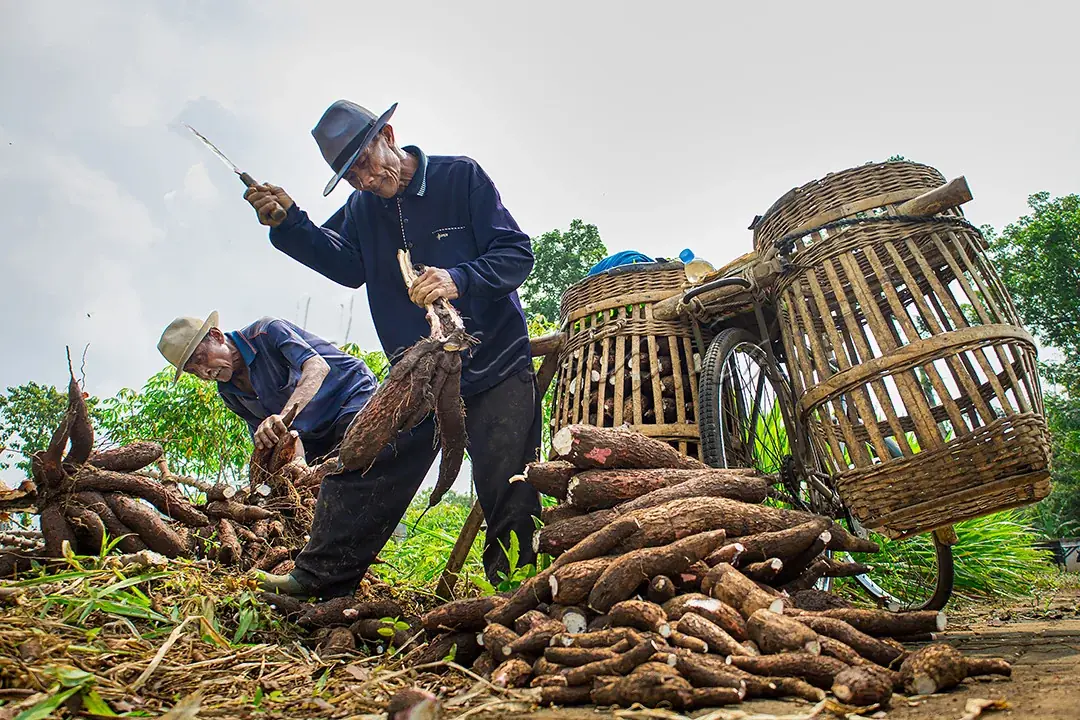
The Root Behind the Headline
Cassava, scientifically known as Manihot esculenta, is a woody shrub cultivated for its thick, starchy roots. It originated in South America and spread over centuries to tropical regions around the world. Today, it is especially important in sub-Saharan Africa, where it provides a substantial share of daily calories for many households. It is also widely grown and eaten in parts of Southeast Asia, the Pacific, and Latin America.
The plant has several qualities that explain its extraordinary reach. It can tolerate periods of drought better than many other staple crops, grows in soils that may be unsuitable for more demanding plants, and can remain in the ground until a household needs to harvest it. Farmers can often stagger harvesting rather than collecting the entire crop at once. This flexibility makes cassava valuable in regions where rainfall is unpredictable and food supplies can be uncertain.
The root itself is rich in carbohydrates, making it an effective source of energy. It is not, however, a complete food. Cassava contains relatively little protein and does not provide all the vitamins and minerals a person needs. Communities that depend heavily on it benefit most when it is eaten alongside beans, fish, meat, vegetables, or other foods that supply missing nutrients.
Its versatility is another reason it has become so deeply embedded in food cultures. In some places, cassava is boiled and served as a simple side dish. In others, it is grated, fermented, pressed, roasted, or dried to create products with distinctive textures and flavours. It can become flour for bread and cakes, starch for thickening sauces, or small pearls used in desserts and drinks.
The same root can therefore appear in very different meals. A family in one country might eat it as a boiled accompaniment to a savoury stew, while another community turns it into a fermented dough or a crisp snack. Tapioca, a familiar ingredient in puddings and other desserts, is also derived from cassava starch.
This is why the headline's reference to nearly 500 million consumers is important. The figure is consistent with historical descriptions from the Food and Agriculture Organization, which has described cassava as a basic food for around 500 million people. It should be understood as an estimate from an earlier FAO publication, rather than a precise, newly measured count of everyone who eats cassava today. The FAO also notes that the crop supports farmers, processors, and traders across the world.
For those households, cassava is not simply a fashionable ingredient that can be replaced with another product. It is tied to local farming systems, family recipes, markets, livelihoods, and the practical realities of what can be grown and afforded.
But there is a second side to this remarkable crop. The very plant that offers dependable calories also has a natural chemical defence. And that is where the danger begins.
The Natural Toxin Hidden Inside Cassava
Cassava contains compounds known as cyanogenic glycosides. The most important of these is called linamarin, although another compound, lotaustralin, is also present. These substances are found naturally in the plant. They are not added during farming, and their presence does not mean that every cassava root is poisonous in the same way.
When the plant's tissues are damaged—for example, when the root is cut, crushed, grated, or chewed—enzymes can act on the cyanogenic compounds and release hydrogen cyanide. Cyanide interferes with the body's ability to use oxygen at the cellular level. In a sufficiently high dose, it can rapidly disrupt vital organs and become life-threatening.
The amount of cyanogenic compounds varies. Some cassava varieties contain relatively low levels and are often described as “sweet” cassava. Others contain much higher levels and are commonly called “bitter” cassava. These names refer to differences in the plant and its chemical content; they are not a reliable safety test for consumers.
A root that tastes mild is not automatically safe to eat raw. Nor should a person assume that a bitter taste is the only warning sign. The amount of toxin can vary according to the variety, growing conditions, plant age, and other factors. Even roots from the same broad type of cassava may not have identical cyanide potential.
The World Health Organization identifies cassava among important foods that contain cyanogenic glycosides. It explains that the danger depends on whether eating the plant results in a cyanide concentration high enough to overwhelm the body's ability to detoxify it. In other words, the risk is related to the dose that reaches the body—not merely to the fact that cassava contains a naturally occurring toxin.
This distinction matters because cassava is not inherently an unsafe food when properly handled. Traditional processing methods have developed precisely because communities learned how to transform the root into something suitable for eating. The problem arises when those methods are skipped, shortened, or carried out incorrectly.