The photograph accompanying this article shows a person's upper arm with numerous raised bumps arranged in two numbered columns. At first glance, the pattern may look unusual or even frightening.
However, the markings provide an important clue.
The image appears consistent with a skin-prick allergy test or an intradermal allergy test. These procedures are used by healthcare professionals to investigate whether a person is sensitive to particular substances.
They are not standard tests for sexually transmitted infections.
What are the raised bumps?
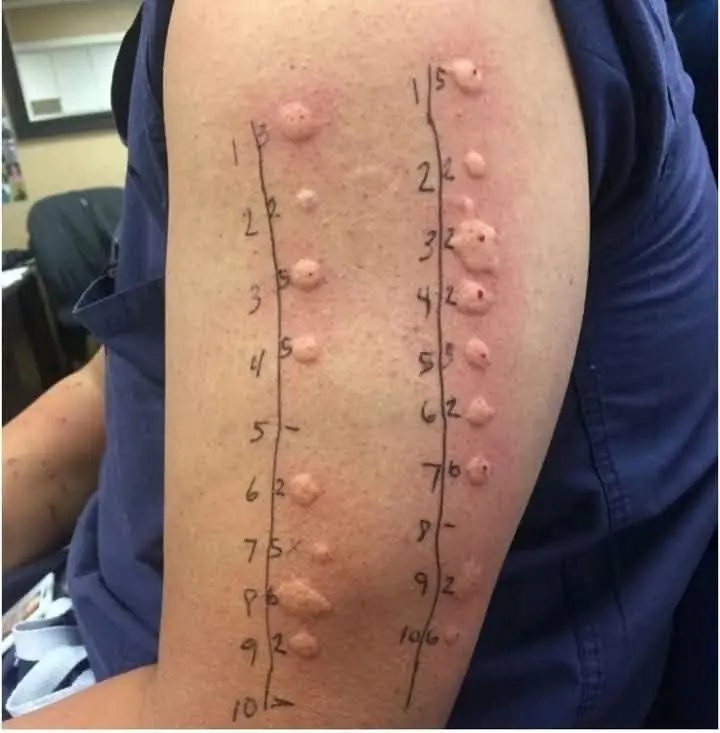
During a skin-prick test, a healthcare professional places small drops of different allergen extracts on the skin, usually on the forearm or back. The skin is then gently pricked so that a tiny amount of each substance comes into contact with the immune system.
The testing locations are numbered so that the medical team can identify which substance corresponds to each reaction.
If someone is sensitized to a particular allergen, the tested area may develop a raised, swollen bump called a wheal.
These bumps can resemble mosquito bites.
In an intradermal test, a very small quantity of an allergen is injected just beneath the surface of the skin. This method is sometimes used when investigating allergies to certain medicines or insect venoms.
The healthcare professional measures the reactions and compares them with appropriate controls.
A larger reaction may indicate greater sensitization, but it does not automatically mean that the person will experience a severe allergic reaction in everyday life.
The result must be interpreted alongside the person's medical history and symptoms.
Why is this different from an STI test?
Sexually transmitted infections are investigated using different methods.
Depending on the suspected infection, a healthcare professional may request a urine sample, blood test, genital swab, or sample from another affected area.
For example, chlamydia and gonorrhea are commonly investigated using molecular tests that detect the genetic material of the bacteria.
Syphilis and HIV are generally investigated using blood tests.
A raised bump on the arm cannot identify these infections.
This distinction matters because dramatic medical photographs are frequently shared online with misleading headlines. A picture showing a medical procedure may be used to suggest a completely different condition.
People who see such images may become frightened or incorrectly assume that they have a disease.
The most responsible approach is to understand what the image actually shows and separate that information from the health topic being discussed.
What does the headline about sleeping with someone really mean?
The phrase "sleeping with someone" is often used as a softer expression for sexual activity.
Sexual intimacy can be an important part of adult relationships, but it also involves responsibilities concerning health, consent, communication, and protection.
When two people have sexual contact, certain infections can pass between them through vaginal, anal, or oral sex.
Some infections can also spread through direct contact with infected skin or mucous membranes.
The difficulty is that a person may carry an infection without knowing it.
They may look completely healthy, feel normal, and have no visible symptoms.
This is one of the reasons sexual health testing is important.
The World Health Organization reports that more than one million curable sexually transmitted infections are acquired every day worldwide among people aged 15–49, with many infections producing no noticeable symptoms.
In other words, the absence of visible symptoms does not guarantee that someone is free from infection.
Why should people take sexual health seriously?
An untreated infection may sometimes cause complications that develop gradually.
Depending on the pathogen, these complications can include reproductive problems, chronic inflammation, pregnancy complications, and damage to certain organs.
However, many common bacterial and parasitic infections are treatable, particularly when identified early.
Some viral infections can be managed with medication, even when they cannot currently be completely eliminated from the body.
The purpose of sexual health awareness is therefore not to create fear or shame.
It is to encourage people to understand how infections spread, recognize possible symptoms, seek appropriate testing, and protect themselves and their partners.
The photograph may show an allergy investigation, but the broader message remains important: medical appearances can be misleading, and accurate testing is far more reliable than assumptions.
Chapter 2: Five Sexually Transmitted Infections That Can Remain Hidden
One of the most concerning characteristics of sexually transmitted infections is that many people do not realize they have acquired one.
Some infections produce symptoms within days or weeks. Others may remain unnoticed for months or longer.
A person can continue their normal routine, maintain relationships, and feel completely healthy while an infection remains present.
This is why understanding the most common infections is so important.
1. Chlamydia: An infection that may cause no obvious symptoms
Chlamydia is caused by the bacterium Chlamydia trachomatis.
It can spread through vaginal, anal, and oral sexual contact.
Many infected people do not experience noticeable symptoms.
When symptoms occur, women may notice unusual vaginal discharge, burning during urination, bleeding between periods, or pelvic discomfort.
Men may experience discharge from the penis, burning during urination, or pain in the testicles.
One reason chlamydia deserves attention is its potential effect on reproductive health.
If an infection is left untreated, it may spread to the reproductive organs and cause pelvic inflammatory disease in women.
This can increase the risk of ectopic pregnancy, chronic pelvic pain, and infertility.
The good news is that chlamydia is generally curable with appropriate antibiotics.
Testing is particularly important after possible exposure, even if there are no symptoms.
2. Gonorrhea: An infection that can affect several parts of the body
Gonorrhea is another bacterial STI.
It is caused by Neisseria gonorrhoeae and can infect the genitals, rectum, and throat.
Women may notice increased vaginal discharge, painful urination, or bleeding between menstrual periods.
Men may experience discharge from the penis and discomfort when urinating.
However, many infections produce few or no symptoms, especially when they affect the throat or rectum.
If gonorrhea is not treated, it can lead to serious reproductive complications.
In women, the infection may contribute to pelvic inflammatory disease. In rare cases, the bacteria can spread through the bloodstream and affect joints or other parts of the body.
Gonorrhea is treatable with antibiotics, but antimicrobial resistance has become an important global concern.
This means that treatment should follow current medical recommendations rather than relying on leftover antibiotics or medication purchased without professional advice.
World Health Organization
3. Syphilis: The infection that can develop in several stages
Syphilis is caused by the bacterium Treponema pallidum.