Chapter 1: What Are Those Strange Bumps Inside Your Mouth?
Most people do not pay much attention to the inside of their mouths until something unusual appears.
It might begin as a tiny, painless bubble beneath the tongue, a soft lump inside the lower lip, or a rounded swelling near the gums. At first, the change may seem insignificant. Some people assume they accidentally bit themselves while eating, while others believe the swelling will disappear without treatment.
In many cases, that assumption is correct. However, not every unusual growth inside the mouth has the same cause.
Some bumps are harmless mucus-filled cysts. Others may develop because of irritation, infection, inflammation, or changes in the tissues lining the mouth. Occasionally, a persistent lump or unusual patch can be an early warning sign of oral cancer.
The important thing is understanding what may be happening and knowing when to seek professional advice.
1. A soft, transparent bubble beneath the tongue
One possible explanation for a smooth, rounded swelling inside the mouth is a ranula.
A ranula is a type of mucus-filled cyst that develops when saliva escapes from or becomes trapped around a salivary gland, usually beneath the tongue.
It may appear as a soft, dome-shaped swelling with a bluish, translucent, or pink appearance.
Small ranulas may cause little discomfort. Some people discover them accidentally while brushing their teeth or examining their mouths.
Larger ones can create problems with speaking, chewing, or swallowing.
According to MedlinePlus, ranulas are associated with the salivary glands beneath the tongue. Their size and symptoms can vary, and medical evaluation is important when a swelling causes difficulties.
MedlinePlus
2. A small, round lump inside the lower lip
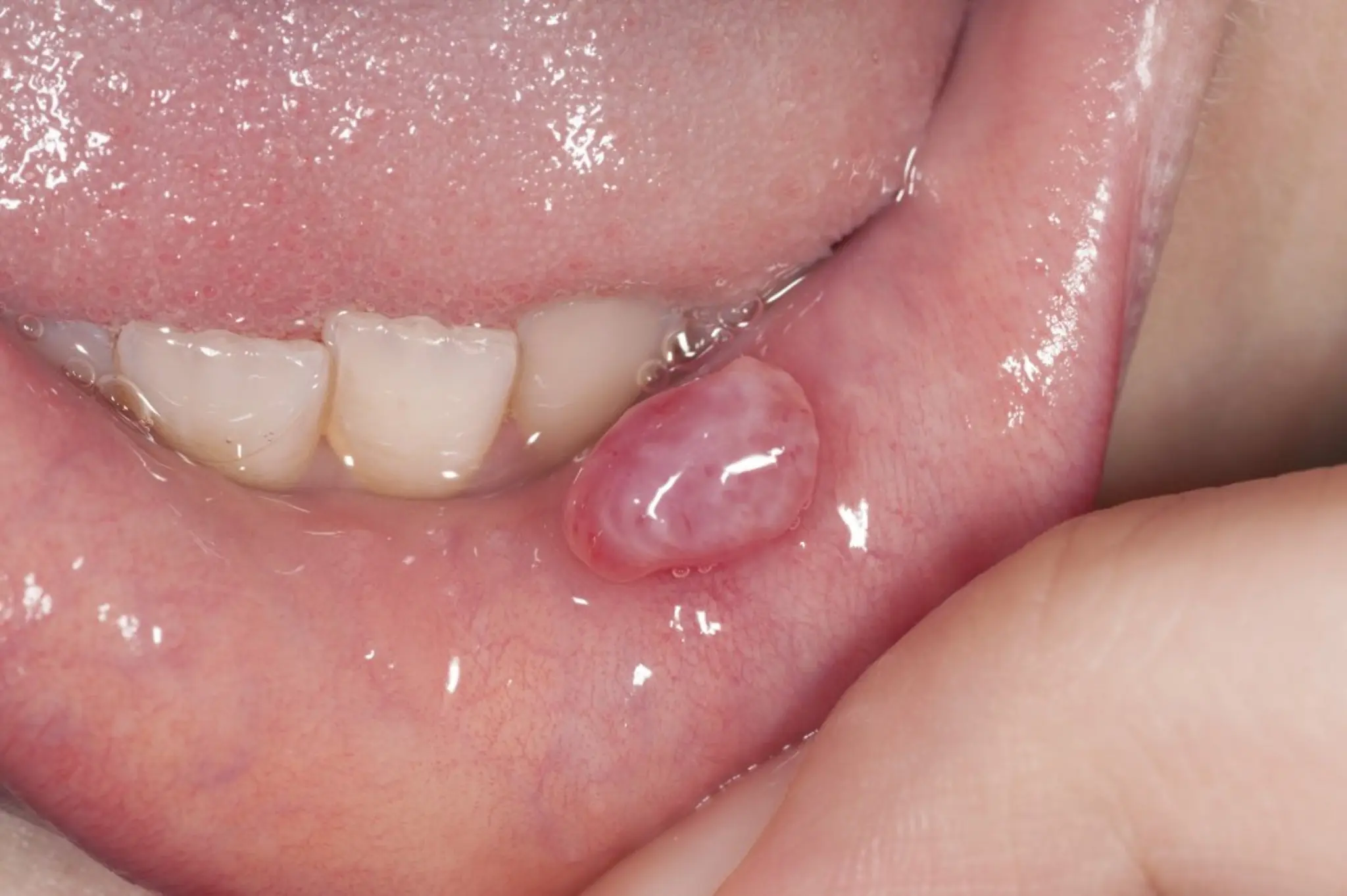
Another common possibility is a mucocele, also known as an oral mucous cyst.
These cysts often develop when a small salivary gland or its duct is injured.
This can happen after accidentally biting the lower lip, repeatedly sucking the lip, or experiencing minor trauma inside the mouth.
A mucocele may look like a small, smooth, round bubble.
Its color can be transparent, bluish, pink, or similar to the surrounding tissue.
Many mucoceles are painless, although their presence can become annoying when talking, eating, or moving the lips.
Some may rupture naturally and temporarily disappear, but they can return.
3. A swelling near the gums
Not every lump inside the mouth comes from a salivary gland.
Some develop in the gum tissue because of irritation, infection, or inflammation.
For example, a dental abscess can produce a painful swelling near a tooth.
It may be accompanied by toothache, sensitivity, unpleasant taste, pus, or swelling around the affected area.
An abscess should not be ignored because a dental infection can spread into surrounding tissues.
Other gum growths may be associated with chronic irritation or benign tissue overgrowth.
A dentist can examine the area and determine whether dental imaging or additional treatment is necessary.
4. Why the appearance alone cannot tell you the diagnosis
One of the biggest mistakes people make is trying to identify a mouth condition based only on photographs.
A smooth, rounded lump may resemble a harmless cyst, but other conditions can sometimes look similar.
Likewise, oral cancer does not always appear as a large or dramatic growth.
Some suspicious changes begin as a small ulcer, a red or white patch, or a thickened area of tissue.
This is why doctors and dentists consider several factors:
-
Where the growth appears.
-
How long it has been present.
-
Whether it is growing.
-
Whether it causes pain or bleeding.
-
Whether its color or texture has changed.
-
Whether swallowing or speaking has become difficult.
A proper examination is much more reliable than comparing photographs online.
The most important message is simple: a small bump is not automatically dangerous, but an unusual growth that persists or changes deserves attention.
Chapter 2: Five Possible Causes of Unusual Growths Inside the Mouth
Finding a lump inside your mouth can be worrying, especially when it appears suddenly.
However, there are several possible explanations, and many are not cancerous.
Understanding the most common causes can help people recognize when a problem may require dental or medical attention.
1. Mucocele: A small cyst caused by trapped saliva
A mucocele is one of the common causes of soft, rounded bumps inside the mouth.
It often develops after an injury to a minor salivary gland or its duct.
The lower lip is a particularly common location.
A person may accidentally bite the same area repeatedly, damaging the delicate tissue and allowing saliva to collect beneath the surface.
The resulting swelling may look like a tiny water-filled blister.
Some mucoceles disappear without treatment, while others repeatedly return.
If the swelling remains, becomes uncomfortable, or interferes with eating, a dentist may recommend treatment.
Importantly, people should not attempt to cut, puncture, or squeeze a mucocele themselves.
Doing so can cause bleeding, infection, and further tissue injury.
2. Ranula: A swelling beneath the tongue
A ranula develops when saliva accumulates in the tissues beneath the tongue.
It may appear as a translucent or bluish swelling on the floor of the mouth.
Small ranulas sometimes remain unnoticed for a long time.
Larger ones may push the tongue upward or create discomfort when speaking and swallowing.
In certain cases, a ranula can extend into the tissues of the neck.
A healthcare professional may use an examination and imaging tests to determine its size and extent.