This Looked Like an Ordinary Family Photo From 1872, but Take a Closer Look at the Sister’s Hand
At first glance, there is nothing particularly unusual about this old family photograph. A mother sits quietly in the center, surrounded by her three children. Their dark clothing, solemn expressions, and carefully arranged positions make the picture look like thousands of other family portraits taken during the Victorian era.
But one small detail has turned this seemingly ordinary photograph into an internet mystery.
Look closely at the older daughter standing beside her mother. Near her hand, just below the waistline of her dress, there appears to be a strange shape that does not seem to belong where it should. Some viewers believe it resembles an additional hand. Others notice what looks like a set of fingers resting against the girl's clothing, apparently disconnected from the arm that should explain them.
Once you notice it, the photograph becomes difficult to look at in the same way again.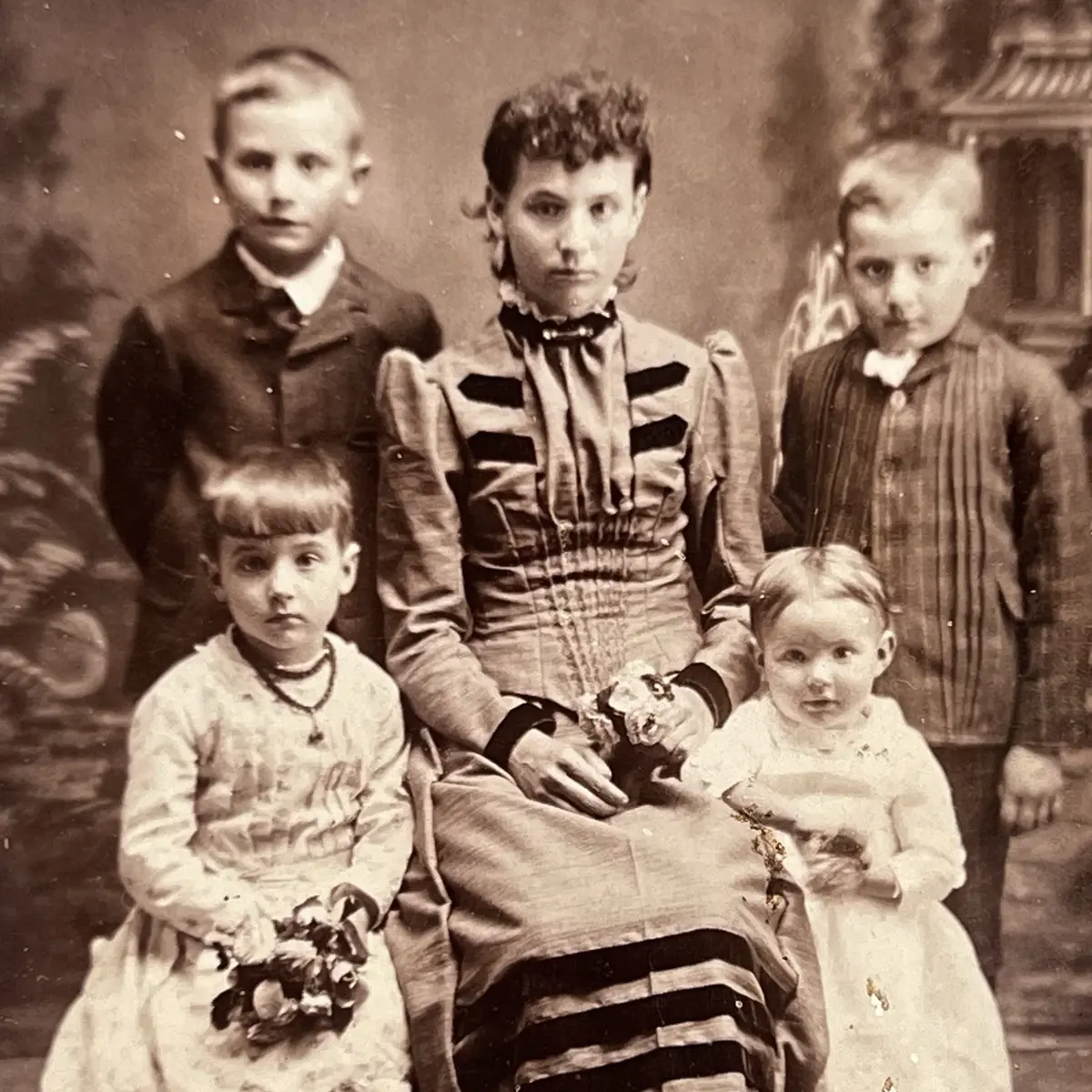
The question is not simply whether the shape looks unusual. The more interesting question is how it came to appear in a photograph that seems so carefully arranged. Was another person standing just outside the frame? Could the shape belong to the mother or one of the children? Did the folds of the dress create an illusion that becomes more convincing when the picture is enlarged?
And perhaps the most important question of all: Does the photograph really date back to 1872, and can anyone establish what the mysterious shape actually is?
The image has circulated online with a dramatic description suggesting that a detail hidden for more than 150 years has finally been noticed. Yet the story becomes even more intriguing when we separate what can be seen from what has merely been claimed.
The photograph may contain a genuinely puzzling detail. But the explanation requires more than a quick glance, a dramatic caption, or an assumption that anything strange in an old picture must have a supernatural origin.
To understand the mystery, we need to look at the family portrait itself, the girl's position, the way Victorian photographs were made, and the surprising reasons why our eyes can sometimes turn an ordinary shape into something that appears impossible.
A Family Portrait That Looks Completely Ordinary
The photograph shows a woman seated in the middle of a formal studio arrangement. She wears a dark, long dress typical of the style commonly associated with the nineteenth century. Her posture is straight, and her hands rest together in front of her.
Three children stand around her.
The older daughter is positioned beside the seated woman, wearing a dark dress that reaches toward her ankles. Two younger children stand on either side of the group. Their clothing is simple and formal, and their expressions are serious.
Nothing about the arrangement immediately suggests that the photograph was intended to capture an unusual event.
In fact, the composition is remarkably familiar. The mother occupies the central position, while the children are arranged close enough to emphasize their relationship. The photographer appears to have created a balanced scene in which each person has a clearly defined place.
The family is not shown laughing, playing, or interacting naturally. Instead, everyone appears to be holding a pose for the camera.
This was a common feature of many historical studio portraits. A family photograph was often treated as an important keepsake rather than a casual snapshot. People dressed carefully, traveled to a photographer's studio, and sat or stood in positions selected to create a formal image.
The result was meant to preserve a respectable representation of the family.
That is precisely why the unusual detail attracts attention.
When a photograph appears carefully organized, viewers naturally expect every visible arm and hand to have an understandable position. The mother's hands seem to belong to her. The younger children's arms appear connected to their bodies. The older daughter's posture also looks straightforward.
Then the eye reaches the small shape near her hand.
Suddenly, the arrangement seems less certain.
The Sister's Hand: The Detail That Changes Everything
The unusual shape is located around the older daughter's hand and the folds of her dress.
In the circulated image, a small area appears to contain fingers or part of a hand in a position that is difficult to interpret immediately. The shape seems to overlap with the girl's clothing, creating the impression that an additional hand may be present.
The problem is not that the detail is completely invisible. It is that the detail is visible enough to invite interpretation, yet unclear enough to resist a simple explanation.
A viewer might initially assume that the hand belongs to the girl herself. But after following the visible arm, the position can begin to look awkward. Another viewer might think the shape belongs to the seated mother, although the angle does not make that conclusion immediately obvious.
The more closely someone studies the image, the more questions seem to appear.
Could the girl be holding something? Is part of the shape hidden by the fabric? Does the mother's arm overlap with the daughter's hand? Is the apparent set of fingers actually a section of the dress that happens to resemble a hand?
These are reasonable questions because the photograph is not a modern, high-resolution image.
The version circulating online has been reproduced at a relatively small size. The original photographic surface is not available for direct examination in the supplied image. That means important details may have been lost through copying, resizing, compression, or cropping.