If the shape changes from one version to another, that would suggest that reproduction or editing may be influencing what viewers see.
If it remains consistent across several independently documented copies, that would provide stronger evidence that the detail was present in the original photograph.
Even then, the shape would still need to be identified.
What Would Be Needed to Solve the Mystery?
The most useful next step would be to locate the original photograph or a reliable archival scan.
A proper investigation would begin with the physical image rather than the headline.
Researchers would want to know where the photograph was found, who owned it, whether it has a studio mark, and whether the family can be identified.
The original print might contain information that is not visible in the circulated copy.
The back of the photograph could include a handwritten name, date, location, or note. The mounting card might provide clues about the photographer or the studio. The paper and photographic process could help narrow the date.
A high-resolution scan would also allow the unusual hand to be examined in greater detail.
The investigator could compare the shape with the visible arms and hands of the mother and children. They could study the direction of the fingers, the position of the wrist, and the way the clothing overlaps.
If multiple original copies exist, they could be compared side by side.
A careful investigation would also avoid assuming that the photograph was taken in 1872 simply because that year appears in a caption.
The date, the identity of the family, and the explanation for the hand are three separate questions. Each requires its own evidence.
It is possible that one of those questions could be answered while the others remain unresolved.
For example, an archive might confirm that the photograph was taken during the 1870s but still be unable to identify the hand. Or the hand might be explained by the clothing even if the family's identity remains unknown.
A genuine investigation does not need to solve every part of the mystery at once.
It needs to establish what can be known and clearly identify what remains uncertain.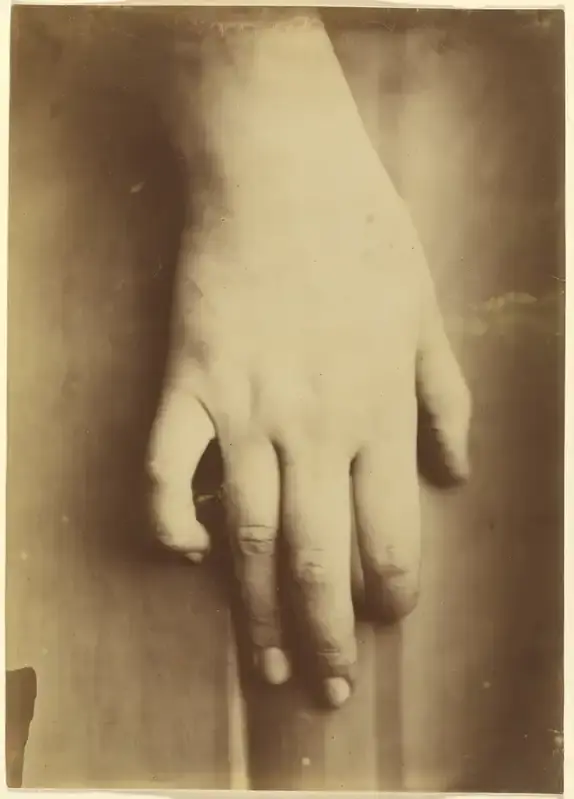
What the Photograph Can—and Cannot—Tell Us
There is something powerful about a photograph that survives for more than a century.
The people in the image may have disappeared from living memory, but their faces remain. Their clothing, posture, and expressions preserve a small part of a moment that would otherwise have been lost.
That is the real value of historical photography.
A family portrait can reveal how people dressed, how they presented themselves, and what they considered important enough to preserve. It can also provide clues about social relationships, family structure, and the conventions of the period.
But a photograph has limits.
It cannot tell us everything about the people who stood before the camera. It cannot explain every shadow or identify every object. And when the image has been copied many times, some of the original information may no longer be available.
The mysterious hand in this portrait illustrates those limits.
The detail is interesting because it appears to challenge the otherwise ordinary arrangement of the family. It encourages viewers to look more carefully and to question what they see.
Yet the photograph does not establish that an extra person was present, that the image was altered, or that anything supernatural occurred.
The most responsible conclusion is that the circulated picture contains an ambiguous hand-like shape near the older daughter's hand. Its exact origin remains unconfirmed, and the widely repeated date of 1872 has not been independently established by the material accompanying the image.
That may not be the dramatic answer some viewers were hoping for.
But it is a more meaningful starting point for understanding the photograph.
The Detail That Keeps Bringing People Back
Look at the photograph once more.
The mother sits in the center, surrounded by her children. The older daughter stands beside her, dressed in the formal clothing of a historical portrait. The younger children remain at the edges of the composition.
Everything appears carefully arranged.
Then the eye returns to the girl's hand.
The strange shape seems to interrupt the order of the scene. It raises a question that the rest of the photograph does not answer immediately.
That is why the image continues to attract attention.
The mystery is not necessarily that something impossible happened in front of the camera. It may be that a small, unclear detail has survived while the information needed to explain it has disappeared.
Perhaps the shape belongs to another visible hand. Perhaps it is a fold of fabric, a shadow, or an artifact created when the photograph was reproduced. Perhaps a better-quality copy would make the answer obvious.
At present, none of those possibilities can be confirmed from the supplied image alone.
And that is precisely what makes the photograph worth examining carefully.
The picture reminds us that history is not always presented as a complete story. Sometimes it survives as a fragment—a face without a name, a date without a record, or a detail that seems to make no sense until someone studies it more closely.
The sister's hand may eventually receive a simple explanation.
Until then, the photograph remains a fascinating example of how a seemingly ordinary family portrait can become an enduring visual puzzle.
The most important lesson is not to assume that the strangest interpretation must be the correct one.
It is to look closely, ask better questions, and remember that the past deserves curiosity as well as caution.