Keeping floors clean can feel like a never-ending household chore. Even after sweeping, vacuuming, and mopping, dust seems to return almost immediately. Footprints appear near the entrance, kitchen floors become sticky after cooking, and small stains can make an otherwise tidy room look messy.
Many people spend money on expensive floor cleaners, specialized detergents, and products promising to leave surfaces sparkling for days. Yet some of the most useful household cleaning ingredients may already be sitting in your kitchen.
Two commonly used ingredients are white vinegar and a small amount of dish soap. When used appropriately on compatible floor surfaces, they can help remove everyday dirt, grease, and residue.
However, the secret is not simply pouring more products into a bucket. The type of flooring, the amount of each ingredient, and the way you mop all matter.
A cleaning mixture that works well on certain ceramic tiles may damage natural stone, hardwood, or other sensitive materials. Understanding these differences can help you clean more effectively without creating unnecessary problems.
Here is how these two ingredients work, how to use them safely, and what other simple habits can help keep your floors looking cleaner for longer.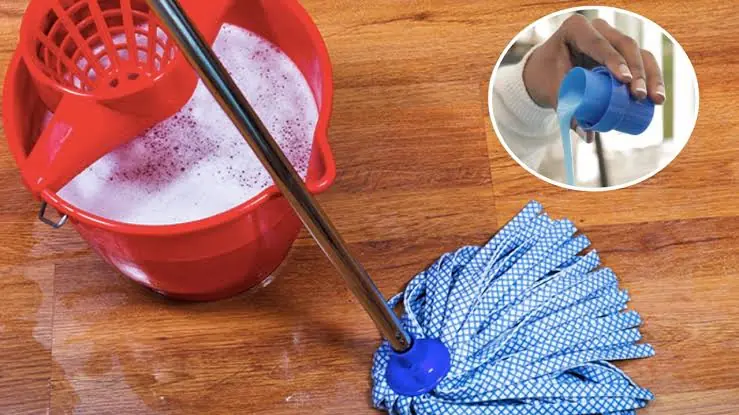
1. White Vinegar: A Common Ingredient for Removing Everyday Residue
White vinegar is one of the most popular household cleaning ingredients.
It contains acetic acid, which gives it its characteristic sour smell and acidic properties.
Because of this acidity, diluted white vinegar can help dissolve certain mineral deposits, soap residue, and some types of everyday buildup on suitable surfaces.
For example, floors near kitchen sinks, bathrooms, and frequently used entrances may accumulate residue from water, cleaning products, and daily activity.
On compatible surfaces, a properly diluted vinegar solution may help loosen some of this buildup.
Why do people use vinegar for mopping?
There are several reasons white vinegar has become a familiar household cleaning option.
It helps dissolve certain mineral deposits.
Hard water can leave mineral residue on surfaces. The mild acidity of diluted vinegar can help dissolve some of these deposits.
It can help remove certain cleaning residues.
When too much detergent is used during previous cleaning sessions, residue may remain on the floor. Diluted vinegar can help remove some types of alkaline buildup on compatible surfaces.
It is inexpensive and widely available.
White vinegar is generally affordable and easy to find in grocery stores.
It does not leave the same type of fragrance residue as many scented cleaners.
Some people prefer vinegar because it does not contain the added perfumes found in many commercial cleaning products.
However, vinegar is not a universal floor cleaner. Its acidity can damage certain materials, particularly natural stone such as marble, limestone, travertine, and some granite finishes.
It can also damage certain grout, sealants, waxed surfaces, and protective coatings.
For this reason, always check the flooring manufacturer's care instructions before using vinegar.
2. Dish Soap: A Simple Way to Help Remove Grease and Dirt
The second ingredient is ordinary dish soap.
Dish soap is designed to remove grease and food residue from dishes, making it useful for cleaning certain washable household surfaces.
Its cleaning action comes from substances called surfactants.
Surfactants help water interact with oily substances that would otherwise resist being washed away.
When used in an appropriate, small amount, dish soap can help loosen:
-
Grease from cooking.
-
Food spills.
-
Everyday dirt.
-
Sticky footprints.
-
Light stains.
-
Oily residue near kitchen areas.
This is particularly useful for floors in busy households where cooking, eating, children, and pets can contribute to daily mess.
Why should you use only a small amount?
Using more dish soap does not necessarily produce cleaner floors.
In fact, excessive soap can leave a sticky film that attracts dust and dirt.
This may make the floor appear dirty again soon after mopping.
A small amount is usually sufficient for light household cleaning.
The goal is to loosen dirt and remove it with clean water, not to cover the floor with a thick layer of detergent.
If the floor feels slippery, looks cloudy, or develops streaks after drying, you may have used too much soap.
3. Can You Combine White Vinegar and Dish Soap?
This is where the popular household cleaning trick becomes interesting.
White vinegar and dish soap are sometimes combined in DIY cleaning recipes because they perform different functions.
Vinegar provides mild acidity, while dish soap contains surfactants that help loosen grease and dirt.
However, combining the two does not automatically make the mixture more powerful.