Second, the setting was important.
Cannes is one of the world's most recognizable film destinations. Its red carpet has become a stage for some of the most photographed fashion moments in modern history.
Diana's presence connected royal glamour with international cinema.
Third, the photograph included a recognizable royal couple.
Prince Charles and Diana were among the most closely followed public figures of the 1980s. Their appearances attracted international press attention, and photographs of them were widely circulated.
Fourth, the connection to Grace Kelly gave the gown a story that could be understood across generations.
People who remembered Grace from her Hollywood career could recognize the reference. Younger viewers could discover the connection through Diana's photograph.
Finally, the later history of both women added emotional weight.
A photograph taken in 1987 could be viewed as a simple fashion moment at the time. Decades later, it became part of a much larger story about celebrity, royal life, public expectations, and tragic loss.
The image has therefore survived not only because the dress was beautiful, but because it connects several chapters of twentieth-century popular culture.
The Dress Was More Than a Copy of Grace Kelly's Look
It is tempting to describe Diana's gown as a replica of Grace Kelly's dress, but that would overlook the work involved in adapting a historical inspiration.
Fashion designers frequently study earlier garments, film costumes, paintings, architecture, and historical silhouettes. They may borrow a color, a neckline, a fabric treatment, or a particular way of arranging an accessory.
The final design still has to work for the person wearing it.
Diana's dress was made for her body, her public role, and the event she was attending.
The original film costume had been created for a character in a fictional story. Diana's gown had to function as formal royal eveningwear at an international festival.
The two garments therefore served different purposes.
Grace's costume helped establish the character of Frances Stevens. It was part of the visual storytelling of To Catch a Thief.
Diana's gown expressed admiration for Grace while presenting the princess in a way that suited the 1987 occasion.
The matching stole was especially important because it echoed the movement and softness of the film costume. It also gave Diana a distinctive silhouette when photographed from different angles.
The result was not simply a reproduction.
It was an interpretation.
That is one of the reasons the dress remains interesting to fashion historians. It demonstrates how a designer can use a historical reference without losing the individuality of the person wearing the new garment.
The Auction That Brought the Dress Back Into the Spotlight
The story of the Cannes gown did not end when Diana left the festival.
Years later, the dress attracted renewed attention when it entered the world of celebrity fashion auctions.
The garment was eventually sold in 2013 for approximately £81,000.
Its sale reflected more than the value of the fabric or the work involved in making it.
Clothing worn by Diana has a special place in modern fashion history because her public appearances were documented so extensively. A dress associated with a major event can preserve a particular moment in time.
Collectors may be interested in the designer, the condition of the garment, its provenance, and the occasion on which it was worn.
The Cannes gown had several qualities that made it especially appealing.
It was created by Catherine Walker, one of Diana's most trusted designers. It had been worn at an internationally recognized film festival. Its inspiration could be traced to Grace Kelly and a classic Hitchcock film.
The garment therefore connected royal history, Hollywood costume design, and the public image of Diana.
Its later auction history helped introduce the story to another generation of readers.
People who had not followed the royal family in 1987 could discover the gown through museum exhibitions, fashion articles, and auction coverage.
The dress became a historical object rather than simply an outfit from an old photograph.
It also demonstrated how clothing can preserve stories that might otherwise be forgotten.
A garment can reveal what a person admired, how they wanted to be seen, and which cultural references mattered to them.
In this case, the gown preserved a connection between Diana and Grace Kelly that extended beyond a single evening.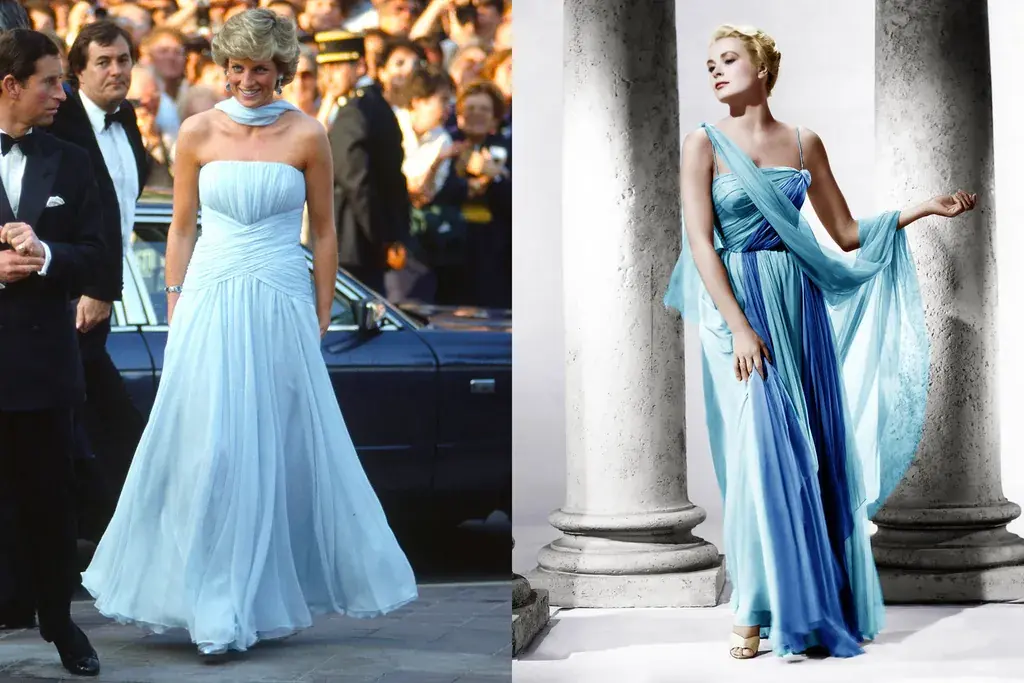
How Diana Used Fashion to Shape Her Public Identity
Diana's relationship with fashion changed considerably during her years in the royal family.
When she first became engaged to Prince Charles, she was a young woman who had not previously experienced life under constant international attention. Her clothing choices were suddenly discussed in newspapers and magazines, and even small details could become major stories.
Early photographs show a style that was often youthful, romantic, and strongly influenced by the expectations of royal presentation.
As the years passed, Diana became more confident in her choices.
She worked with designers who understood her personality and the demands of her public role. Catherine Walker, Bruce Oldfield, Victor Edelstein, and other designers helped her develop a wardrobe that could move between formal royal duties and more personal appearances.
Her clothing also became a way of communicating.
At some events, she chose traditional silhouettes that emphasized the formality of her position. At others, she wore brighter colors, modern tailoring, or simpler designs that made her appear more approachable.
She became known for understanding how clothing appeared in photographs.
A particular color could help her stand out in a crowded public setting. A carefully selected neckline could make a formal outfit feel less severe. A scarf, jacket, or piece of jewelry could become the detail that people remembered.
Her fashion choices were not always intended to send a political or personal message. Sometimes she simply liked a particular design.
But over time, she became increasingly skilled at using her public wardrobe to express individuality.
The Cannes gown fits into this development.
It was elegant and appropriate for a royal evening, but it also revealed something about her personal interests. She was familiar with the image of Grace Kelly and chose to acknowledge it through fashion.
That choice showed that Diana's wardrobe was not simply a collection of clothes selected for her by advisers.
It could also reflect her own tastes, memories, and admiration for other women.
The Public's Fascination With Two Women Who Became Princesses
Grace Kelly and Diana Spencer came from different backgrounds and entered royal life in different ways.
Grace was an established Hollywood actress when she married Prince Rainier III of Monaco. She had already achieved international recognition before becoming a princess.
Diana was a young woman from an aristocratic British family when she married Prince Charles. Her public identity changed dramatically after the engagement announcement, and she became one of the most photographed women in the world.
Despite those differences, both women became symbols of a particular kind of modern royalty.
They were admired for their appearance, followed by the press, and discussed as personalities beyond their official duties.
Their marriages also attracted enormous attention.
Grace's marriage to Rainier was widely described as a real-life fairy tale. The Hollywood star had become a princess, and the story seemed to combine romance, glamour, and European royal tradition.
Diana's marriage to Charles initially generated similar excitement. The young bride was presented as a romantic figure entering one of the world's most famous royal families.