But public attention could be demanding.
Both women had to manage the difference between their private lives and the expectations placed on them by the media.
Grace eventually stepped away from acting to fulfill her role in Monaco. Diana became increasingly involved in charity work and public causes while also developing a more independent identity.
The comparison between them should not be taken too far. Their experiences were not identical, and their personalities, responsibilities, and circumstances were different.
Still, the connection explains why Diana's tribute at Cannes felt meaningful.
She was honoring a woman who had also experienced the extraordinary transition from public celebrity to princess.
The Meaning of a Fashion Tribute After Someone Has Died
Fashion tributes are common in film, music, and public life.
Designers may recreate a famous silhouette, borrow a color associated with a particular person, or reinterpret an outfit that has become part of cultural memory.
Sometimes the tribute is explicit. Other times it is subtle, with the designer using a detail that only a knowledgeable observer might recognize.
When the person being honored has died, the garment can carry additional emotional significance.
It becomes a way of keeping a memory visible.
Diana's Cannes gown is an example of this process. Grace had died five years earlier, but her film image remained alive through television, cinema screenings, photographs, and fashion retrospectives.
The dress gave Diana an opportunity to acknowledge that legacy.
It also allowed the public to recognize a shared visual language between two women who had become important figures in modern royal history.
The emotional power of the dress grew over time because Diana also died unexpectedly.
Today, people can look at the photograph and remember both women at once. They may see Grace's elegance, Diana's admiration, and the tragic events that later changed the way their lives were remembered.
That is a legitimate emotional response to a historical image.
But it does not require an invented mystery.
A tribute can be meaningful without being prophetic. A dress can become symbolic without having been designed as a farewell. A photograph can feel haunting because of later events without containing a hidden warning.
The real story is powerful enough.
Why Viral Headlines Turn Historical Photographs Into Mysteries
The wording in the supplied image follows a familiar pattern used by online curiosity articles.
It begins with an intriguing claim: photographers captured a picture without realizing what they had photographed. It then suggests that a disturbing detail was discovered later.
This type of headline creates an information gap.
Readers are encouraged to wonder what the photographers missed. Was there someone in the background? Was Diana looking at something unusual? Was there a hidden object or an unexpected expression?
The headline does not immediately explain the supposed discovery. Instead, it asks the reader to continue looking.
There is nothing inherently wrong with creating curiosity around an old photograph. Historical images often contain details that become more interesting with time.
The problem arises when the promise of a shocking discovery is stronger than the available evidence.
In the Cannes photograph, the most important historical detail is the inspiration behind Diana's gown. It connects her to Grace Kelly and to Hitchcock's To Catch a Thief.
The photograph also gains emotional meaning because both women later died in car accidents.
However, there is no established evidence of a disturbing secret hidden in the image itself.
Readers should be cautious when an article claims that a photograph contains a mysterious message but does not identify the exact visible detail or provide reliable historical documentation.
A genuine discovery should be explainable.
If a person in the background has been identified, the article should say who that person is and why their presence matters. If a garment has a hidden feature, the article should show it clearly. If a photograph reveals a previously unknown event, the claim should be supported by records.
Without those details, the story may be using mystery as a way to attract attention rather than to explain history.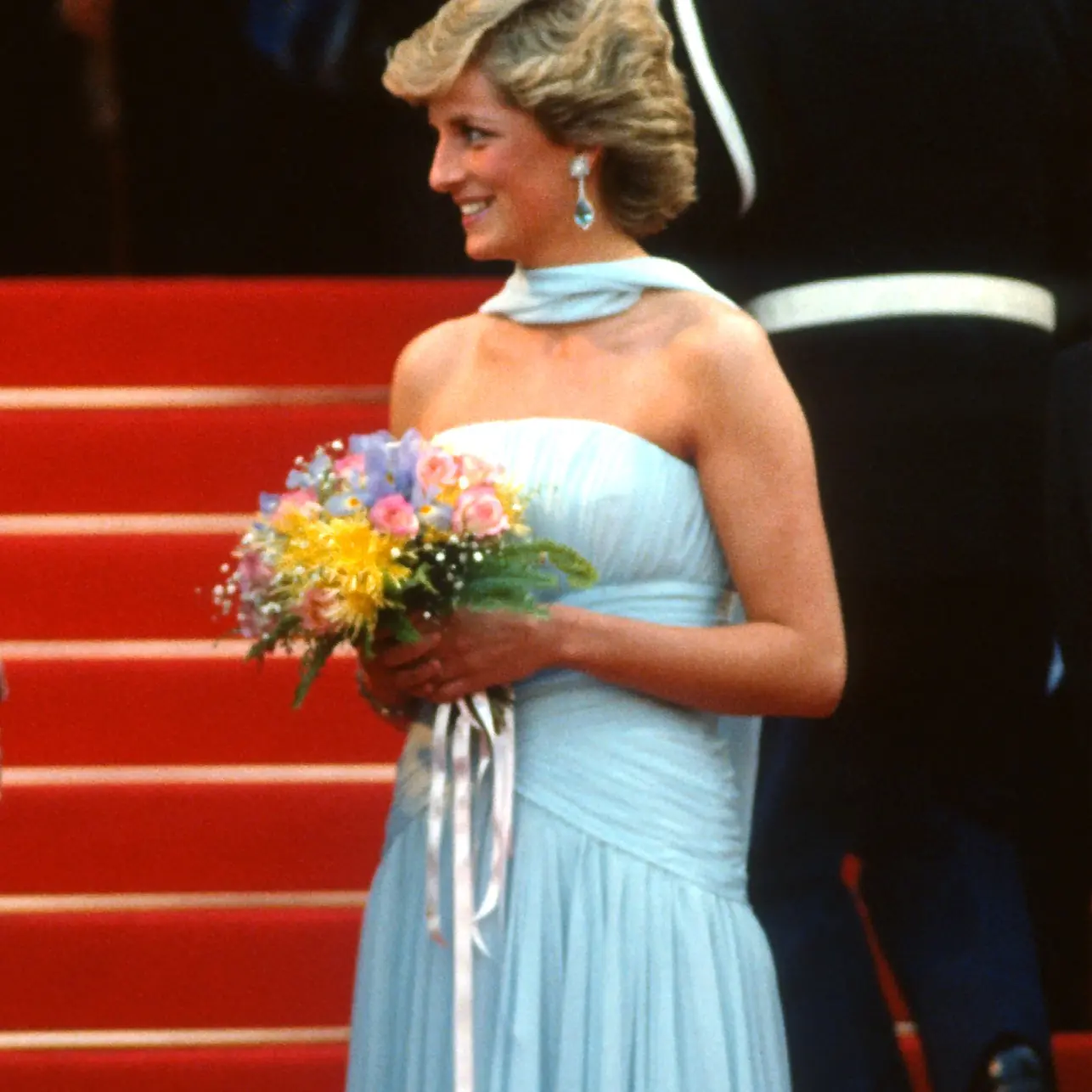
The Importance of Looking at the Original Photograph
Old photographs can be difficult to interpret when they are cropped, compressed, or circulated without their original captions.
The supplied image is a screenshot of a web article, not a complete archival photograph with all its original metadata.
Some areas have been cropped, and the picture is displayed at a small size. That makes it difficult to identify every person in the background or establish details that might be visible in a higher-resolution version.
The original photographs from the Cannes event are preserved in editorial archives, including collections associated with photographers such as Tim Graham, Anwar Hussein, and Steve Wood.
Their archival descriptions identify the date, location, occasion, and clothing.
Those records provide important context.
They establish that Diana wore a pale-blue silk chiffon strapless gown designed by Catherine Walker at a gala event in Cannes on May 15, 1987, honoring Alec Guinness.
They also help distinguish between different photographs from the same visit.
Diana attended several events during the Cannes trip, and not every photograph from that period shows the same outfit. Some images show her in a striped dress with a white jacket, while others capture the pale-blue evening gown.
This matters because online articles sometimes combine photographs from different moments and present them as one continuous scene.
A careful historical account should identify which image is being discussed and avoid attributing details from one photograph to another.
The best way to understand the Cannes gown is to consider the original event, the designer's inspiration, and the documented history of the garment.
That approach reveals a much more interesting story than simply searching for a mysterious figure in the background.
A Final Look at the Woman Behind the Photograph
There is something particularly moving about seeing Diana in the pale-blue gown today.
The photograph captures her at 26, during a period when she was still navigating the responsibilities of royal life and developing her own public identity. She appears elegant and composed, surrounded by people who are watching her every movement.
But the dress tells another story.
It recalls Grace Kelly, a woman who had experienced the transition from international film star to princess and who had once met Diana in person.
It also recalls the French Riviera, Hitchcock's cinema, and a period when Hollywood glamour and European royalty seemed closely connected.
The later deaths of both women inevitably influence how people interpret the image. Their shared association with car accidents gives the photograph a melancholy dimension that was not part of the original occasion.
Yet the most important thing to remember is that Diana's gown was an act of admiration, not a documented farewell.
The photographers captured a beautiful royal appearance. History later gave that photograph a deeper emotional meaning.
Perhaps that is why it continues to fascinate people decades after the event.
It is not simply a picture of a princess wearing a beautiful dress. It is a visual connection between two women, two generations, and two lives that became part of the public imagination.
And the detail that makes the photograph so remarkable is not a mysterious object hidden in the background.
It is the story woven into the dress itself.