Several factors can influence how the eyes appear, including:
-
The amount and distribution of melanin
-
The structure of the iris
-
Lighting conditions
-
Surrounding colors
-
Clothing and makeup
-
Pupil size
This is why someone might look as though their eye color has changed depending on whether they are outdoors in bright daylight or indoors under artificial lighting.
Usually, the underlying pigmentation has not dramatically changed.
The appearance of the color has changed because the light reaching and leaving the eye has changed.
Blue Eyes and Human Evolution
The history of blue eyes is also a fascinating example of how human genetic diversity develops.
Humans originally evolved in environments where darker pigmentation was generally common. As populations migrated into different regions, genetic variation in pigmentation accumulated and became more common in certain populations.
Scientists continue to investigate why particular pigmentation variants became widespread.
One explanation sometimes discussed is sexual selection, meaning that unusual physical characteristics could influence mate preferences.
Other research considers environmental factors, population structure, genetic drift, and historical migration.
Importantly, there is no single universally accepted explanation for why blue eyes became common in particular populations.
Human evolution is usually the result of multiple interacting forces rather than one simple cause.
Are Blue-Eyed People More Closely Related Than They Think?
In a very broad genetic sense, many blue-eyed individuals may share an ancient ancestral connection associated with the genetic variants that contribute to blue eye color.
But that does not mean blue-eyed people are close relatives.
Consider how many generations separate people living today from humans who lived thousands of years ago.
Even if two individuals share a very distant ancestor, their family trees can contain millions of other ancestors and countless genetic branches.
The connection is therefore best understood as a shared piece of ancient genetic history.
It is similar to finding that millions of people carry an ancient genetic variant. The shared variant tells us something about human population history, but it doesn't establish a meaningful modern family relationship.
Blue Eyes Are Only One Part of a Much Bigger Genetic Story
The science of eye color demonstrates just how complicated human genetics can be.
A feature that looks simple on the surface—such as whether someone's eyes are blue or brown—can involve multiple genes, regulatory regions, pigmentation pathways, and interactions between genetic variants.
And eye color isn't fixed entirely by one simple genetic switch.
Researchers have identified numerous genes involved in pigmentation, and their effects can overlap.
This is why modern genetic research has moved beyond the traditional idea that one characteristic is always controlled by one gene.
The human body is much more complicated than that.
Does Having Blue Eyes Affect Your Health?
Eye color itself is not a disease or a sign of poor health.
However, because blue eyes contain less melanin, people with lighter-colored eyes may have somewhat greater sensitivity to bright light.
They may find intense sunlight uncomfortable and may benefit from wearing sunglasses that provide appropriate UV protection.
Some studies have also investigated relationships between lighter eye pigmentation and certain eye conditions, but these associations should not be interpreted as predictions about an individual person's health.
Having blue eyes does not mean someone will develop an eye disease.
Regular eye examinations, UV protection, and attention to changes in vision are much more useful than trying to predict health based on eye color alone.
The Real Surprise Is How Ancient the Connection May Be
Perhaps the most remarkable part of the story isn't simply that blue-eyed people share a genetic variation.
It's the realization that a small genetic change can survive through countless generations.
A genetic variant that appeared in an ancient population could be passed from parent to child, carried across migrations, survive wars and environmental changes, and eventually appear in people living on completely different continents.
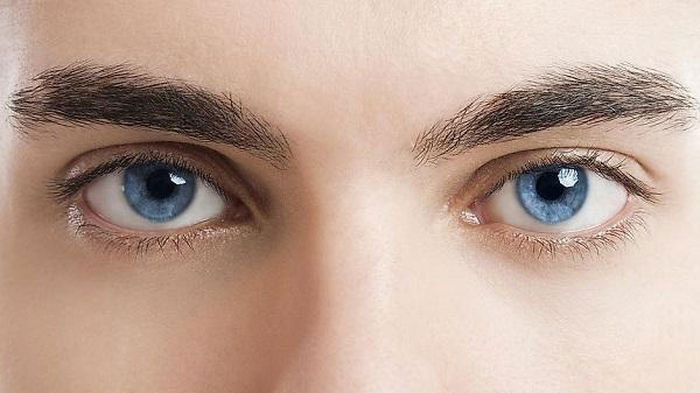
Every pair of blue eyes therefore represents more than a visible physical trait.
It can also be viewed as a tiny window into human population history.
Of course, an individual's complete ancestry is vastly more complicated than their eye color. Blue eyes cannot tell you exactly where someone came from, and they cannot reveal a person's entire genetic background.
But they can provide scientists with clues about how genetic variation moved through human populations over time.
What Scientists Know—and What They Don't
The strongest evidence supports the idea that genetic variation involving HERC2 and OCA2 plays a major role in blue eye color and that many blue-eyed individuals share ancient genetic ancestry related to these variants.
But scientists are still studying the full story.
Eye color is influenced by multiple genes, and human pigmentation is biologically complex.
Researchers also continue to investigate how genetic drift, migration, population mixing, environmental factors, and selection shaped the distribution of eye colors around the world.
So the popular statement that “all blue-eyed people came from one person” should be treated as a simplified version of a much more complicated scientific story.
The real discovery is arguably more interesting.
A small genetic change in our distant past became part of the biological history of millions of people living today.
A Reminder of How Connected Human History Really Is
The next time you notice someone's blue eyes, there may be more behind that color than you realize.
Those shades of blue are produced by a complex interaction between genetics, pigmentation, and light. And behind the genetics lies a history stretching back thousands of years.
People with blue eyes aren't members of one modern family.
They don't necessarily share a recent ancestor.
But many carry genetic clues pointing toward an ancient shared history.
One small variation in human DNA can travel through generations for thousands of years—and eventually become one of the most recognizable features of a person.
That is what makes the science of blue eyes so fascinating.
What appears to be a simple difference in appearance can actually tell us something profound about human genetics, migration, evolution, and the extraordinary journey of DNA through time.