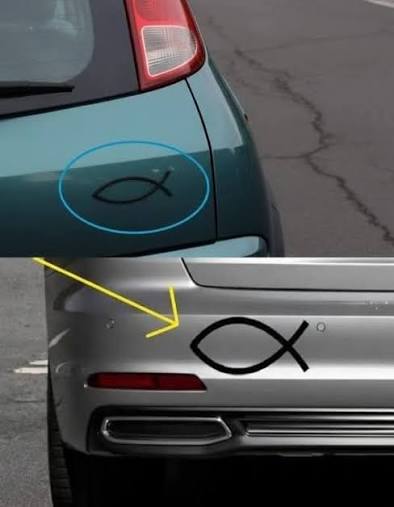
Have you ever been driving down the road and noticed a small fish-shaped symbol attached to the back of another car?
At first glance, it might look like nothing more than a simple decoration. Maybe a random sticker. Maybe a symbol chosen because the driver likes fishing.
But in many cases, that little fish has a meaning that goes far beyond decoration.
The symbol is commonly known as the Ichthys, or Christian fish symbol. It has been used by Christians for centuries and became especially recognizable in modern times as a simple way of expressing Christian faith.
But there is more to the symbol than most people realize.
Where did it come from? Why is it shaped like a fish? Why do people put it on cars? And does every fish-shaped symbol mean the same thing?
Let's take a closer look.
The Little Fish Is Often Called the Ichthys
The traditional Christian fish symbol is known as the Ichthys, sometimes spelled Ichthus.
It looks very simple: two curved lines meet to create the shape of a fish.
Unlike many religious symbols, it doesn't contain a complicated image or detailed artwork.
Its simplicity is part of its appeal.
The Greek word ichthys means “fish.” Early Christians also connected the word with a Greek acronym formed from the initial letters of a confession of faith referring to Jesus Christ as the Son of God and Savior.
Because of this connection, the fish became an important Christian symbol.
Today, you may see it on:
-
Cars
-
Bumper stickers
-
Jewelry
-
Clothing
-
Church signs
-
Business logos
-
Home decorations
-
Keychains
-
Social media profiles
So when you see one on the back of a car, it often means the driver wants to express some connection with Christianity.
Why a Fish?
This is where the story becomes particularly interesting.
Fish appear several times in the New Testament, and the imagery became meaningful within Christianity.
Jesus' disciples included fishermen.
Several of the best-known disciples, including Peter, Andrew, James, and John, were associated with fishing before becoming followers of Jesus.
There are also biblical stories involving fish, including the feeding of large crowds with bread and fish.
Jesus also used fishing as a metaphor when speaking to his followers.
In one well-known passage, his disciples are described as being called to become “fishers of men”—a metaphor for bringing people into the faith.
So the fish wasn't an arbitrary choice.
It already had strong associations with the teachings and stories surrounding Jesus.
Was the Fish Used by Secret Christians?
You may have heard a popular story claiming that early Christians used the fish as a secret code to identify themselves while hiding from persecution.
The story is often told like this:
One Christian would draw part of a fish.
If the other person completed the symbol, both people would know that they shared the same faith.
It's a fascinating story.
But there's an important distinction between tradition and historical evidence.
There is evidence that the fish was an early Christian symbol, and archaeological examples of fish imagery have been found in early Christian contexts.
However, the idea that Christians routinely used the fish as a secret underground password is difficult to establish as a universal historical practice.
Early Christians certainly faced periods of persecution in the Roman Empire, but the fish symbol was not necessarily used as a formal secret identification system in the dramatic way popular stories sometimes suggest.
The reality is probably more complicated—and arguably more interesting.
The Fish Became a Recognizable Christian Symbol
Over time, Christian communities used fish imagery in a variety of artistic and religious contexts.
The symbol appeared in early Christian art, inscriptions, objects, and other forms of religious expression.
Its meaning could be connected to Christ, baptism, Christian identity, and biblical stories involving fish.
As Christianity developed and spread, other symbols became prominent as well.
The cross eventually became the most widely recognized symbol of Christianity.
But the fish never disappeared.
Instead, it remained a simple and recognizable representation of Christian identity.
Why Put It on a Car?
So why do people place the symbol on their vehicles?
For many drivers, the answer is straightforward:
It's a way to publicly express their faith.
A car is a highly visible personal possession.
A small symbol on the trunk, rear window, bumper, or side of a vehicle can communicate something about the owner's beliefs without requiring words.
The driver may be saying:
“I am a Christian.”
Or:
“My faith is important to me.”
Or simply:
“This symbol represents something meaningful in my life.”
It can function in much the same way as someone wearing a religious necklace or displaying a religious symbol at home.
Not Every Fish Symbol Means Exactly the Same Thing
This is an important point.
If you see a fish-shaped symbol on a car, you shouldn't automatically assume you know exactly what the driver believes.
The traditional plain Ichthys is generally associated with Christianity.
But there are many variations.
Some fish symbols include a cross.
Some contain the name of Jesus.
Some include Greek lettering.
Others have additional text.
There are also humorous or modified versions that may deliberately change the traditional design.
For example, you may occasionally see a fish symbol with legs or other additions intended as a joke or commentary.
These variations can have very different meanings.
So the basic fish shape provides a clue, but the surrounding design matters.
What About the Fish With “Jesus” Inside It?
Some Christian fish symbols include text inside the body of the fish.
You might see words such as:
JESUS
or a Greek inscription.
These versions make the religious meaning much more explicit.
The traditional Greek acronym associated with the Ichthys is particularly significant because the individual Greek words form a Christian confession of faith.
The symbol therefore operates on two levels.
To someone unfamiliar with the history, it simply looks like a fish.
To someone familiar with Christian symbolism, it can communicate a specific religious message.
Why Is It So Popular on Cars?
There are several reasons the symbol works particularly well as a vehicle emblem.
First, it's recognizable.
Second, it's small.
Third, it doesn't require a long explanation.
And fourth, it can be displayed without dominating the appearance of the vehicle.
A driver might not want a large religious message covering the entire back window.
A small fish provides a much more subtle option.
It's essentially a visual shorthand.
One tiny shape can communicate an idea that would otherwise require several words.
The Symbol Also Has a Personal Meaning for Some Drivers
For some people, the fish isn't merely a label identifying them as Christian.
It may represent something deeply personal.
It can remind them of their faith during everyday life.
It may represent gratitude.
Hope.
Forgiveness.
Spiritual identity.
Or a connection to their church community.
For someone who has gone through a difficult period, displaying the symbol may also serve as a personal reminder of beliefs that help them through challenges.
Of course, everyone who uses the symbol may interpret it somewhat differently.
A symbol can have a shared historical meaning while still carrying an individual emotional meaning.
The Biblical Connection Goes Even Deeper
The connection between Christianity and fish isn't limited to one story.
Fish appear repeatedly in the New Testament.
There are stories of miraculous catches of fish.
There is the feeding of crowds with bread and fish.
There is the account of Jesus appearing to disciples after his resurrection in a scene involving fish.
And, as mentioned earlier, several of Jesus' disciples were fishermen.
This repeated imagery helped make the fish a natural symbol within early Christianity.
It's difficult to separate the development of the symbol from the larger role that fishing and fish played in biblical storytelling.
Does the Symbol Mean the Driver Is Religious?
Usually, the symbol is intended to communicate a religious association.
But it's important not to assume too much about a stranger based on a bumper sticker.
Someone may display a symbol because of their family background, personal beliefs, cultural connection, or simply because they appreciate its meaning.
And symbols can be used humorously or commercially as well.
A fish-shaped emblem isn't a complete biography of the person behind the steering wheel.
It's simply a visual message.
What If the Fish Is Turned Into Something Funny?
You've probably seen variations of the traditional fish symbol that look unusual.
Some have feet.
Some have text.
Some contain humorous phrases.
Some appear to be parodying the traditional Christian design.
These versions can represent everything from humor to religious criticism to personal expression.
That's why it's worth looking carefully at the details.
The basic fish shape may look familiar, but a modification can completely change the intended message.
The Fish Symbol Is Much Older Than Modern Bumper Stickers
One of the most fascinating things about seeing this symbol on a modern car is realizing that its history goes back far beyond the automobile.
The people who first used Christian fish imagery lived nearly two thousand years ago.
They didn't have cars.
They didn't have bumper stickers.
They didn't have modern logos.
Yet a simple fish-shaped design eventually survived across centuries and found a place on everything from ancient religious artwork to modern vehicles.
That's a remarkable example of how symbols can travel through history.
A design that began in an ancient religious context can still be instantly recognizable on a highway today.
Why Simple Symbols Can Be So Powerful
The fish symbol also demonstrates something important about communication.
Humans have always used symbols to express complicated ideas quickly.
A heart can represent love.
A peace symbol can represent peace.
A national flag can represent an entire country.
And the Christian fish can represent a particular religious tradition and identity.
The power of a symbol is that it doesn't require a paragraph of explanation.
One image can trigger an entire collection of ideas.
That's why people continue to use symbols even in an age dominated by text and digital communication.
What Should You Think When You See One?
The next time you're sitting in traffic and notice a little fish on the back of a car, you'll probably recognize it differently.
Instead of thinking:
“Someone put a fish sticker on their car.”
You may realize:
“That could be an Ichthys, a traditional Christian symbol.”
It may be a quiet expression of faith.
It may represent a personal belief.
It may be a connection to Christianity or a church community.
Or, if the design has been modified, it may carry an entirely different message.
The important thing is not to assume too much beyond the symbol itself.
The Fascinating Story Behind a Tiny Symbol
The little fish on the back of a car may look insignificant.
But behind those two curved lines is a history stretching back nearly two thousand years.
The Ichthys became associated with Christianity through the Greek word for fish, biblical references to fish, and its connection to an early Christian confession of faith.
Today, people continue to use the symbol as a simple way to express their Christian identity.
So the next time you see one while driving, take a second look.
That tiny fish isn't necessarily about fishing.
It may be carrying a message about faith, identity, history, and belief—all in a symbol small enough to fit on the back of a car.
And perhaps that's what makes it so fascinating.
Sometimes, the smallest symbols can carry the biggest stories.