At first, you might assume that the discoloration is caused by sweat, friction, poor hygiene, or a buildup of dead skin cells. You may even try stronger soaps, exfoliating products, or home remedies in the hope that the original skin tone will return.
But what if the dark patches are not simply a cosmetic concern?
In some cases, these changes may be associated with a skin condition known as acanthosis nigricans. Although the condition itself is not usually dangerous, it can sometimes be a visible clue that something else is happening inside the body, particularly when insulin resistance or certain metabolic conditions are involved.
The important thing to understand is that not every dark patch indicates a medical problem, and not everyone with acanthosis nigricans has diabetes. Skin discoloration can have many different causes, ranging from irritation and hormonal changes to inherited characteristics and other dermatological conditions.
However, recognizing the pattern, understanding the possible explanations, and knowing when to seek medical advice can help you make better decisions about your health.
So, what exactly is acanthosis nigricans? Why does it appear in certain areas of the body? And when should darkened skin prompt a visit to a healthcare professional?
The answers may help you look at these seemingly minor skin changes in a completely different way.
1. What Is Acanthosis Nigricans?
Acanthosis nigricans is a skin condition characterized by areas of darker, thicker, often velvety skin. It most commonly appears in body folds and creases, where skin touches skin or where moisture and friction are more likely to occur.
The name may sound unfamiliar, but the appearance is recognizable once you know what to look for.
The affected areas may develop a brown, gray-brown, or nearly black appearance, depending on the person's natural skin tone and the severity of the condition. The skin may also feel rougher or thicker than the surrounding skin.
Common locations include:
-
The back and sides of the neck.
-
The armpits.
-
The groin and inner thighs.
-
The skin beneath the breasts.
-
The knuckles, elbows, or knees in some individuals.
-
Other skin folds, depending on the person.
The discoloration often develops gradually. At first, a person may notice a slightly darker area in a crease. Over time, the patch may become more noticeable, with a thicker texture and more pronounced skin markings.
In some cases, small skin growths known as skin tags may also be present, particularly around the neck or armpits.
Acanthosis nigricans is not contagious. You cannot catch it by touching someone who has it, sharing clothing, or using the same household facilities.
It is also not necessarily a sign that someone is failing to maintain proper hygiene.
This distinction is important because people with visible skin discoloration sometimes experience embarrassment or assume they have done something wrong. In reality, acanthosis nigricans may be associated with biological processes that cannot be corrected simply by washing more frequently.
Although its appearance can be concerning, the condition is often manageable once the underlying cause has been identified.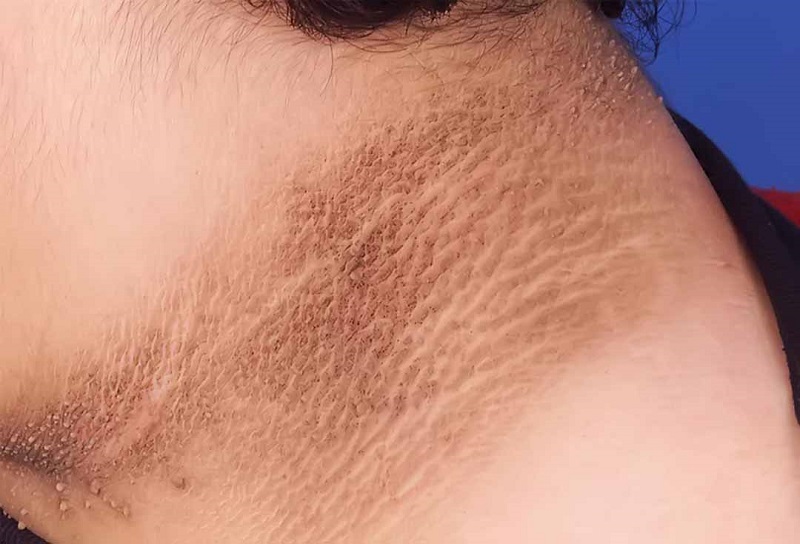
2. What Does Acanthosis Nigricans Look Like?
One of the most recognizable features of acanthosis nigricans is the combination of darker pigmentation and a thicker, velvety texture.
Unlike a simple stain on the skin, the affected area may feel different when touched. Its surface can appear slightly raised or leathery, and the natural lines of the skin may become more prominent.
The color varies. On lighter skin, the patches may appear tan or brown. On darker skin, they may look deep brown, grayish, or almost black.
The condition is often symmetrical, meaning that similar areas on both sides of the body may be affected. For example, someone might notice darkening in both armpits or along both sides of the neck.
However, appearances vary, and symmetry alone cannot establish a diagnosis.
Acanthosis nigricans generally does not cause significant pain. Some people experience mild itching or irritation, while others notice no discomfort at all.
This can make the condition easy to overlook, especially when the patches develop slowly.
It is also important to recognize what acanthosis nigricans is not. Dark skin around the neck or armpits can result from friction, eczema, contact dermatitis, previous inflammation, certain medications, and other conditions.
For example, post-inflammatory hyperpigmentation can leave darker marks after a rash, irritation, or injury has healed. A fungal or other skin infection may also produce discoloration, sometimes accompanied by scaling or itching.
Because these conditions can look similar, it is not possible to diagnose acanthosis nigricans reliably from skin color alone.
A healthcare professional can assess the texture, distribution, medical history, and other relevant findings to determine the most likely explanation.
3. Why Does the Skin Become Darker and Thicker?
To understand acanthosis nigricans, it helps to look beyond the visible surface of the skin.
The skin is an active organ. Its cells respond to hormones, inflammation, mechanical irritation, and signals from other parts of the body.
In acanthosis nigricans, changes in these signaling processes can encourage skin cells to grow and accumulate differently, producing the characteristic thickened appearance. Increased pigmentation may also contribute to the darker color.
The precise mechanism varies according to the underlying cause.
In many people, the condition is associated with insulin resistance. Insulin is a hormone that helps glucose move from the bloodstream into cells. When the body becomes less responsive to insulin, the pancreas may produce more insulin to compensate.
Elevated insulin levels may influence growth-related signaling pathways in the skin, contributing to the changes associated with acanthosis nigricans.
However, insulin resistance is not the only possible explanation.
The condition can also be associated with certain medications, hormonal disorders, inherited tendencies, and, much less commonly, particular internal cancers.
In some individuals, no obvious underlying disorder is identified.
The key point is that the skin changes are not simply a matter of pigment collecting on the surface. Scrubbing or bleaching the area may fail to address the biological process responsible for the thickening and discoloration.