Every once in a while, an unusual household trick suddenly starts appearing everywhere online.
One of the strangest is also one of the simplest: putting a roll of toilet paper inside the refrigerator.
At first, the idea sounds almost ridiculous.
Why would anyone place something that normally belongs in the bathroom next to milk, vegetables, leftovers, and other food?
Yet the trick has attracted attention because people claim the toilet paper can help deal with some of the most annoying refrigerator problems, particularly excess moisture, unpleasant odors, and dampness.
But does it actually work?
The answer is more nuanced than many viral posts suggest.
A roll of toilet paper is highly absorbent, so it can take in some moisture from its surrounding environment. That basic property helps explain why the hack exists. However, there is much less reason to believe that a single roll of toilet paper can dramatically improve a refrigerator, extend the life of food, or save thousands of dollars.
Still, understanding why people use the trick can teach you something useful about how humidity, condensation, odors, and food storage work inside your refrigerator.
So before you put a roll in your fridge, here is what you should know.
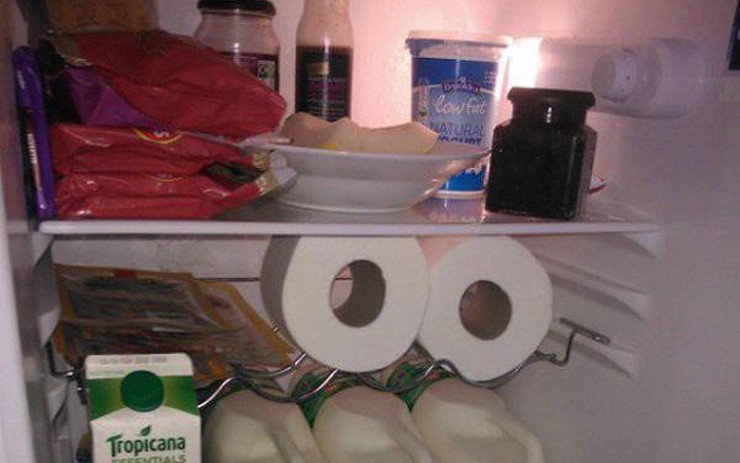
Why Would Anyone Put Toilet Paper in the Refrigerator?
The basic idea is simple.
Toilet paper absorbs moisture.
That is one of the reasons it is useful for its intended purpose. The fibers are designed to absorb liquid quickly, and the material has a porous structure that allows it to hold moisture.
A refrigerator also contains moisture.
Every time the refrigerator door opens, warmer air from the room enters.
That air can contain water vapor.
When the warm, moist air meets the colder surfaces inside the refrigerator, some of that moisture can condense.
Food itself also contributes moisture.
Fresh vegetables naturally contain water. Warm leftovers release moisture as they cool. Uncovered containers can allow water vapor to escape into the refrigerator.
Over time, moisture can contribute to a damp environment.
That is where the toilet paper hack supposedly comes in.
The idea is that the roll acts as a simple moisture absorber.
It may absorb a small amount of excess humidity around it, potentially helping certain areas feel less damp.
But there is an important limitation:
A toilet paper roll is not a specialized refrigerator dehumidifier.
Its moisture-absorbing ability is limited, especially in comparison with a properly functioning refrigerator's drainage and humidity-control systems.
Could Toilet Paper Help With Refrigerator Odors?
This is another reason the trick has become popular.
Refrigerators can develop unpleasant smells for many reasons.
Perhaps leftovers were stored too long.
Maybe an uncovered container leaked.
A vegetable drawer contains produce that has started to spoil.
Or a strong-smelling food—such as onions, garlic, certain cheeses, or seafood—has transferred its odor to the surrounding air.
People sometimes claim that toilet paper can help absorb those smells.
There is a little logic behind the idea, but it should not be overstated.
Toilet paper primarily functions as an absorbent material. It is not specifically designed to neutralize refrigerator odors.
Some odor molecules may become associated with moisture and surfaces, but a roll of toilet paper should not be considered a powerful odor-removal product.
If your refrigerator smells bad, the more important solution is identifying the source.
A clean refrigerator with properly stored food is far more effective than simply adding something inside and hoping the odor disappears.
The Real Problem May Be Excess Moisture
If your refrigerator seems unusually damp, there may be a bigger question to ask:
Why is there so much moisture in the first place?
A refrigerator should not normally contain large amounts of standing water or persistent condensation.
Small amounts of condensation can occur under normal conditions, particularly in certain areas of the refrigerator.
But excessive moisture can be related to several factors.
The Door Is Being Opened Frequently
Every time you open the refrigerator door, warm room air enters.
That warm air can increase humidity inside the compartment.
If the door is opened repeatedly throughout the day, the refrigerator has to work harder to restore its internal conditions.
Warm Food Is Being Stored Inside
Putting hot or very warm food directly into the refrigerator can increase the amount of heat and moisture inside.
Large amounts of steam may condense as the food cools.
Allowing food to cool appropriately before refrigeration—while still following safe food-handling practices—is generally more sensible than relying on absorbent materials to manage the resulting moisture.