People naturally love the idea that an everyday object sitting in their home can solve an expensive problem.
A roll of toilet paper costs very little.
The idea is easy to understand.
The result is visually interesting.
And the phrase “save thousands” makes the story much more compelling.
But inexpensive does not automatically mean effective.
The internet is full of household hacks that contain a grain of truth wrapped in a much larger claim.
The responsible approach is to separate those two things.
Yes, toilet paper absorbs moisture.
Yes, refrigerators contain moisture.
No, that does not automatically mean one causes the other to solve a major refrigerator problem.
Could It Help With Food Freshness?
Another popular claim surrounding the trick is that reducing refrigerator humidity will somehow keep food fresh for much longer.
This needs to be handled carefully.
Moisture does affect food quality.
However, different foods have different storage requirements.
Some produce can deteriorate faster in excessively dry conditions.
Other foods may benefit from lower moisture.
There is no single humidity level that is ideal for every item in your refrigerator.
This is precisely why produce drawers and storage recommendations differ.
Rather than trying to dry out the entire refrigerator, it is usually better to follow appropriate storage practices for the specific food.
That can help preserve quality without creating new problems.
The Most Important Question: Why Is Your Refrigerator Damp?
This may be the most useful question to take away from the entire hack.
If you feel the need to put something absorbent inside your refrigerator, ask why.
Is condensation appearing every day?
Are containers collecting excessive water?
Is the crisper drawer constantly wet?
Is the door seal damaged?
Is warm food being placed inside frequently?
Is there a drainage issue?
Is the appliance older and struggling to maintain temperature?
Once you identify the underlying reason, you have a much better chance of fixing the problem.
And that is true far beyond refrigerators.
A household hack may temporarily hide a symptom.
Finding the cause is what solves the problem.
So, Should You Put Toilet Paper in Your Fridge?
There is no compelling reason to treat this as an essential refrigerator practice.
Some people may find that a roll absorbs a little moisture.
It may also pick up some odor from the surrounding air.
But those effects are limited, and there is no strong basis for assuming that the trick will dramatically improve refrigerator performance or save thousands of dollars.
For curiosity, the experiment is inexpensive.
For serious refrigerator problems, however, it is not a substitute for maintenance, cleaning, proper food storage, or professional repair when necessary.
And whatever you do, keep the toilet paper away from direct contact with food.
The Bottom Line
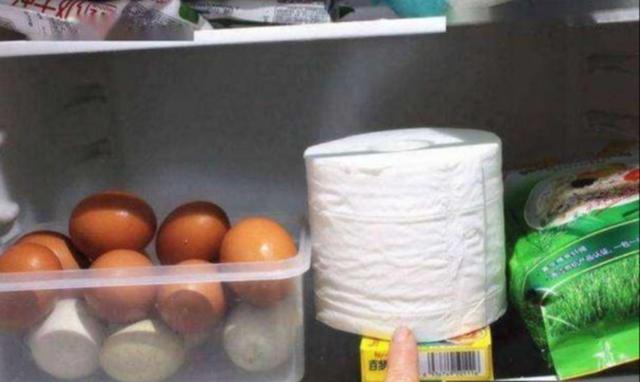
The bizarre idea of putting a roll of toilet paper in the refrigerator actually has a simple explanation: toilet paper is absorbent, and refrigerators contain moisture.
That may allow the roll to absorb a small amount of moisture from its immediate surroundings. Some people also believe it can help with unpleasant smells, although toilet paper is not specifically designed as an odor neutralizer.
What it cannot do is magically fix a refrigerator with a damaged door seal, blocked drainage, poor airflow, temperature problems, or a mechanical fault.
And despite dramatic viral claims, there is no good reason to believe that a roll of toilet paper in the fridge will literally save thousands of dollars.
The more effective approach is much less mysterious: keep the refrigerator at a safe temperature, store food properly, clean spills promptly, maintain the door seal, avoid blocking airflow, and investigate persistent moisture or odors.
So the next time you see a post telling you to put toilet paper in your refrigerator, remember the simplest explanation.
The roll may absorb some moisture - but the real solution is understanding why that moisture is there in the first place.
That is the part of the hack worth remembering.