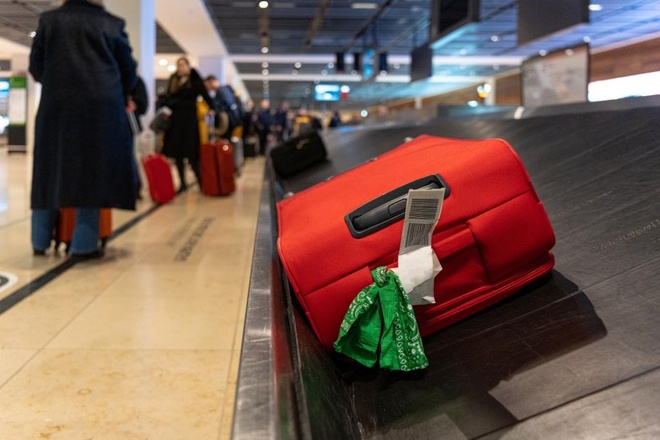
If you've ever stood at an airport baggage carousel watching identical black suitcases go around and around, you already know how difficult it can be to recognize your own luggage.
That's why travelers often add something distinctive to their bags.
A colorful ribbon tied around the handle seems like a simple solution. It makes the suitcase easier to spot, helps prevent confusion, and gives you a quick visual marker when hundreds of nearly identical bags appear on the carousel.
But there's a catch.
Some baggage-handling professionals advise travelers not to attach loose ribbons, straps, or other decorations to their luggage handles.
The reason isn't that a ribbon is inherently dangerous or that airport staff have a universal rule against them. Rather, loose accessories can sometimes interfere with automated baggage systems, become caught during handling, or make a suitcase more difficult to process.
So before you tie that favorite ribbon around your suitcase, here's what you should know.

Why Travelers Put Ribbons on Their Luggage
The idea is completely understandable.
Walk through an airport baggage claim and you'll quickly notice the problem: countless suitcases look almost exactly alike.
Black.
Navy.
Gray.
Hard-shell luggage in nearly identical shapes.
A small ribbon can make a bag instantly recognizable.
You may see a bright red ribbon on the handle and think:
"That's mine."
For travelers who frequently check luggage, this simple trick can reduce the chance of accidentally picking up someone else's suitcase.
It can also make baggage claim less stressful.
But while the ribbon may help you, it doesn't necessarily help the baggage-handling system.
Airports Don't Handle Every Bag by Hand
One of the most important things to understand is that checked luggage often travels through a complex network of conveyor belts, scanners, sorting machines, transfer points, and automated systems.
After you check your suitcase, it may travel through several stages before reaching the aircraft.
At different points, the bag may be:
-
Scanned
-
Weighed
-
Sorted
-
Routed toward a particular gate
-
Loaded onto a cart
-
Transferred between conveyors
-
Loaded onto an aircraft
-
Unloaded at the destination
Much of this process is highly automated.
That means luggage isn't simply carried gently from the check-in counter to the airplane.
It's moving through an industrial transportation system.
And anything attached to the exterior of the suitcase can potentially interact with that system.
Loose Ribbons Can Become a Handling Problem
A ribbon tied securely around a suitcase handle may seem harmless.
But if part of it is loose, long, or dangling, it can potentially catch on equipment or become separated.
Conveyor systems use moving belts, rollers, guides, and other components.
Airport baggage systems are designed to handle luggage efficiently, but loose objects can sometimes create problems.
This is why travelers are generally better off avoiding anything that hangs freely from their checked baggage.
The same principle applies to:
-
Long straps
-
Loose cords
-
Dangling tags
-
Decorative chains
-
Oversized accessories
The less loose material there is on the outside of your suitcase, the less likely it is to interfere with baggage handling.
The Bigger Issue May Be the Baggage Tag
There's another problem travelers sometimes overlook.
Your suitcase already has something extremely important attached to it:
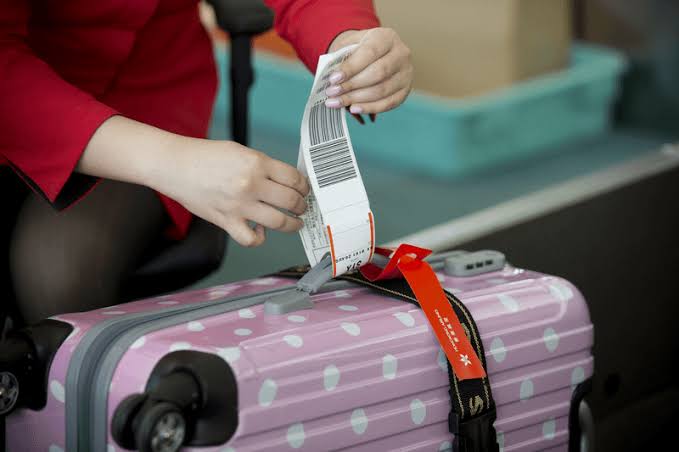
the official baggage tag.
That tag contains identifying information used to route your luggage to its destination.
Depending on the airport and airline system, baggage tags may contain barcodes or other machine-readable information.
If you attach a ribbon or accessory too close to the tag, it could potentially interfere with the tag being scanned or with the tag remaining securely attached.
This doesn't mean a small ribbon automatically causes a scanning failure.
It simply means that anything that obstructs the official baggage tag is unnecessary risk.
The baggage tag should always remain clearly visible and unobstructed.
Why Baggage Identification Is So Important
Modern airports process enormous volumes of luggage.
A suitcase may pass through several airports, especially if you're traveling with connections.
For example:
Home airport → Connecting airport → Final destination
At each stage, the baggage system needs to know where that bag belongs.
The airline's baggage tag is the primary identifier used for this process.
Your colorful ribbon is only a visual aid for you.
It doesn't tell the airport where your suitcase needs to go.
That's why the official baggage tag should always take priority over decorative markings.
A Ribbon Can Still Be Useful for Personal Identification
This doesn't mean you should never personalize your suitcase.
A distinctive marker can be extremely useful.
The key is choosing something that doesn't interfere with the bag's normal handling.
Instead of a long ribbon that hangs from the handle, consider:
-
A distinctive luggage tag
-
A small fixed marker
-
A unique suitcase color
-
A durable luggage strap
-
A recognizable sticker designed for luggage
The goal is simple:
Make the suitcase easy for you to identify without adding something that can easily snag or detach.
Why Luggage Straps Can Be Different
Some travelers use luggage straps instead of ribbons.
A properly fitted luggage strap can help keep a suitcase closed if the zipper fails and can make the bag easier to identify.
But even with straps, proper use matters.
A strap should be designed for luggage, fit securely around the suitcase, and not contain loose sections that can become caught.
If the airline or airport has specific requirements, those should take priority.
Don't Rely Only on an Exterior Decoration
Another important point is that luggage can sometimes be damaged during travel.
A ribbon can fall off.
A sticker can peel away.
A luggage tag can become damaged.
Your suitcase may also look different after passing through a busy baggage system.
That's why it's smart to have identifying information inside the suitcase as well.
Put your name and contact information inside the bag.
If the external baggage tag becomes detached, internal identification may help airline staff determine who owns the suitcase.
Take a Photo of Your Suitcase Before Checking It
Here's another simple habit that can be surprisingly useful.
Before handing over your checked bag, take a photograph of it.
Capture:
-
The entire suitcase
-
Any distinctive markings
-
The luggage tag
-
Its color and model
-
Any existing scratches or damage
If your suitcase is delayed or lost, having a recent photo can make it easier to describe the bag to airline staff.
It can also document the suitcase's condition before travel.
Remove Old Baggage Tags
If you've traveled before, your suitcase may still have old baggage stickers attached.
That's something worth cleaning up before your next flight.
Old tags and outdated barcodes can potentially create confusion during handling.
Before checking your bag:
Remove old airline baggage tags and destination stickers.
Keep only the current identification provided for the current journey.
Your suitcase doesn't need a collection of souvenirs from every airport you've ever visited.
Why Black Suitcases Are So Difficult to Identify
The popularity of black luggage creates another issue.
Black is practical.
It doesn't show dirt as easily.
It's easy to match with other travel accessories.
And manufacturers produce enormous numbers of black suitcases.
The downside?
Everyone else has one too.
That's why people use ribbons, bright tags, stickers, or other markers.
If you're buying new luggage, choosing a distinctive color or pattern can eliminate much of the problem from the beginning.
Your Ribbon Isn't What Determines Whether Your Bag Arrives
It's also important not to exaggerate the warning.
A ribbon on a suitcase does not automatically mean your luggage will be lost.
Millions of travelers use ribbons, tags, and other identifiers without experiencing any problems.
The concern is simply that loose accessories can create an unnecessary point of failure.
Baggage systems are complicated.
The fewer loose objects attached to a checked bag, the simpler it is for the bag to move through the system.
What Baggage Handlers Really Want Travelers to Understand
The main lesson isn't:
"Decorations are forbidden."
It's closer to:
"Make sure your suitcase is prepared for automated handling."
That means:
-
Secure all zippers
-
Remove loose straps
-
Avoid dangling accessories
-
Keep baggage tags visible
-
Remove old tags
-
Don't overpack
-
Make sure handles are properly stored when possible
-
Use durable identification
These small steps can make your luggage easier to process.
What Happens to a Suitcase After Check-In?
Once you hand over your checked luggage, it begins a journey that most passengers never see.
The suitcase may enter a conveyor system beneath or behind the terminal.
It can pass through security screening and automated sorting equipment.
From there, it may travel toward a specific loading area.
Eventually, baggage workers and equipment move it onto the aircraft.
After landing, the process happens in reverse.
The suitcase is unloaded, transported to the baggage system, sorted again, and eventually delivered to the carousel.
If you have a connecting flight, the bag may go through additional stages.
That's a lot of movement for one suitcase.
Why Loose Items Are More Vulnerable
Every transfer creates another opportunity for something attached to the suitcase to become loose.
A ribbon that looks perfectly secure at home may loosen during repeated movement.
A decorative item can be pulled.
A strap can become caught.
A tag can tear.
A small accessory can disappear without you noticing.
That's why professional travel advice often favors secure, integrated identification over loose decorations.
What About Ribbons on Carry-On Bags?
The situation is somewhat different with carry-on luggage.
If your bag remains with you throughout the journey, you're able to see and control how it's handled.
A small ribbon attached securely to a carry-on may not present the same issue as a loose accessory on checked luggage moving through automated baggage equipment.
Still, keeping accessories secure is a good general practice.
Better Ways to Make Your Suitcase Stand Out
If you love the idea of making your luggage easy to recognize, you don't have to give it up.
Consider these alternatives.
Choose a unique luggage color
Bright colors and unusual patterns are easy to identify.
Use a durable luggage tag
Choose one that is securely attached and doesn't hang excessively.
Add a small fixed marker
A distinctive but compact accessory can help you recognize your bag.
Use a luggage strap designed for travel
Make sure it fits tightly and doesn't have loose ends.
Add identifying information inside
This gives you a backup if external identification is lost.
Always Check the Baggage Tag Before Leaving the Carousel
Even if your suitcase has a bright ribbon, don't grab it automatically.
Before leaving baggage claim, compare the bag's:
-
Color
-
Size
-
Brand
-
Model
-
Luggage tag
-
Unique markings
with your own information.
Two suitcases can look nearly identical.
A visual marker helps, but the official baggage tag is what confirms that the bag belongs to you.
What If Your Bag Doesn't Arrive?
If your suitcase doesn't appear on the carousel, don't simply leave the airport.
Go to the airline's baggage service desk.
Provide the information from your baggage receipt or tag.
A photo of the suitcase can also be helpful.
Describe distinctive features such as:
"Black hard-shell suitcase with a silver logo and a blue luggage tag."
The more specific your description, the easier it may be for staff to identify the bag.
The Best Travel Habit Is Preparation
A smooth trip often depends on boring little details.
Checking your passport.
Confirming your flight.
Arriving on time.
Charging your phone.
Labeling your luggage.
Removing old baggage tags.
And making sure nothing is dangling from your suitcase.
None of these things is exciting.
But they can save you from a lot of unnecessary stress.
So, Should You Remove the Ribbon?
If you already use a ribbon on your suitcase and it is short, tightly secured, and positioned where it doesn't interfere with baggage tags or moving parts, it doesn't automatically mean you need to panic.
However, if the ribbon is long, loose, or hanging from the handle, removing it or replacing it with a more secure identification method is a sensible choice.
The goal isn't to make your suitcase invisible.
It's to make it distinctive without creating unnecessary handling issues.
Final Thoughts
A colorful ribbon tied around a suitcase may seem like one of the easiest travel hacks in existence.
And for passengers standing at a crowded baggage carousel, it can certainly make a bag easier to recognize.
But checked luggage travels through a sophisticated system of conveyors, scanners, sorting equipment, carts, and aircraft-loading processes.
That means loose accessories can sometimes become a liability.
A dangling ribbon may catch, loosen, fall off, or interfere with other parts of the baggage-handling process. It can also potentially get in the way if it's positioned around the official baggage tag.
The safest approach is not necessarily to avoid every luggage accessory, but to keep your bag secure, streamlined, and easy to identify.
Use a durable luggage tag.
Remove old baggage labels.
Keep your official baggage tag unobstructed.
Put identifying information inside your suitcase.
Take a photo before checking it.
And if you want a visual marker, choose something securely attached rather than a long ribbon that can flap or hang loose.
In the end, the best luggage accessory is one that helps you recognize your suitcase without making the baggage system work harder.
Because when your bag is traveling through an airport without you, simple and secure is usually better than flashy and loose.